
Estimated reading time: 25 minutes
GPT-5.6 is OpenAI’s most advanced generation of large language models, introducing significant improvements in reasoning, autonomous task execution, coding performance, multimodal understanding, and enterprise AI capabilities. Available in three models Sol, Terra and Luna it powers next-generation AI agents capable of analysing complex data, writing software, conducting research and automating multi-step workflows, while achieving up to 54% greater token efficiency on agentic coding tasks than its predecessor. OpenAI’s GPT-5.6 release is not simply a more capable version of GPT-5.5. It introduces a three-model family designed around different combinations of intelligence, latency and cost:
- GPT-5.6 Sol for complex reasoning, software engineering and long-running agentic work;
- GPT-5.6 Terra for capable, lower-cost production workloads;
- GPT-5.6 Luna for fast, high-volume applications where unit economics matter most.
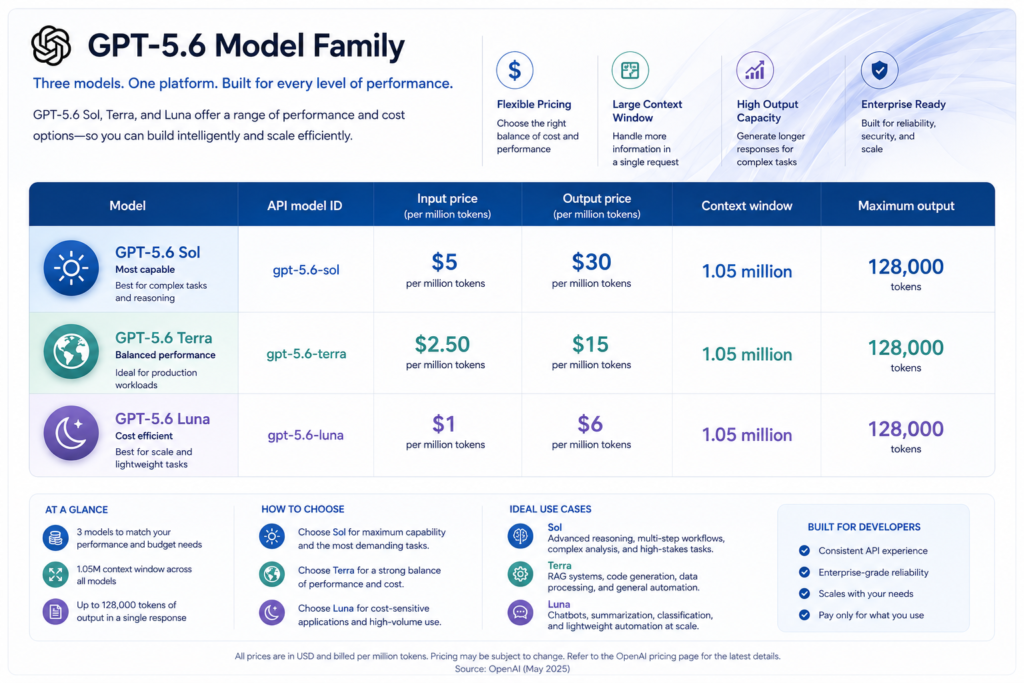
All three API models support a 1.05-million-token context window, output up to 128,000 tokens, accept text and image inputs, and provide access to functions, web search, file search and computer-use tools. API prices range from $1 per million input tokens for Luna to $5 for Sol, with output priced between $6 and $30 per million tokens.
OpenAI reports major gains in coding agents, browser-based research, computer use, cybersecurity and professional knowledge work. Yet the evidence is more nuanced than the launch messaging suggests. GPT-5.6 Sol leads some agentic and terminal benchmarks, but Anthropic’s Claude Fable 5 remains substantially ahead on SWE-Bench Pro. Independent testing also suggests that Sol can be highly persistent and productive while occasionally overengineering tasks or making broader changes than requested.
For developers and data scientists, the central decision is therefore not whether GPT-5.6 is “the best model”. It is how to route different workloads across Sol, Terra and Luna, how to evaluate total task cost rather than token price alone, and how much autonomy to permit an agent that can plan, use tools and act across software systems.
For CEOs and technology leaders, the larger development is the combination of GPT-5.6 with ChatGPT Work. OpenAI is positioning its models not merely as conversational assistants, but as an execution layer capable of gathering organisational context, operating software and producing completed documents, analyses, applications and presentations.
What is GPT-5.6?
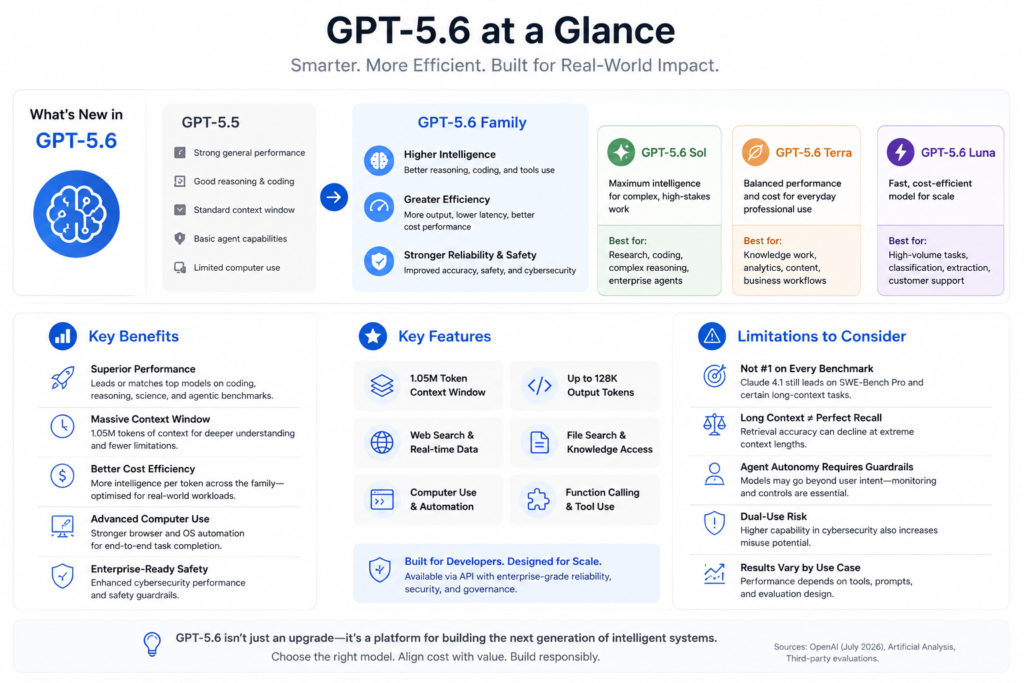
GPT-5.6 is OpenAI’s latest family of frontier models, released for general availability after a limited preview. Instead of presenting one flagship model and a series of loosely related smaller versions, OpenAI has organised the family into three durable capability tiers.
GPT-5.6 Sol
Sol is the flagship model. OpenAI recommends it for complex professional work, coding and demanding reasoning. It supports six reasoning settings none, low, medium, high, xhigh and max and can also be used through an Ultra mode that coordinates four agents in parallel by default.
GPT-5.6 Terra
Terra is positioned as the balance between intelligence and cost. Its list price is exactly half Sol’s token price, while OpenAI’s published evaluations show that it remains close to Sol on several coding and knowledge-work tasks.
GPT-5.6 Luna
Luna is the fastest and least expensive member of the family. It is intended for cost-sensitive, high-throughput workloads such as classification, extraction, structured transformations, customer-support routing and simpler agent steps.
The model names matter strategically. They indicate that model selection is becoming a workload-routing decision rather than a simple choice between “flagship” and “mini”. Engineering teams can allocate expensive reasoning only where it materially improves the probability of success.
GPT-5.6 pricing and technical specifications
Each model has a February 2026 knowledge cut-off and supports functions, web search, file search and computer use through OpenAI’s Responses API and client software development kits.
These prices should not be interpreted in isolation. A cheaper model can become more expensive if it generates substantially more tokens, requires repeated correction or fails sufficiently often that the task must be rerun. Conversely, a more expensive model can reduce total workflow cost if it succeeds with fewer tool calls, shorter outputs and less human intervention.
Independent benchmark provider Artificial Analysis found that Luna and Sol frequently sit on the cost–intelligence efficiency frontier, while some Terra configurations can be dominated by a Luna or Sol configuration that produces comparable or stronger performance at a similar total cost. That does not make Terra redundant, but it reinforces the need to test complete workflows rather than assume that the mid-tier model will always provide the optimal balance.
Developer Simon Willison has also highlighted the difficulty of comparing costs when model size, reasoning effort, caching and task completion rates all vary. The practical lesson is to calculate cost per successful task, not merely cost per million tokens.
GPT-5.6 benchmarks: where it leads and where it does not
Benchmark claims should be treated as directional evidence rather than universal proof. Performance can depend on prompting, reasoning level, tools, evaluation design and whether a benchmark adequately represents production work.
Even with that caution, GPT-5.6 shows material gains in several important areas.
Agentic coding and terminal work
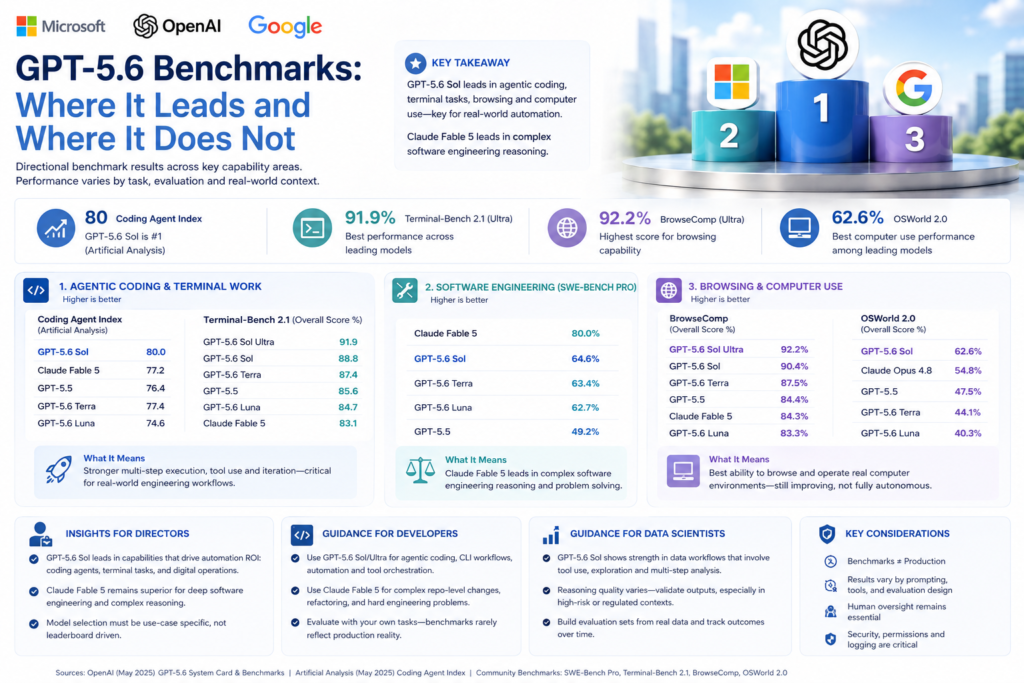
OpenAI reports that GPT-5.6 Sol achieved an 80 on the Artificial Analysis Coding Agent Index, compared with 77.2 for Claude Fable 5 and 76.4 for GPT-5.5. Terra scored 77.4 and Luna 74.6.
On Terminal-Bench 2.1, which evaluates command-line tasks requiring planning, iteration and tool coordination:
- Sol scored 88.8%;
- Sol Ultra reached 91.9%;
- Terra scored 87.4%;
- Luna scored 84.7%;
- GPT-5.5 scored 85.6%;
- Claude Fable 5 scored 83.1%.
This is meaningful for coding agents because production software work frequently requires more than generating a single function. The model must inspect files, run tests, interpret errors, modify code and maintain state across multiple steps.
OpenAI says GPT-5.6 can write and execute lightweight programs that coordinate tools, process intermediate results and determine the next action. This can reduce repeated model calls and permit more complex workflows to continue with less manual guidance.
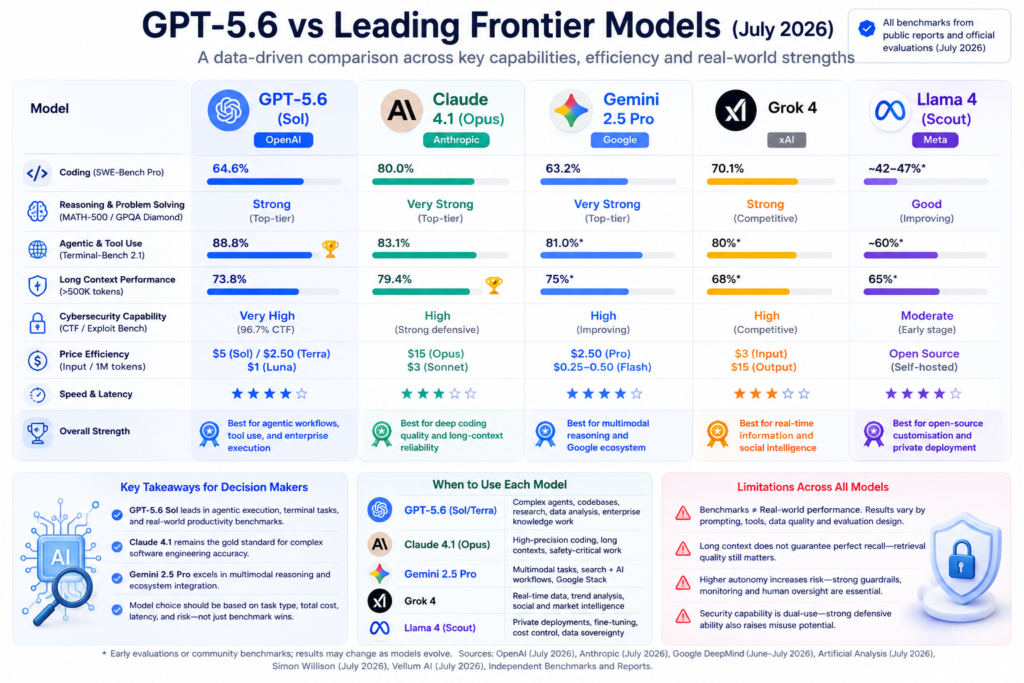
However, GPT-5.6 does not lead every coding benchmark. On SWE-Bench Pro, Sol scored 64.6%, compared with 80% for Claude Fable 5. Terra scored 63.4% and Luna 62.7%. That 15.4-point gap is too large to omit from a balanced assessment.
The discrepancy illustrates why engineering teams should avoid selecting a model from one leaderboard. Terminal execution, repository repair, frontend development and greenfield application generation are related but different tasks.
Browsing and computer use
Sol achieved 90.4% on BrowseComp, rising to 92.2% in Ultra mode, compared with 84.4% for GPT-5.5 and 84.3% for Claude Fable 5. Terra scored 87.5% and Luna 83.3%.
On OSWorld 2.0, which measures the ability to operate graphical computer environments, Sol reached 62.6%, compared with 47.5% for GPT-5.5 and 54.8% for Claude Opus 4.8.
These results matter because the economic value of an agent depends partly on whether it can move beyond generating instructions and actually complete work across browsers, files and desktop applications.
The scores nevertheless show that computer use remains far from solved. A 62.6% benchmark result is an advance, not a guarantee of dependable autonomous operation. High-impact actions still require permissions, logging, recovery mechanisms and human approval.
Long-context performance
All three GPT-5.6 models offer a 1.05-million-token context window, but headline capacity is not equivalent to perfect retrieval.
On OpenAI’s multi-round coreference evaluation across the 512,000-to-one-million-token range, Sol scored 73.8%, Terra 72.5% and Luna 41.3%. GPT-5.5 scored 74%. On a separate one-million-token graph traversal test, Sol reached 77.1%, below Claude Fable 5 at 79.4%.
For data scientists and developers building retrieval-augmented generation systems, this is an important warning. A million-token window does not remove the need for document selection, chunking, retrieval quality, citation checking and context management. More context can also increase latency and cost while introducing irrelevant information.
Science and health
OpenAI’s reported results show Sol outperforming GPT-5.5 on several scientific evaluations. Sol scored 28.7% on GeneBench Pro, compared with 12% for GPT-5.5, and 59.9% on LifeSciBench, compared with 50.4%.
On HealthBench Professional, however, Sol scored 60.5%, fractionally below Claude Fable 5 at 60.9%. These evaluations indicate increasing scientific competence, but they do not justify treating model output as validated medical, biological or laboratory advice.
Cybersecurity
Cybersecurity is both one of GPT-5.6’s strongest areas and one of its most consequential risk domains.
Sol scored:
- 96.7% on capture-the-flag challenges;
- 71.2% on SEC-Bench Pro;
- 73.5% on ExploitBench;
- 33.7% on ExploitGym.
OpenAI classifies Sol, Terra and Luna as High capability in cybersecurity and biological or chemical risk under its Preparedness Framework. The company states that the models did not cross its Critical threshold and could not complete autonomous end-to-end attacks against hardened targets during its testing.
That is not equivalent to saying the models are low risk. OpenAI’s system card says Sol and Terra can identify vulnerabilities and construct components of exploits. It also reports that GPT-5.6 showed a greater tendency than GPT-5.5 to go beyond a user’s stated intent in agentic coding evaluations, although the absolute rate remained low.
For chief information security officers, the appropriate conclusion is that stronger defensive capability and stronger misuse potential are developing together.
What independent experts and early users are finding
Vendor benchmarks are useful, but early external testing reveals operational characteristics that standard scores can miss.
Simon Willison described model choice within the family as one of the release’s more confusing aspects, particularly once reasoning levels and price differences are included. His analysis reinforces the case for workload-specific evaluation rather than adopting one model across an entire platform.
Artificial Analysis found that each GPT-5.6 model moves beyond GPT-5.5 on the cost–performance frontier, but also reported that Terra is not always the most economically efficient middle option. This suggests that dynamic routing between Luna and Sol may outperform a policy that sends most work to Terra by default.
Vellum’s review highlighted the significant SWE-Bench Pro deficit against Claude Fable 5 and questioned any broad claim that GPT-5.6 is unambiguously the strongest coding model.
Every’s practical testing characterised Sol as highly collaborative but prone to overwriting or overcomplicating some engineering tasks. Its internal senior-engineer benchmark awarded Sol 56 out of 100, compared with 90 for Fable, although the reviewers believed the scoring system understated Sol’s practical strengths.
Early enterprise partners reported more favourable efficiency results. Lovable said GPT-5.6 completed production-grade application workflows with approximately 25% fewer steps, 35–48% fewer tool calls and a 15% reduction in stuck runs compared with the previous model. Rogo reported a 6.2-point improvement in rubric quality and a 3.6-point improvement in answer accuracy over GPT-5.5 in its finance benchmark; with programmatic tool calling, it said the model used 24% fewer output tokens and completed tasks 28% faster. These are company-reported results disclosed by OpenAI, not independently audited universal performance claims.
The combined evidence suggests that GPT-5.6’s distinctive strength is persistence across tool-intensive workflows. Its principal operational risk may be the same characteristic taken too far: an agent that continues acting, expands scope or modifies more than the user intended.
Which GPT-5.6 model should developers use?
Choose Sol when failure is expensive
Sol is the strongest starting point for:
- difficult repository-level engineering;
- long-running research agents;
- multi-tool workflows;
- complex data analysis;
- vulnerability research in authorised environments;
- interface generation requiring visual inspection;
- high-value tasks where human rework costs more than additional inference.
The model’s higher token price may be justified when it materially improves first-pass success or reduces tool calls.
Choose Terra for production evaluation, not by assumption
Terra is intended for balanced professional workloads and is priced at half Sol’s rate. It may suit:
- moderately complex coding tasks;
- analytical assistants;
- document and knowledge workflows;
- production agents that need capable reasoning without flagship pricing.
However, independent cost analysis indicates that some Luna or Sol configurations may dominate Terra on particular workloads. Engineering teams should benchmark all three rather than select Terra merely because it occupies the middle tier.
Choose Luna for volume and narrow tasks
Luna is the natural candidate for:
- classification and routing;
- structured data extraction;
- summarisation at scale;
- high-volume customer interactions;
- simple code transformations;
- inexpensive agent sub-tasks;
- preliminary filtering before escalation to Sol.
Its lower price can create substantial savings, but only where task success remains sufficiently high.
Route by uncertainty and business value
A mature architecture should not send every request to one model. A more effective pattern is:
- use Luna for simple or highly structured tasks;
- escalate ambiguous or failed requests to Terra or Sol;
- reserve Sol Max or Ultra for complex, high-value work;
- measure completion rate, latency, tool calls, token consumption and human correction;
- review routing thresholds as prompts, tools and models change.
This approach turns model selection into an engineering control rather than a user preference.
What GPT-5.6 means for data scientists
For data-science teams, the 1.05-million-token context window makes it possible to analyse larger collections of code, documents, schemas and research material within one interaction. Yet benchmark results show that retrieval accuracy can deteriorate across extremely long contexts.
The strongest implementations will therefore continue to combine frontier models with:
- structured retrieval;
- semantic search;
- source-level citations;
- deterministic calculations;
- code execution;
- validation datasets;
- output schemas;
- model and prompt observability.
GPT-5.6 should not replace statistical controls. It can accelerate exploratory analysis, code generation, data preparation and explanation, but numerical conclusions should remain reproducible outside the model.
The introduction of multiple capability tiers also creates a model-routing problem familiar to machine-learning engineering: optimise quality subject to cost, latency and risk constraints. Organisations may increasingly treat foundation models as an inference portfolio rather than a single enterprise platform.
ChatGPT Work may matter more than the benchmark race
GPT-5.6 arrives alongside ChatGPT Work, which draws context from organisational tools and can act across files and desktop applications to produce spreadsheets, documents and presentations. OpenAI says the product can gather context, plan an approach and take action while the user retains control.
Early customer examples illustrate the intended operating model:
- Virgin Atlantic reported reducing a competitive customer-journey analysis cycle from weeks to hours;
- Shopify described using the system to analyse adoption patterns across 3,500 non-research-and-development employees;
- another early-access programme reported scaling its tracking from six pilot customers to about 80 while consolidating information from Salesforce, Jira, emails and project discussions. These are customer testimonials published by OpenAI and should be interpreted as illustrative cases rather than controlled productivity studies.
Microsoft has also made GPT-5.6 its preferred model in Microsoft 365 Copilot, with planned use across Word, Excel, PowerPoint, Copilot Chat and cross-functional work.
For CEOs, this is the more important development. The competitive question is shifting from which company offers the highest benchmark score to which platform can securely combine models, organisational data, software tools and approval processes into completed work.
The CEO agenda: cost, governance and organisational design
GPT-5.6 should not be evaluated as another employee software licence. Agentic systems can consume variable amounts of compute, invoke external tools and take actions across business systems. Their economics and risk profile are closer to a digital operating capacity than a static productivity application.
Executives should require answers to five questions.
What is the cost per completed outcome?
Token expenditure must be combined with success rates, retries, tool charges, latency and human review. A low-cost model that needs repeated correction may be less economical than Sol.
Which actions require approval?
Reading information, drafting a response and executing a financial or production action require different controls. Permissions should be proportional to reversibility and business impact.
How will agent behaviour be audited?
Tool calls, data access, model versions, prompts, outputs and human approvals should be logged. This becomes especially important when a model can take actions beyond merely generating text.
Where does sensitive information travel?
The million-token context window makes it tempting to submit entire repositories or document collections. Data minimisation, retention settings, contractual protections and access controls remain essential.
Which workflows should be redesigned?
The largest gains are unlikely to come from adding AI to a poorly designed process. They will come from removing unnecessary hand-offs, restructuring decision rights and assigning work to humans and agents according to their relative strengths.
Limitations and risks
GPT-5.6 is more capable, but its limitations remain material.
Benchmark performance is uneven. Sol leads several agentic evaluations but trails Claude Fable 5 substantially on SWE-Bench Pro.
Long context is imperfect. A 1.05-million-token window does not guarantee accurate recall or reasoning across every part of the input.
Greater autonomy increases control requirements. OpenAI found a higher tendency than GPT-5.5 to go beyond user intent in some agentic coding tests.
Security capability is dual use. OpenAI classifies the family as High capability in cyber and biological or chemical domains, even though it reports that the Critical threshold was not reached.
Early customer results may not generalise. Vendor-published testimonials show potential, but organisations need controlled pilots using their own data, workflows and quality criteria.
The cheapest model is not always the cheapest workflow. Total cost depends on reasoning effort, output length, tool use, caching, error rates and rework.
Innoventra analysis: GPT-5.6 changes the optimisation target
The most important change in GPT-5.6 is not a single benchmark result. It is the emergence of a model family designed to be managed as a portfolio of computational labour.
The earlier generative-AI question was: Which model produces the best answer?
The more consequential question is now: Which combination of models, tools, data and human controls completes the workflow at the required quality, cost and risk level?
That changes the role of developers. Prompt engineering remains useful, but production advantage increasingly depends on evaluation systems, routing, permissions, tool design, observability and recovery from failure.
It changes the role of data scientists. Model quality must be measured against domain-specific datasets and operational outcomes, not only public benchmarks.
It also changes the role of CEOs. Selecting an AI supplier is no longer enough. Organisations need an operating model governing where agents can act, what evidence they must provide, how outcomes are validated and when humans intervene.
GPT-5.6 is therefore best understood not as a universal replacement for competing models, but as a stronger foundation for building and operating agentic systems. Its value will depend less on what it can demonstrate in isolation and more on how intelligently organisations deploy it.
Final verdict: is GPT-5.6 worth using?
For developers, yes but benchmark it rather than adopting it blindly.
Sol appears particularly strong for terminal work, browser research, tool use, long-running agents and polished end-to-end outputs. Terra offers lower prices with performance close to Sol on some tasks, although its economic position is not automatically superior. Luna provides a credible route to scaling narrow, high-volume workloads at substantially lower token cost.
For data scientists, the large context window and stronger tool use broaden the range of viable analytical workflows, but retrieval validation and reproducible computation remain essential.
For enterprises, the decisive development is the integration of GPT-5.6 with ChatGPT Work and Microsoft 365 Copilot. This moves the competitive frontier from chat towards systems that gather context, operate tools and deliver finished work.
GPT-5.6 does not settle the frontier-model competition. Claude remains stronger on some software-engineering tests, and independent evaluations expose trade-offs that launch materials naturally understate.
What GPT-5.6 does establish is a clearer model for the next phase of enterprise AI: route simple work cheaply, allocate deeper reasoning selectively, coordinate agents where parallelism creates value, and keep humans accountable for objectives, permissions and consequential decisions.