
Cursor’s Success Is About More Than AI It Is a Blueprint for the Next Generation of Business
Estimated reading time: 8 minutes
Category: AI Strategy | Business Growth | Digital Transformation
By Innoventra Insights
Executive Summary
Over the past two years, Cursor has emerged as one of the most influential companies in artificial intelligence. While much of the attention has focused on its AI-powered coding capabilities and rapid commercial growth, the company’s broader significance has received far less attention.
Cursor is not simply demonstrating what artificial intelligence can do for software developers. It is demonstrating how AI is changing the economics of building and scaling a business.
For decades, organisations grew by hiring more people, adding management layers and investing heavily in operational infrastructure. Competitive advantage largely belonged to businesses with greater financial resources, larger workforces and established market positions.
Artificial intelligence is beginning to reshape those assumptions.
Cursor has shown that when intelligent systems are designed as the foundation of a business rather than an additional feature, relatively small teams can deliver levels of productivity and innovation that previously required much larger organisations.
This shift matters far beyond software development. Whether operating in manufacturing, financial services, healthcare, retail or professional services, business leaders are confronting the same strategic question:
How can artificial intelligence fundamentally redesign the way work is performed rather than simply making existing processes marginally faster?
Executive Insight
“Cursor’s greatest innovation is not AI-generated code. It is demonstrating that competitive advantage increasingly comes from redesigning work around intelligence rather than adding intelligence to existing work.”
Cursor Represents a New Economic Model
Every major technological shift produces organisations that redefine how industries operate.
Amazon transformed retail by reinventing distribution.
Netflix changed entertainment by eliminating physical delivery.
Stripe simplified digital commerce by removing complexity from online payments.
Cursor belongs in this category—not because it created the world’s first AI coding assistant, but because it approached artificial intelligence differently from many competitors.
While numerous technology companies treated AI as another feature to bolt onto existing products, Cursor redesigned the developer experience around AI from the outset.
That distinction appears subtle, yet it represents one of the most important strategic lessons emerging from the AI economy.
Historically, organisations increased output primarily by increasing resources. More employees generally meant greater expertise, higher production capacity and faster delivery.
AI is beginning to weaken this relationship.
Instead of measuring organisational capability by headcount alone, businesses are increasingly being measured by how effectively they combine human expertise with intelligent systems.
In other words, productivity per employee may become a far more important competitive metric than workforce size itself.
This has profound implications for small and medium-sized enterprises.
For decades, SMEs struggled to compete against larger organisations because they lacked comparable resources, specialist teams and capital. AI is beginning to reduce some of these structural disadvantages by enabling smaller organisations to automate routine work, accelerate decision-making and deliver sophisticated capabilities without proportionally increasing costs.
The result is not the replacement of people, but the amplification of their capabilities.
Leadership Perspective
“The organisations leading the AI era will not necessarily employ the most people. They will enable each employee to create significantly greater value.”
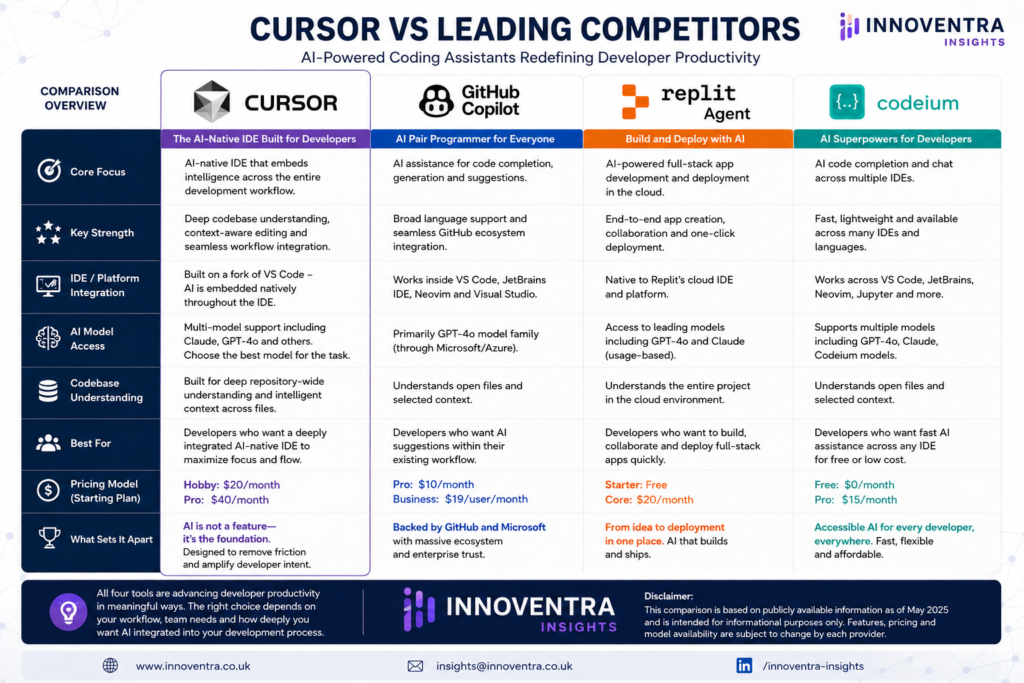
Cursor Solved the Right Problem
Many successful technology companies succeed because they identify a problem others underestimate.
Cursor recognised something that software engineers had quietly accepted for years.
Contrary to popular perception, developers spend only part of their working day writing new code. A significant proportion of their time is devoted to understanding unfamiliar codebases, debugging software, reviewing pull requests, navigating documentation and switching between multiple tools before meaningful development can even begin. Research across software engineering consistently shows that cognitive overhead and context switching are major constraints on developer productivity.
Rather than asking how AI could simply generate more code, Cursor focused on reducing these hidden sources of friction.
Instead of forcing developers to move continually between chatbots, documentation and development environments, AI became part of the workflow itself.
Natural-language editing, intelligent code understanding, repository-wide context and conversational problem-solving reduced interruptions that had long been accepted as unavoidable.
This distinction explains why Cursor attracted such strong developer enthusiasm.
Customers rarely purchase technology because it contains more features.
They invest because it removes effort, uncertainty and delay.
This principle extends far beyond software development.
Manufacturers seek to eliminate production bottlenecks.
Healthcare organisations aim to reduce administrative burden.
Professional service firms strive to minimise repetitive knowledge work.
Retailers compete by making purchasing faster and simpler.
In every industry, reducing friction often creates more customer value than adding complexity.
Executive Insight
“Every unnecessary click, search or context switch represents hidden economic cost. Cursor’s competitive advantage lies in eliminating thousands of these small inefficiencies rather than introducing flashy new features.”
Building on Trust Instead of Starting from Scratch
One of Cursor’s most strategically important decisions was deciding what not to build.
Many technology start-ups attempt to reinvent entire ecosystems.
Cursor chose a different path.
Rather than creating a completely new development environment, the company built upon Visual Studio Code—already one of the world’s most widely adopted developer platforms.
This decision significantly reduced adoption barriers.
Developers did not need months of retraining or entirely new workflows. They could continue working within a familiar environment while benefiting from AI capabilities that fundamentally improved productivity.
From a business perspective, this demonstrates an important strategic principle that extends well beyond software.
Competitive advantage does not always come from replacing established infrastructure.
Often, it comes from enhancing trusted ecosystems with intelligent capabilities.
Microsoft did not invent spreadsheets, yet Excel became dominant by continuously improving how people worked.
Shopify did not reinvent retail; it simplified online commerce for millions of merchants.
Likewise, Cursor recognised that developers were not looking for another code editor. They wanted a better way to develop software.
Director’s Takeaway
“Successful innovators do not always replace existing ecosystems. They create dramatically better experiences within ecosystems customers already trust.”
Why Product-Led Growth Became Cursor’s Competitive Advantage
Cursor’s technology explains why developers stayed. Its growth model explains why the company scaled so quickly.
Unlike many enterprise software companies that depend on large sales teams, lengthy procurement cycles and expensive marketing campaigns, Cursor expanded primarily through product-led growth. Developers adopted the platform because it solved an immediate problem, then introduced it to colleagues, engineering teams and, eventually, decision-makers.
This pattern reflects a broader change across enterprise software.
Increasingly, individual users—not procurement departments—are influencing technology adoption. When employees experience measurable productivity gains, organisational adoption often follows naturally.
The most effective products therefore become their own marketing engine.
This matters because customer advocacy is significantly harder for competitors to replicate than pricing or advertising. A recommendation from a trusted colleague often carries greater weight than even the most sophisticated marketing campaign.
For SMEs, the lesson is particularly relevant.
Businesses with limited marketing budgets can still compete successfully if their products create enough value for customers to recommend them voluntarily. Sustainable growth increasingly depends on delivering exceptional customer experiences rather than simply increasing advertising expenditure.
Executive Insight
“Marketing creates awareness. Outstanding products create advocates. Long-term growth depends far more on the latter.”
Cursor Is an AI-Native Company Not an AI-Enabled Company
Perhaps the most overlooked reason behind Cursor’s success is that it was designed as an AI-native business.
There is an important distinction.
Many organisations today are AI-enabled. They have added chatbots, assistants or generative AI features to products originally designed for a pre-AI world.
Cursor took the opposite approach.
Artificial intelligence was not an enhancement. It was the foundation around which the entire user experience was designed.
This distinction has significant strategic implications.
When AI is introduced as an afterthought, existing workflows, approval processes and legacy systems often remain unchanged. Productivity improvements therefore tend to be incremental.
AI-native organisations rethink the workflow itself. They ask a fundamentally different question:
If artificial intelligence existed from day one, how would we design this business differently?
That shift moves AI from being a productivity tool to becoming part of the organisation’s operating model.
It is a lesson many industries are only beginning to appreciate.
Banks should not simply ask how AI can accelerate existing approval processes. They should reconsider how lending decisions are designed.
Healthcare providers should not merely automate paperwork. They should redesign patient pathways to reduce unnecessary administrative work while preserving clinical judgement.
Manufacturers should not focus solely on predictive maintenance. They should rethink production planning using real-time intelligence.
The organisations achieving the greatest returns from AI are those redesigning work, not simply automating isolated tasks.
Leadership Perspective
“The competitive advantage of AI does not come from using the technology. It comes from redesigning how work flows through the organisation.”
Why Investors Are Looking Beyond Coding
Public discussion often focuses on Cursor’s coding capabilities.
Investors are analysing something far broader.
Software companies that become embedded in customers’ daily workflows create durable strategic advantages. Every interaction generates insight into how users work, which features they value and where further efficiencies can be created.
Combined with subscription-based revenue, this creates an attractive business model characterised by recurring income, strong customer retention and continuous product improvement driven by real-world usage.
Investors also recognise another important trend.
Artificial intelligence is increasingly becoming part of the infrastructure of knowledge work. Just as cloud computing became foundational for digital businesses over the past decade, AI assistants embedded within professional workflows may become standard across industries.
Companies that establish trusted positions early within these workflows are likely to benefit from strong customer loyalty and high switching costs. Once teams integrate an AI tool deeply into daily operations, replacing it becomes considerably more difficult than switching between conventional software applications.
This partly explains why investors continue to place significant value on AI-native businesses despite increasing competition.
They are investing not simply in today’s products, but in long-term workflow ownership.
Executive Insight
“Investors are not just backing AI models. They are backing companies that become indispensable to how knowledge work is performed.”
What Every Business Leader Can Learn from Cursor
Although Cursor operates in software development, its strategic lessons apply across almost every sector.
The first lesson is to solve friction before adding features. Customers consistently value simplicity, speed and reliability more than unnecessary complexity.
Second, build on trusted ecosystems wherever possible. Reinventing infrastructure consumes time and capital that could instead be invested in creating distinctive customer value.
Third, measure productivity by outcomes rather than activity. AI changes how work is completed, making traditional measures such as hours worked or team size less meaningful than the value created.
Fourth, design products and services around user behaviour. Cursor succeeded because it integrated naturally into existing workflows instead of forcing customers to learn entirely new ones.
Finally, treat AI as a strategic capability rather than a technology project. Organisations that limit AI to isolated pilots risk missing its broader transformational potential.
These principles apply whether the organisation employs twenty people or twenty thousand.
Key Takeaway
“The organisations creating lasting competitive advantage will not necessarily possess the most advanced AI. They will be the ones that integrate AI most effectively into everyday decision-making.”
Looking Ahead
Cursor’s story is still being written, and significant challenges remain. Competition from established technology companies, rapid advances in foundation models and rising customer expectations mean sustaining leadership will require continuous innovation.
Yet regardless of how the competitive landscape evolves, Cursor has already demonstrated something important.
Artificial intelligence is no longer simply changing how software is written. It is changing how organisations think about growth, productivity and competitive advantage.
For business leaders, the central lesson is clear. The future will not belong to organisations that merely adopt AI. It will belong to those that redesign their businesses around it.
As history has shown with Amazon, Netflix and Stripe, transformative companies rarely succeed because they introduce new technology alone. They succeed because they rethink how value is created.
Cursor’s greatest contribution may therefore be neither its code editor nor its AI capabilities. It is the blueprint it offers for the next generation of AI-native organisations where intelligent systems amplify human expertise, remove unnecessary friction and enable businesses of every size to achieve far more with the resources they already have.
Throughout history, organisations have competed through scale, capital and operational efficiency. Artificial intelligence is introducing a fourth source of competitive advantage: organisational intelligence.
Cursor’s success suggests that the next generation of market leaders may not simply be those with the largest workforces or the biggest technology budgets. They will be those capable of redesigning work more intelligently than their competitors.
In that sense, Cursor is not merely a successful AI company. It offers an early blueprint for how businesses of every size may compete during the next decade.