
Executive Summary
Artificial intelligence is entering a new phase. The conversation is no longer centred on whether large language models can generate text or write code. Instead, the focus has shifted towards how frontier AI is transforming productivity, scientific discovery and competitive advantage across entire industries. Every major model release now influences how organisations hire talent, invest capital and redesign knowledge work.
The scale of adoption illustrates why each new frontier model attracts global attention. Recent enterprise research shows that well over three-quarters of organisations are now using AI in at least one business function, while investment in generative AI continues to accelerate as businesses move beyond experimentation into enterprise deployment. At the same time, technology companies are investing tens of billions of dollars annually in AI infrastructure, reflecting expectations that foundation models will become as strategically important as cloud computing and mobile internet over the coming decade.
Yet model capability tells only part of the story. The next generation of frontier AI is not simply becoming more intelligent it is becoming increasingly capable of completing complex, multi-stage professional tasks. Modern AI systems can already analyse thousands of pages of technical documentation, generate production-quality software, interpret multimodal information, assist scientific research and automate sophisticated business workflows. This represents a transition from AI acting primarily as a conversational assistant towards functioning as a collaborative digital knowledge worker.
The implications differ significantly across professions.
For software engineers, frontier AI is increasingly automating repetitive coding, documentation, debugging and software testing. Industry studies suggest developers using advanced AI assistants can complete certain programming tasks 20–50% faster, allowing engineering teams to devote more effort to system architecture, security, performance optimisation and customer innovation rather than routine implementation.
For data scientists, the competitive advantage is shifting away from writing SQL queries or building standard machine learning pipelines. AI can increasingly automate data cleaning, exploratory analysis and feature engineering, placing greater value on professionals who understand causal reasoning, experimental design, statistical validation and translating analytical findings into strategic business decisions.
For cybersecurity teams, the stakes are rising even faster. AI is improving vulnerability detection, threat intelligence and incident response while simultaneously lowering the barrier for sophisticated phishing campaigns, malware development and automated reconnaissance. This dual-use nature of AI is rapidly moving cybersecurity from an operational concern to a board-level strategic risk requiring continuous investment in governance and resilience.
For consultants, accountants, lawyers and financial analysts, frontier AI is compressing hours of document review, market research and report preparation into minutes. Rather than replacing professional judgement, it is increasing the premium placed on critical thinking, domain expertise, regulatory understanding and the ability to validate AI-generated outputs. As routine cognitive work becomes increasingly automated, uniquely human capabilities become more economically valuable.
For executive leaders, the most important lesson is organisational rather than technical. Evidence from leading enterprise adoption studies consistently shows that organisations generating the greatest returns from AI are not necessarily those deploying the most advanced models. They are the organisations redesigning business processes, investing in workforce capability and embedding governance alongside technology deployment. In other words, competitive advantage is increasingly determined by how organisations transform work, not simply by which AI model they choose.
Executive Insight
Every frontier AI release increases model capability. The organisations that outperform, however, are rarely those with access to the newest technology first they are those that systematically redesign workflows, develop AI-literate workforces and build governance that allows innovation to scale safely.
This article examines what the latest frontier AI developments mean for software engineers, data scientists, cybersecurity professionals, business leaders and policymakers. More importantly, it explains why the future of AI will be shaped not only by faster models, but by the organisations and professionals capable of converting intelligence into measurable economic value.
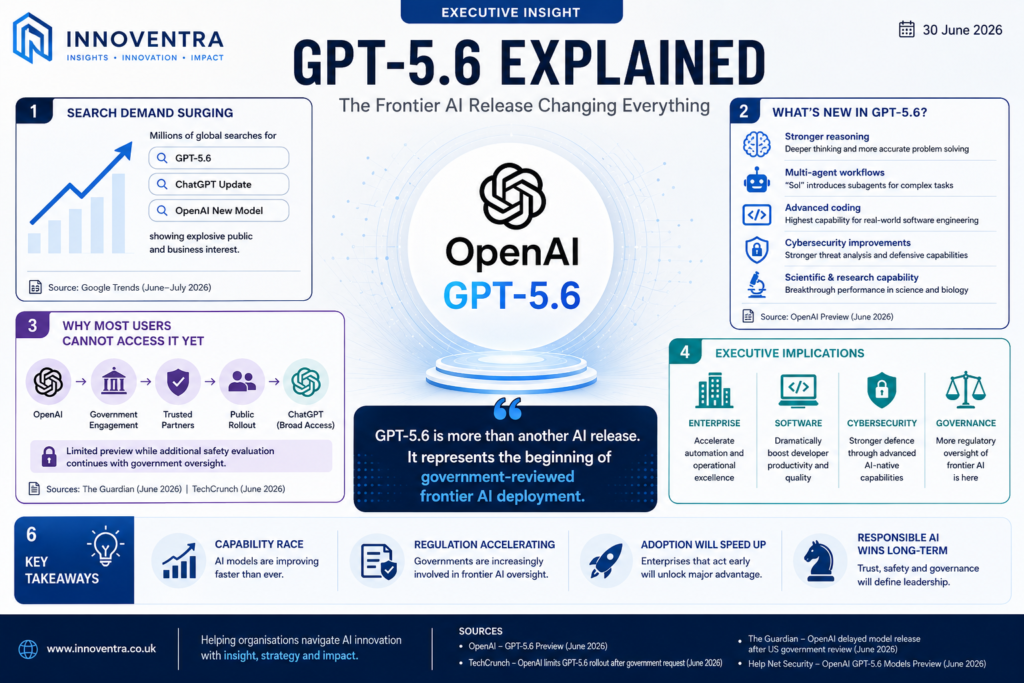
Figure A GPT-5.6 Executive Brief
What GPT-5.6 Means for Different Professions
The arrival of increasingly capable frontier AI models is unlikely to affect every profession equally. Research consistently shows that AI creates the greatest value where work is knowledge-intensive, repetitive and digitally enabled. The implications therefore vary according to how professionals create, analyse and communicate information.
Software Engineers: From Writing Code to Engineering Systems
For software engineers, the role of AI continues to evolve beyond code completion. Modern frontier models increasingly assist with debugging, documentation, test generation, code review, infrastructure configuration and multi-file software development.
Recent industry studies suggest that developers using advanced AI coding assistants complete many routine programming tasks significantly faster than those working without AI support. The greatest productivity gains, however, are not generated by replacing engineers but by allowing experienced developers to spend more time on software architecture, security, scalability and customer-facing innovation.
This changes the skills employers value.
Rather than rewarding professionals who simply produce more code, organisations are increasingly seeking engineers capable of designing robust systems, validating AI-generated code, understanding security implications and integrating AI into software development lifecycles.
Executive Insight
The future software engineer will spend less time writing individual functions and more time designing intelligent systems that combine human expertise with AI capabilities.
Data Scientists: Analysis Is Becoming Automated—Judgement Is Not
The role of data scientists is also changing rapidly.
Frontier AI models can increasingly automate SQL generation, exploratory data analysis, feature engineering, documentation and report writing. Tasks that previously consumed several hours may soon require only minutes.
Yet this does not reduce the importance of data scientists.
Instead, it increases demand for professionals who understand experimental design, causal inference, statistical validation, model governance and business interpretation.
As AI produces larger volumes of analysis, organisations require experts capable of determining whether those conclusions are reliable, unbiased and commercially meaningful.
In other words, AI is reducing the value of producing analysis while increasing the value of interpreting it.
Cybersecurity Professionals: The Advantage Cuts Both Ways
Cybersecurity may experience one of the fastest transformations.
Advanced AI models can identify software vulnerabilities, analyse malware behaviour, automate threat intelligence and accelerate incident response. Security teams are already integrating AI into vulnerability management and defensive testing to improve speed and coverage.
However, the same capabilities are becoming available to attackers.
Sophisticated phishing campaigns, automated reconnaissance and malicious code generation are becoming easier to execute, increasing pressure on organisations to strengthen cyber resilience, governance and employee awareness.
This is one reason governments are paying increasing attention to frontier AI capabilities.
The question is no longer whether AI affects cybersecurity it is whether organisations can adopt AI faster than adversaries exploit it.
Knowledge Workers: Productivity Becomes a Competitive Differentiator
Professionals working in consulting, finance, law, accounting, marketing and research are also entering a new productivity era.
Large language models increasingly assist with:
- analysing extensive documentation;
- summarising regulatory information;
- preparing presentations;
- conducting market research;
- producing first drafts of reports; and
- synthesising evidence from multiple sources.
Rather than replacing expertise, these capabilities reduce the time spent on repetitive cognitive work.
The professionals likely to benefit most will be those capable of combining AI outputs with commercial judgement, industry expertise and critical evaluation.
Why the Real Competition Is No Longer About Models
Public attention often focuses on which company has built the most capable AI model.
For organisations, this is becoming the wrong question.
History demonstrates that competitive advantage rarely comes from purchasing technology alone.
Cloud computing, enterprise software and digital transformation generated value only after organisations redesigned processes, developed workforce capability and changed operating models.
AI appears to be following the same pattern.
Leading organisations are increasingly asking:
- Which workflows should AI redesign?
- Which decisions should remain human-led?
- Which employees require AI training?
- How should AI outputs be validated?
- What governance is required for responsible deployment?
These questions will determine competitive advantage long after benchmark scores have been forgotten.
Five Strategic Questions Every Board Should Be Asking
Rather than asking “Should we adopt GPT-5.6?”, executive teams should ask:
1. Which business processes could AI improve by at least 20–30% over the next two years?
2. Which knowledge-intensive roles will require reskilling rather than replacement?
3. Do we have governance capable of managing increasingly autonomous AI systems?
4. How dependent are we becoming on a small number of frontier AI providers?
5. If our competitors adopted advanced AI faster than us, where would they gain the greatest advantage?
These questions shift the conversation from technology adoption to organisational transformation.
Innoventra Perspective
“Every frontier AI release receives attention because the technology improves. The organisations that outperform, however, are rarely those with access to the newest model first. They are those that redesign work, develop AI-literate workforces and establish governance capable of scaling innovation responsibly.”
The next decade of AI competition is unlikely to be won through access alone.
It will be won by organisations that combine technological capability with strategic leadership, trusted governance and continuous workforce adaptation.