
Executive Summary
Britain is one of the world’s strongest AI nations. It has world-class universities, Europe’s deepest AI ecosystem, globally recognised companies such as DeepMind, Wayve, Synthesia and Isomorphic Labs, and a government strategy that has already delivered 38 of the 50 actions in the AI Opportunities Action Plan.
Yet the real test is not whether Britain can produce excellent AI research. It already does. The harder question is whether the UK can convert research into productivity, industrial growth and globally scaled companies.
This is where the comparison with the United States matters. The US does not simply produce AI breakthroughs. It converts them into companies, infrastructure, platforms and global markets. Stanford’s AI Index reported that US private AI investment reached $109.1bn in 2024, compared with $4.5bn in the UK.
Key Insight
Britain’s AI challenge is not invention. It is conversion: turning research into adoption, adoption into productivity, and productivity into global economic advantage.
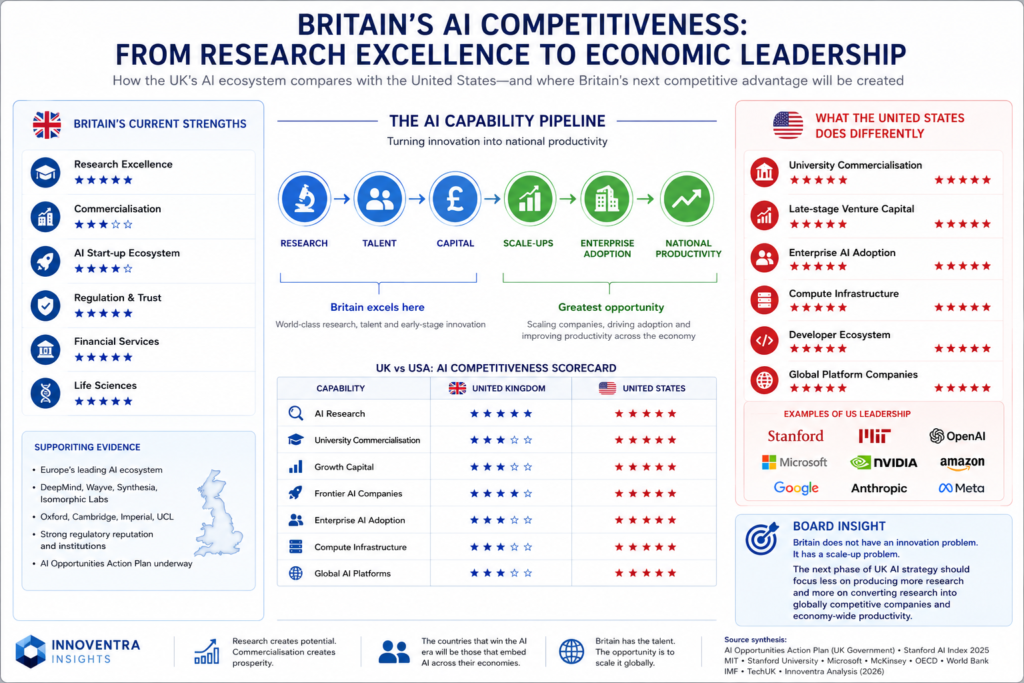
Figure 1. Britain’s AI Competitiveness: From Research Excellence to Economic Leadership
Britain Has Strength. America Has Scale.
The UK enters the AI race with genuine advantages: elite universities, strong financial services, trusted legal institutions, a thriving start-up ecosystem and a growing public-sector AI agenda.
But the US has built something larger: a full commercialisation machine.
American universities such as MIT and Stanford do not merely publish research; they repeatedly generate companies. MIT reports that more than 30,000 active companies founded by its alumni employ 4.6 million people and generate around $1.9tn in annual revenue.
The lesson is clear. Research excellence matters, but it only becomes national advantage when it is connected to capital, customers, infrastructure and commercial ambition.
“Innovation creates ideas. Commercialisation creates industries.”
What US Universities Do Differently
Oxford, Cambridge, Imperial, UCL and Edinburgh are globally respected. The problem is not academic quality.
The difference is ecosystem design. Oxford and Cambridge consistently rank among the world’s leading universities, yet the UK’s challenge is not producing knowledge it is capturing its economic value. MIT estimates that companies founded by its alumni generate around US$1.9 trillion in annual revenues, illustrating how deeply entrepreneurship is embedded within its institutional model. Stanford has similarly become a cornerstone of Silicon Valley’s innovation ecosystem. The strategic lesson is not that British universities produce weaker research they do not but that American universities have developed stronger systems for converting research into globally scaled businesses.
According to Stanford’s 2025 AI Index, private AI investment in the United States exceeded US$100 billion in 2024, dwarfing investment elsewhere. The importance of this gap extends beyond funding. Larger pools of growth capital enable companies to remain independent for longer, invest more aggressively in computing infrastructure, attract global talent and expand internationally before seeking acquisition. Capital therefore functions as a strategic capability, not merely a financial resource.
US universities sit inside powerful commercial networks. Researchers move into start-ups. Students raise venture funding early. Corporations sponsor research and acquire talent. Venture capital sits close to the lab. This creates a repeated pathway from research to market.
The US has also expanded national AI research infrastructure. The National AI Research Resource pilot now supports more than 600 research projects and 6,000 students across all US states and territories.
Britain can learn from this. University spin-outs should not be treated as side activities. They should be a core part of national AI strategy.
Key Insight
The UK’s competitive challenge is not producing world-class research. It is converting world-class research into world-class companies.
What US Corporations Do Differently
American corporations invest across the entire AI value chain: compute, data centres, foundation models, enterprise software, developer platforms, consulting capability and customer adoption.
Microsoft alone said it was on track to invest around $80bn in FY2025 in AI-enabled data centres.
That scale matters. AI leadership now depends not only on talent, but also on compute, energy, cloud infrastructure and enterprise distribution.
British firms are strong in finance, law, consulting, life sciences and creative industries. But too many still treat AI as a tool rather than a transformation programme. The UK’s Technology Adoption Review found that the management skills gap is a significant barrier to adoption alongside technical skills.
“The United States does not only fund AI research. It funds every stage between research and global market leadership.”
The Productivity Gap Is the Real Risk
The UK’s biggest AI opportunity is not building the next OpenAI. It is making thousands of British businesses more productive.
This is where policy should focus. SMEs account for the overwhelming majority of UK firms, yet many face barriers including skills, cost, governance, data security and uncertainty over ROI. techUK has identified lack of expertise, regulatory compliance and high costs as major blockers to AI adoption.
If AI adoption remains concentrated among large technology firms and financial institutions, the national productivity impact will be limited.
Key Insight
Countries become richer when technology spreads through the economy, not when innovation remains concentrated in a small number of elite firms.
Five Lessons Britain Should Learn from the United States
1. Treat commercialisation as seriously as research.
Universities should be measured not only by publications, but by spin-outs, patents, industry partnerships and scaled companies.
2. Build deeper growth capital.
The UK creates strong AI companies, but too many require overseas capital to scale. Britain needs stronger late-stage funding capacity.
3. Make AI adoption a national productivity mission.
The priority should be SMEs, public services, manufacturing, healthcare and regional economies—not only frontier research.
4. Invest in compute and energy infrastructure.
AI leadership increasingly depends on data centres, chips, power and cloud capacity.
5. Develop AI leadership, not just AI skills.
Boards and managers need to redesign workflows, governance and operating models around AI.
Conclusion
Britain can be one of the world’s most successful AI economies, but not by copying the United States directly.
The UK’s advantage lies in trusted institutions, research excellence, financial services, life sciences, regulation, creative industries and public-sector opportunity.
The challenge is connection.
Research must connect to capital. Capital must connect to scale. AI tools must connect to productivity. Universities must connect to industry. Public policy must connect to adoption.
The next AI race will not be won by the country that produces the most impressive announcements. It will be won by the country that converts AI into measurable economic capability.
Britain has the ingredients. The next phase depends on execution.