
What They Are Doing Differently and Why Higher Education Must Change
Executive Summary
Artificial intelligence is forcing universities to confront the most fundamental question in higher education since the Industrial Revolution: what is the purpose of a university when knowledge is no longer scarce? For centuries, universities derived their competitive advantage from producing and disseminating knowledge. Today, frontier AI systems can retrieve information, summarise scientific literature, generate software, analyse complex datasets and solve advanced technical problems in seconds. The competitive advantage of higher education is therefore shifting from knowledge transmission to capability creation. Universities that continue to compete primarily on information delivery risk educating graduates for an economy that is disappearing. Those that redesign education around innovation, judgement, entrepreneurship and interdisciplinary problem-solving are increasingly shaping the future of global competitiveness.
This transformation is occurring at extraordinary speed. The Stanford AI Index 2025 found that US private AI investment reached US$109.1 billion in 2024, almost 12 times China’s US$9.3 billion and 24 times the UK’s US$4.5 billion. Meanwhile, 78% of organisations reported using AI in 2024, compared with 55% only a year earlier, demonstrating one of the fastest enterprise technology adoption cycles ever recorded. The implication for universities is profound: employers are redesigning work far faster than most curricula are evolving.
The challenge extends beyond technology. According to the OECD, national AI competitiveness increasingly depends on the strength of an entire ecosystem, including research excellence, talent development, compute infrastructure, venture capital, industrial partnerships and governance—not simply research output. This explains why a relatively small group of universities consistently produces a disproportionate share of AI founders, breakthrough researchers and globally competitive technology companies.
This paper argues that the world’s leading AI universities are succeeding because they have fundamentally redefined the role of higher education. Rather than viewing themselves as providers of degrees, they operate as innovation ecosystems where education, research, entrepreneurship, venture capital and industry collaborate continuously. Their graduates do not simply secure employment they increasingly create new industries, attract investment and commercialise scientific discovery. The question for governments is therefore no longer how universities should adopt AI. It is how universities can become engines of long-term national productivity.
Innoventra Executive Insight
“The defining competitive advantage of tomorrow’s universities will not be their ability to teach artificial intelligence. It will be their ability to develop graduates capable of creating economic value with artificial intelligence.”
The Knowledge Monopoly Has Ended
The history of universities has largely been the history of information scarcity. Before the internet, universities possessed something that few organisations could replicate: privileged access to libraries, laboratories, world-leading academics and specialist expertise. Degrees became valuable because universities controlled access to knowledge.
Artificial intelligence has fundamentally changed that equation.
Today’s students can interrogate frontier AI models capable of explaining advanced mathematics, generating software, reviewing academic literature, translating languages and simulating complex business scenarios almost instantly. Access to information, once the defining advantage of higher education, is becoming increasingly democratised. This does not reduce the importance of universities. Instead, it forces them to compete on something considerably more valuable: developing human capabilities that AI cannot easily replicate.
This distinction is critical because most universities remain organised around educational models developed during the twentieth century. Assessment systems continue to reward information recall, individual coursework and narrowly defined disciplinary expertise, despite employers increasingly valuing critical thinking, adaptability, systems thinking, collaborative problem-solving and AI literacy. The issue is therefore not whether universities should introduce more AI modules. It is whether their educational philosophy reflects the realities of an AI-driven economy.
The World’s Best Universities Are Solving a Different Problem
One of the most common misconceptions surrounding AI in education is that leading universities are succeeding because they teach more computer science.
The evidence suggests something far more interesting.
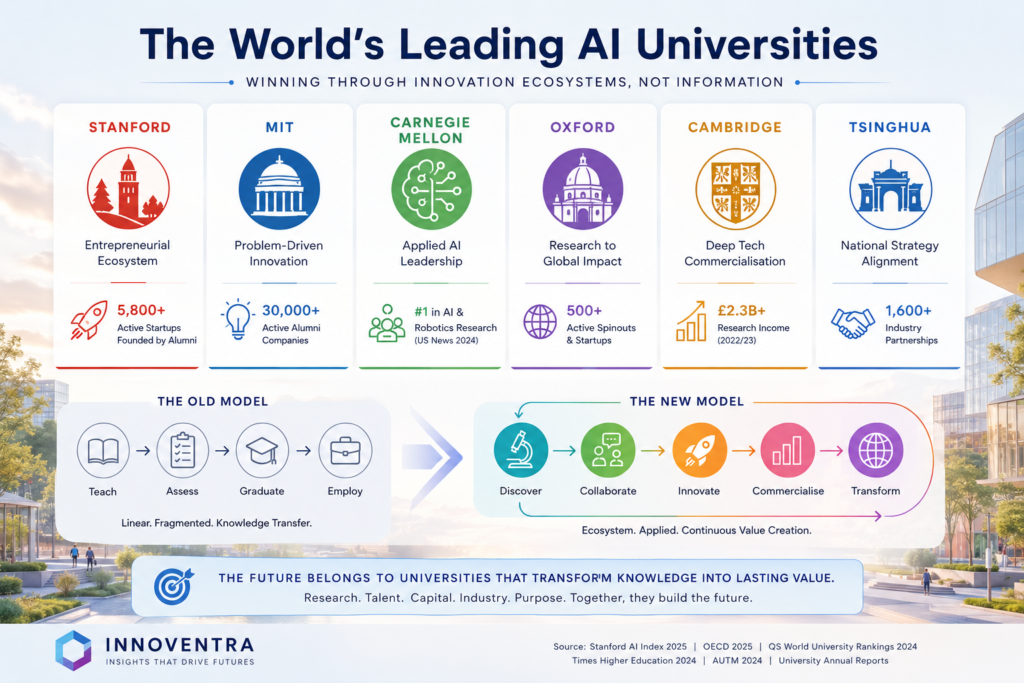
The institutions consistently producing the world’s most influential AI researchers, entrepreneurs and technology leaders including Stanford, MIT, Carnegie Mellon, Oxford, Cambridge and Tsinghua share remarkably similar organisational characteristics despite operating in very different political and economic environments.
Rather than concentrating exclusively on technical excellence, they integrate five mutually reinforcing capabilities:
- frontier research;
- interdisciplinary education;
- deep industry collaboration;
- entrepreneurial ecosystems;
- rapid commercialisation of research.
These universities recognise that research alone rarely creates economic value. Competitive advantage emerges when discovery, investment, talent and enterprise operate as one integrated system.
This distinction explains why regions surrounding leading universities consistently outperform comparable knowledge economies. Silicon Valley developed around Stanford rather than by coincidence. Kendall Square emerged alongside MIT because research translated rapidly into venture-backed companies. Cambridge’s technology cluster has similarly evolved through sustained collaboration between academia, industry and investors.
The lesson is profound. Universities are no longer competing only with one another. They are competing as part of regional innovation ecosystems.
Why Graduate Employability Is Being Redefined
Employability has traditionally been measured through graduate salaries, employment rates and professional qualifications. Artificial intelligence is making these indicators progressively less predictive of long-term success.
The Stanford AI Index shows that AI capabilities continue improving across increasingly demanding reasoning, scientific and software engineering benchmarks, while enterprise adoption continues to accelerate. As intelligent systems become embedded across every major industry, graduates will work alongside technologies that continuously reshape professional practice.
The consequence is that technical knowledge depreciates more rapidly than at any point in modern history.
Graduates entering employment in 2030 are unlikely to remain competitive solely because of what they learned at university. They will remain competitive because of how effectively they continue learning throughout their careers.
This changes the purpose of higher education.
Rather than preparing students for their first job, universities must increasingly prepare graduates for multiple technological revolutions across careers lasting forty years or more.
Knowledge remains essential.
Adaptability becomes decisive.
Key Insight
The universities leading the AI era have not abandoned academic excellence. They have expanded it. Their competitive advantage comes from combining research, entrepreneurship, industry collaboration, interdisciplinary learning and continuous innovation into a single operating model. In the AI economy, universities no longer compete through knowledge alone they compete through the ecosystems they build around it.
The World’s Best AI Universities Are Not Teaching More AI They Are Building Better Innovation Ecosystems
If university rankings alone determined economic success, many of the world’s highest-ranked institutions would produce similar levels of innovation, startup creation and industrial impact. They do not.
A striking pattern emerges when examining the ecosystems surrounding institutions such as Stanford University, Massachusetts Institute of Technology, Carnegie Mellon University, University of Oxford, University of Cambridge and Tsinghua University. Their competitive advantage extends well beyond academic excellence. They combine frontier research, entrepreneurial culture, venture capital, interdisciplinary collaboration and industry partnerships into integrated innovation ecosystems capable of transforming research into economic value at exceptional speed.
The evidence increasingly suggests that the future of higher education will be determined less by how much universities teach and more by how effectively they create innovation ecosystems around learning. This represents a profound shift in the role of universities—from centres of knowledge to engines of economic competitiveness.
1. Stanford University — Building the World’s Most Valuable AI Ecosystem
Stanford’s global influence cannot be explained by research excellence alone. Its true competitive advantage lies in its proximity to Silicon Valley, where universities, entrepreneurs, venture capital firms and technology companies operate as a single innovation ecosystem.
This environment enables students to work alongside founders, investors and AI researchers long before graduation. Rather than viewing entrepreneurship as an optional activity, Stanford embeds commercialisation throughout the research lifecycle. Faculty frequently collaborate with industry, researchers become founders, and students gain exposure to venture capital, accelerators and startup ecosystems as part of their educational experience.
The results are extraordinary. The Stanford AI Index reports that the United States produced 40 notable frontier AI models in 2024, significantly more than any other country, with Stanford remaining one of the world’s leading academic contributors to influential AI research while industry increasingly dominates frontier model development.
Perhaps more importantly, Stanford demonstrates that geography matters less than ecosystem design. Universities do not generate economic value in isolation. They create value by connecting research, talent, capital and industry into a continuous cycle of innovation.
Executive Insight
Stanford’s greatest asset is not its AI curriculum—it is an ecosystem where research, venture capital and entrepreneurship reinforce one another, allowing scientific breakthroughs to become globally significant companies.
2. MIT — Teaching Students to Solve Problems, Not Pass Examinations
Many universities organise education around disciplinary knowledge. MIT organises education around solving complex problems.
Its educational philosophy combines engineering, design thinking, entrepreneurship and interdisciplinary collaboration from the earliest stages of study. Students are expected to prototype solutions, work with industry, conduct applied research and transform ideas into practical innovations rather than simply demonstrating theoretical understanding.
This approach reflects a broader shift occurring across AI-intensive industries. Employers increasingly seek graduates capable of integrating technical expertise with commercial awareness, systems thinking and multidisciplinary collaboration. In an environment where AI can increasingly automate routine technical tasks, competitive advantage depends on identifying problems worth solving rather than merely executing predefined solutions.
MIT’s influence extends far beyond graduate employment. Its research ecosystem has generated thousands of companies, contributing significantly to technological innovation across artificial intelligence, robotics, biotechnology and advanced manufacturing. The university’s emphasis on experimentation and commercialisation demonstrates that the future value of higher education lies not simply in producing skilled employees, but in producing innovators capable of creating entirely new industries.
3. Carnegie Mellon — Why Applied AI Outperforms Theoretical AI
If Stanford demonstrates the power of entrepreneurial ecosystems, Carnegie Mellon demonstrates the importance of applied capability.
For decades, Carnegie Mellon has been recognised globally for artificial intelligence, robotics, computer vision and autonomous systems. Yet its success stems from more than research excellence.
The university has consistently prioritised project-based learning, interdisciplinary engineering and close collaboration with employers. Students develop AI systems for real operational environments rather than limiting learning to theoretical coursework.
This distinction has become increasingly important as enterprise AI adoption accelerates. The Stanford AI Index shows that 78% of organisations reported using AI in 2024, compared with 55% the previous year, creating rapidly growing demand for graduates capable of deploying AI within complex organisational settings rather than simply understanding its underlying algorithms.
Carnegie Mellon’s educational philosophy reflects this reality. Graduates leave not only with technical competence but with experience integrating AI into practical business, engineering and societal challenges.
4. Oxford and Cambridge — Turning Research into Economic Growth
The United Kingdom illustrates an important lesson for higher education policy.
Oxford and Cambridge consistently rank among the world’s leading research universities. However, their greatest contribution increasingly lies in their ability to transform academic research into globally competitive businesses.
Companies including Google DeepMind, Isomorphic Labs and numerous biotechnology and advanced engineering startups have strong connections to the Oxford-Cambridge research ecosystem.
Rather than viewing commercialisation as separate from academic excellence, these universities increasingly treat entrepreneurship as an extension of research itself. Dedicated innovation parks, technology transfer offices, venture partnerships and industry collaborations enable discoveries to move rapidly from laboratories into commercial applications.
For policymakers, this distinction is critical.
Research publications generate academic reputation.
Commercialisation generates economic growth.
The world’s most successful AI universities increasingly recognise that both are essential.
5. Tsinghua University — Aligning Universities with National Strategy
Western universities often emphasise institutional independence.
China demonstrates an alternative model.
Tsinghua University has become one of the world’s leading AI institutions because its research priorities are closely aligned with national industrial strategy. Artificial intelligence development is supported through coordinated investment across universities, government, advanced manufacturing and technology companies.
This alignment enables research, infrastructure, talent development and industrial deployment to reinforce one another at national scale.
While governance models differ substantially between countries, the strategic lesson remains relevant.
Universities create significantly greater economic value when educational priorities, research investment and industrial policy reinforce one another rather than operating independently.
The Seven Characteristics Shared by Every World-Class AI University
Despite operating within different political systems, funding models and cultures, the world’s leading AI universities consistently share seven characteristics.
| Characteristic | Why It Matters |
|---|---|
| Research excellence | Attracts world-class academics and talent. |
| Industry embedded into education | Students solve real organisational problems before graduating. |
| Entrepreneurship culture | Graduates create companies rather than solely seeking employment. |
| Interdisciplinary learning | AI is integrated across medicine, law, engineering, business and science. |
| Rapid commercialisation | Research becomes products, patents, startups and investment. |
| Global partnerships | Universities collaborate internationally across academia and industry. |
| Lifelong learning | Graduates continually update skills throughout their careers. |
Remarkably, none of these characteristics depends primarily on artificial intelligence itself.
Instead, they represent organisational capabilities that enable universities to convert AI into economic, scientific and societal value.
Innoventra Research Insight
Our analysis suggests that AI leadership in higher education is becoming progressively less dependent on teaching advanced algorithms and increasingly dependent on building institutional ecosystems where research, entrepreneurship, industry collaboration and lifelong learning reinforce one another.
In other words, the future winners are unlikely to be the universities with the largest computer science departments. They will be those that redesign higher education around innovation rather than information.
Part 3 — Rethinking Higher Education for the AI Economy
The Universities That Will Lead the Next Decade Will Measure Different Outcomes
For decades, higher education has been evaluated using familiar indicators: research publications, citation impact, graduate employment rates and international rankings. While these measures remain important, they increasingly fail to capture the capabilities that determine success in an AI-driven economy.
The rapid diffusion of AI illustrates why. According to the latest evidence from the Organisation for Economic Co-operation and Development, AI adoption is increasingly constrained not by technology but by skills shortages, with around 40% of non-adopting employers in manufacturing and finance identifying a lack of skills as the primary barrier, while more than half of SMEs not yet using generative AI report similar challenges. Employers also report growing demand for highly educated workers with strong problem-solving, creativity and managerial capabilities, alongside technical AI skills.
This represents a fundamental shift in educational value creation. Universities are no longer competing simply to produce graduates with technical knowledge. They are competing to produce graduates capable of learning continuously, collaborating with intelligent systems and solving increasingly complex interdisciplinary problems.
Why Graduate Employability Is Being Redefined
One of the most significant changes occurring in labour markets is that skills are becoming more valuable than static qualifications alone.
Across OECD economies, AI-related occupations continue to expand while employer demand increasingly focuses on adaptable capabilities rather than narrow technical expertise. OECD analysis shows that the AI workforce has almost tripled as a share of employment in less than a decade, yet shortages of AI-capable workers remain widespread across countries.
At the same time, evidence from labour-market studies suggests employers are increasingly rewarding demonstrable AI capabilities, systems thinking and practical problem-solving alongside formal education. Rather than replacing degrees, AI is increasing the importance of combining academic excellence with continuously evolving professional skills.
This has profound implications for universities. Institutions that continue to assess students primarily through examinations measuring information recall risk preparing graduates for work that intelligent systems increasingly perform themselves.
Executive Insight
The labour market is not reducing the value of higher education. It is changing what higher education must produce. The future graduate will be evaluated less by what they know and more by how effectively they apply, challenge and extend knowledge alongside AI.
The Seven Characteristics of Future-Ready Universities
Our analysis of leading AI universities, labour-market evidence and international policy research identifies seven institutional characteristics that consistently distinguish future-ready universities from traditional knowledge providers.
1. Capability Becomes the Primary Learning Outcome
Knowledge remains essential, but competitive advantage increasingly depends on judgement, creativity, critical thinking and interdisciplinary problem-solving.
2. AI Is Embedded Across Every Discipline
Artificial intelligence becomes part of medicine, law, engineering, business, education and the humanities—not solely computer science.
3. Industry Shapes Curriculum Design
Leading universities co-design programmes with employers, ensuring graduates develop capabilities aligned with rapidly evolving workforce requirements.
4. Research Is Measured by Societal and Economic Impact
Publications remain important, but increasing emphasis is placed on commercialisation, policy influence, startup creation and public value.
5. Entrepreneurship Is Integrated Into Education
Students learn how to identify opportunities, commercialise innovation and translate research into sustainable economic activity.
6. Lifelong Learning Replaces One-Time Qualification
Universities increasingly become long-term learning partners, providing modular education, executive development and continuous professional upskilling.
7. Responsible AI Becomes a Core Graduate Competency
Graduates require not only technical proficiency but also the ability to deploy AI ethically, transparently and responsibly across increasingly complex organisational environments.
What Governments Should Do
Governments frequently respond to AI by increasing research funding or investing in computing infrastructure. While both remain essential, international evidence suggests these investments alone are unlikely to secure long-term competitiveness.
The world’s strongest AI ecosystems integrate universities, research institutions, venture capital, digital infrastructure, employers and public policy into coherent national innovation systems. Countries that successfully align education policy with industrial strategy are better positioned to commercialise research, retain talent and translate scientific excellence into productivity growth.
Future higher education policy should therefore prioritise:
- embedding AI literacy across all disciplines;
- strengthening university–industry collaboration;
- expanding lifelong learning and professional reskilling;
- investing in research commercialisation and entrepreneurship;
- developing governance frameworks that promote trustworthy AI adoption.
These priorities align closely with OECD recommendations that AI policy should combine technology investment with workforce capability, training and institutional adaptation.
What University Leaders Should Do
Perhaps the greatest risk facing universities is not failing to adopt AI. It is adopting AI while leaving educational philosophy unchanged.
Many institutions continue to evaluate success using metrics designed for an economy in which information was scarce and technological change relatively gradual. Artificial intelligence has altered both assumptions.
Future-ready universities should increasingly measure:
- graduate adaptability;
- entrepreneurial capability;
- interdisciplinary collaboration;
- AI literacy;
- research commercialisation;
- employer partnerships;
- societal impact.
These measures are considerably harder to achieve than introducing new AI modules, but they are also far more likely to determine long-term institutional relevance.
Innoventra AI University Capability Framework™
Our analysis suggests that the world’s highest-performing AI universities consistently develop seven interconnected capabilities.
Research Excellence → Industry Collaboration → Entrepreneurial Education → Research Commercialisation → Lifelong Learning → Responsible AI Governance → National Productivity
The framework illustrates an important principle.
Artificial intelligence itself does not create economic competitiveness.
Competitive advantage emerges when universities combine technology with institutions, leadership, investment, governance and human capability into a coherent innovation ecosystem.
Innoventra Perspective
Higher education is entering its most significant period of transformation since the expansion of mass university education in the twentieth century. The defining challenge is no longer how universities incorporate artificial intelligence into teaching. It is whether universities can redesign themselves for an economy in which intelligence has become increasingly abundant but uniquely human capability has become proportionally more valuable.
The institutions most likely to define the next decade will not necessarily possess the largest research budgets or highest global rankings. They will be those that consistently transform discovery into innovation, innovation into enterprise and enterprise into long-term societal value. In this emerging landscape, universities become more than educational institutions—they become strategic assets that determine a nation’s capacity to innovate, attract investment and compete in the global AI economy.
Innoventra Executive Insight
“The future of higher education will not be defined by artificial intelligence. It will be defined by how effectively universities cultivate the capabilities that artificial intelligence cannot easily replicate: judgement, creativity, ethical leadership, interdisciplinary thinking and the ability to transform knowledge into economic and societal value.”
Executive Recommendations
- Shift educational outcomes from knowledge acquisition to capability development.
- Embed AI literacy across every academic discipline, not just computing.
- Measure universities by innovation, commercialisation and societal impact alongside academic excellence.
- Strengthen university–industry partnerships to improve graduate readiness and accelerate research translation.
- Expand lifelong learning to support continuous workforce adaptation.
- Integrate responsible AI governance into every stage of higher education.
- Align higher education policy with national innovation and industrial strategies to maximise long-term productivity.