
Executive Summary
Artificial intelligence is entering its most consequential phase since the emergence of the internet. While the first wave of AI was characterised by chatbots and generative content, the next wave will be defined by autonomous decision-making, multimodal intelligence, scientific reasoning and industry-specific AI systems capable of transforming productivity, competitiveness and economic growth. The question facing organisations is no longer whether AI will reshape their industry, but which technologies will create sustainable competitive advantage and how quickly leaders can translate innovation into measurable business value.
The pace of this transformation is unprecedented. Global private investment in AI reached US$33.9 billion in 2024, more than eight times higher than in 2022, while the global AI market is forecast to exceed US$1.8 trillion by 2030, reflecting compound annual growth approaching 25%. Yet despite rapid adoption, research consistently highlights a widening execution gap. According to leading industry studies, only around 5% of organisations have successfully scaled AI to deliver material enterprise-wide value, while the majority continue to struggle with fragmented data, governance challenges and limited organisational readiness. This suggests that competitive advantage will increasingly depend on execution rather than experimentation.
This report identifies and ranks the ten AI developments most likely to shape global competitiveness over the next decade, using an evidence-based framework that evaluates four critical dimensions: innovation, commercial impact, adoption maturity and implementation feasibility. Rather than measuring media attention or short-term market enthusiasm, the analysis focuses on technologies most likely to generate sustainable value across governments, businesses and critical industries. The findings indicate that AI agents, multimodal foundation models, advanced reasoning systems and AI for scientific discovery are emerging as the technologies with the greatest potential to redefine productivity and innovation over the next five years.
The research also challenges one of the most common misconceptions surrounding artificial intelligence that success belongs to those who adopt the newest technology first. Evidence from enterprise AI adoption suggests the opposite. Organisations consistently generating the strongest returns are those combining advanced AI with high-quality data, trusted governance, skilled workforces and redesigned business processes. In other words, technology is becoming only one component of a much broader capability ecosystem.
Executive Insight
“The defining competitive advantage of the AI era will not be access to the most advanced models. It will be the ability to integrate the right AI technologies with trusted data, resilient governance and organisational capability at enterprise scale.”
Ultimately, the AI race is evolving beyond algorithms into a competition between innovation ecosystems. Nations and organisations that align research excellence, digital infrastructure, investment, regulation, talent and industry adoption will capture a disproportionate share of future economic value. Those that continue to treat AI as a standalone technology initiative risk falling behind competitors who view it as a strategic transformation programme. This report provides senior leaders with a structured, evidence-based assessment of where AI is heading, which developments matter most, and the strategic decisions required to remain competitive in one of the fastest-moving technology transitions in modern history.
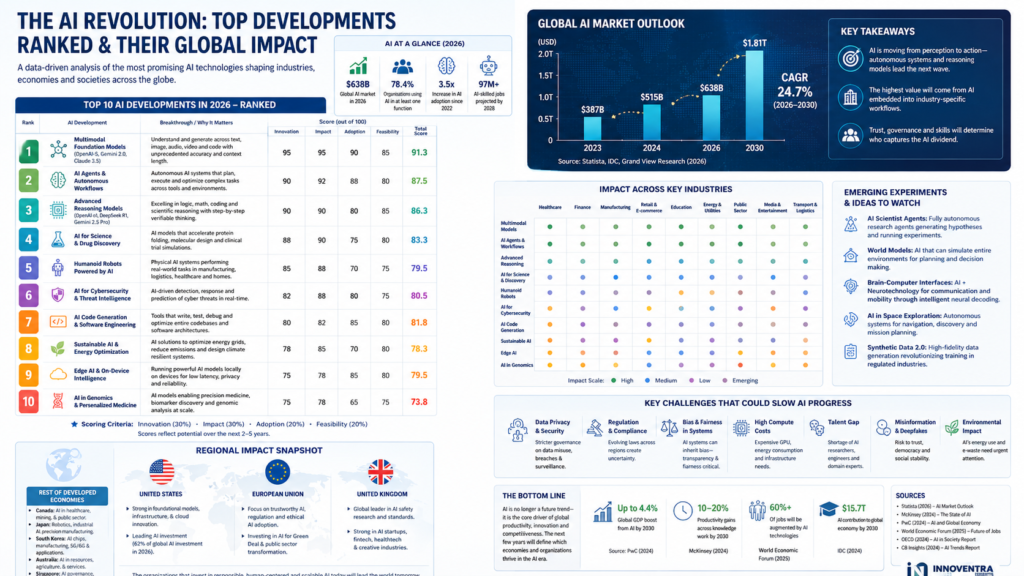
Top 10 AI Developments in 2026: Global Ranking of Emerging Artificial Intelligence Technologies
Why AI Innovation Is Accelerating Faster Than Ever
Global investment in artificial intelligence has reached unprecedented levels. Governments across the United States, United Kingdom, European Union, Japan, South Korea, Canada and Singapore continue expanding sovereign AI capabilities, while major technology firms are committing tens of billions of dollars towards advanced computing infrastructure, semiconductor development and AI research.
According to industry forecasts from IDC, PwC, McKinsey, Stanford HAI and the World Economic Forum, AI could contribute between $15 trillion and $20 trillion to the global economy by the early 2030s through productivity improvements, new products, scientific discoveries and operational efficiencies.
However, not every AI breakthrough delivers equal strategic value.
That is why this ranking evaluates technologies according to four weighted dimensions:
- Innovation capability
- Potential industry impact
- Commercial adoption
- Technical and regulatory feasibility
This approach provides organisations with a practical framework for prioritising AI investments.
1. Multimodal Foundation Models Remain the Core Platform
The highest-ranked technology continues to be multimodal foundation models.
Unlike earlier language models, these systems combine text, images, audio, video and increasingly real-time reasoning within a single architecture. This allows organisations to automate complex workflows that previously required multiple disconnected AI systems.
Applications include:
- Healthcare diagnostics
- Legal document analysis
- Financial reporting
- Engineering design
- Customer service
- Defence intelligence
- Scientific research
Rather than representing another incremental improvement, multimodal AI is becoming the operating system upon which future enterprise AI applications will be built.
2. AI Agents Signal the Beginning of Autonomous Work
Perhaps the most disruptive development is the emergence of AI agents.
Unlike traditional chatbots, autonomous AI agents can:
- Plan multi-stage tasks
- Coordinate software tools
- Retrieve information
- Make intermediate decisions
- Learn from previous interactions
- Collaborate with other AI systems
Enterprise organisations are increasingly experimenting with AI agents for procurement, finance, cybersecurity, software development and operational management.
The transition from “AI assistants” towards “AI colleagues” represents one of the defining technological shifts of this decade.
3. Reasoning Models Expand AI Beyond Prediction
Recent reasoning models demonstrate significant improvements in structured thinking, scientific problem solving and mathematical reasoning.
These systems perform considerably better on tasks requiring:
- Logical deduction
- Research analysis
- Coding
- Strategic planning
- Engineering calculations
As reasoning capabilities improve, AI moves beyond content generation towards supporting high-value professional decision-making.
This has significant implications for consulting, finance, healthcare, engineering and public policy.
4. AI Is Becoming a Scientific Discovery Engine
Artificial intelligence is rapidly evolving from a productivity tool into a scientific discovery engine. Leading research institutions and pharmaceutical companies now use AI to accelerate drug discovery, protein folding, climate modelling, advanced materials design, battery innovation and molecular simulation, reducing research cycles from years to months in some applications. The breakthrough of DeepMind’s AlphaFold, which predicted the structures of more than 200 million proteins, has fundamentally transformed biological research, while AI-driven platforms are increasingly identifying novel drug candidates and accelerating clinical development.
Rather than replacing scientists, AI augments human expertise by uncovering complex patterns across datasets far beyond human analytical capacity. As R&D costs continue to rise, organisations that integrate AI into scientific workflows are expected to achieve substantial productivity gains, positioning the pharmaceutical, biotechnology, advanced manufacturing and energy sectors among the largest beneficiaries of the next wave of AI-driven innovation.
Regional Competition Is Intensifying
The infographic highlights an important strategic trend.
The global AI race is increasingly becoming competition between innovation ecosystems rather than individual companies.The United States leads AI because it controls the full frontier-AI stack: capital, compute, cloud, chips, talent and commercial scale. In 2024, US private AI investment reached $109.1 billion almost 12 times China’s $9.3 billion and 24 times the UK’s $4.5 billion. US institutions also produced 40 notable AI models, compared with 15 from China and three from Europe, showing that America is not just funding AI; it is converting capital into globally influential products.
The deeper advantage is ecosystem speed. Companies such as OpenAI, Google, Microsoft, Meta, Anthropic, NVIDIA and Amazon operate at the intersection of frontier research, hyperscale cloud, semiconductor design and global distribution. This allows the US to move faster than most economies from breakthrough research to commercial deployment. While China leads in AI publications and patents and is closing the performance gap on benchmarks, the US remains strongest where economic value is created: frontier models, enterprise platforms, cloud infrastructure, AI chips and venture-backed commercialisation.
Key insight: America’s AI leadership is not built on invention alone. It is built on a compounding system where capital funds compute, compute trains better models, better models attract customers, customers generate revenue, and revenue funds the next wave of innovation. That feedback loop is why the US remains at the front of the global AI race.
European Union
European Union
The European Union is pursuing a distinctly different AI strategy from the United States, competing through industrial excellence, scientific research, trusted governance and sovereign digital infrastructure rather than private capital alone. Although Europe trails the US in frontier model development and venture funding, it possesses globally competitive strengths in advanced manufacturing, automotive engineering, pharmaceuticals, aerospace and robotics industries where AI is expected to generate the greatest long-term productivity gains. This industrial foundation positions Europe to become a leader in the application of AI across the real economy rather than solely in consumer-facing AI platforms.
Recognising the need to strengthen its competitiveness, the European Commission has launched InvestAI, a €200 billion public-private initiative, including €20 billion to develop AI Gigafactories capable of training next-generation foundation models. The EU is also expanding its network to 19 AI Factories across 16 Member States, providing startups, researchers and industry with access to AI-optimised supercomputing infrastructure. Meanwhile, 20% of EU enterprises with at least 10 employees were already using AI technologies in 2025, up from 13.5% in 2024, demonstrating accelerating enterprise adoption across the region.
Key competitive strengths include:
- €200 billion InvestAI programme supporting Europe’s AI ecosystem
- €20 billion investment in AI Gigafactories and sovereign compute infrastructure
- 19 AI Factories providing advanced AI computing across 16 Member States
- World-leading industrial sectors including automotive, aerospace and pharmaceuticals
- Strong scientific research, engineering and robotics capabilities
- Global leadership in trustworthy AI governance through the AI Act
Executive Insight: Europe’s long-term advantage will not be determined by building the largest AI models, but by embedding trusted AI into the world’s most advanced industrial economy. If the United States leads AI innovation, Europe has the opportunity to lead AI industrialisation turning artificial intelligence into measurable productivity across manufacturing, healthcare, energy and critical infrastructure
United Kingdom
The United Kingdom has established itself as one of the world’s leading AI research ecosystems, consistently ranking among the top three countries for frontier AI research, venture investment in Europe and AI startup creation. Home to globally recognised universities including University of Oxford, University of Cambridge and Imperial College London, the UK has produced internationally significant AI companies such as DeepMind, Wayve, Synthesia, ElevenLabs and Isomorphic Labs. In 2024, the UK attracted approximately US$4.5 billion in private AI investment, making it Europe’s largest AI investment destination and third globally behind only the United States and China. AI already contributes an estimated £72 billion annually to the UK economy, while government ambitions aim to increase this to more than £800 billion by 2035 through wider adoption and productivity gains.
The UK’s challenge is therefore not innovation—it is commercial scale. Many breakthrough companies have relied on overseas investment, cloud infrastructure and global technology ecosystems to expand internationally. Recognising this, the government has committed to significantly expanding sovereign AI compute capacity, investing in AI research infrastructure, skills development and public-sector adoption through its national AI strategy. The UK’s long-term competitiveness will depend on strengthening the connections between world-class universities, patient capital, enterprise customers and global markets, enabling more AI breakthroughs to mature into globally dominant companies rather than becoming acquisition targets.
Key competitive strengths include:
- Europe’s largest AI investment market (~US$4.5 billion private investment in 2024)
- AI contributes approximately £72 billion to the UK economy annually
- Globally recognised universities producing frontier AI research and talent
- Strong ecosystem across financial services, life sciences, cybersecurity and defence
- Internationally successful AI companies including DeepMind, Wayve, Synthesia, ElevenLabs and Isomorphic Labs
- Government investment in sovereign AI compute, digital infrastructure and public-sector AI adoption
Executive Insight: The UK’s competitive advantage lies in generating world-class AI innovation. Its next strategic challenge is ensuring more of that innovation is financed, commercialised and scaled domestically. In the AI economy, research creates opportunity—but commercial execution creates national prosperity.
Every Major Industry Will Be Transformed
The infographic demonstrates that AI is no longer confined to technology companies.
High-impact adoption is emerging across:
- Healthcare
- Financial Services
- Manufacturing
- Energy
- Retail
- Logistics
- Education
- Government
- Defence
- Telecommunications
Rather than replacing industries, AI is reshaping how organisations operate, make decisions and deliver services.
This transition is expected to create entirely new competitive advantages for organisations capable of integrating AI strategically.
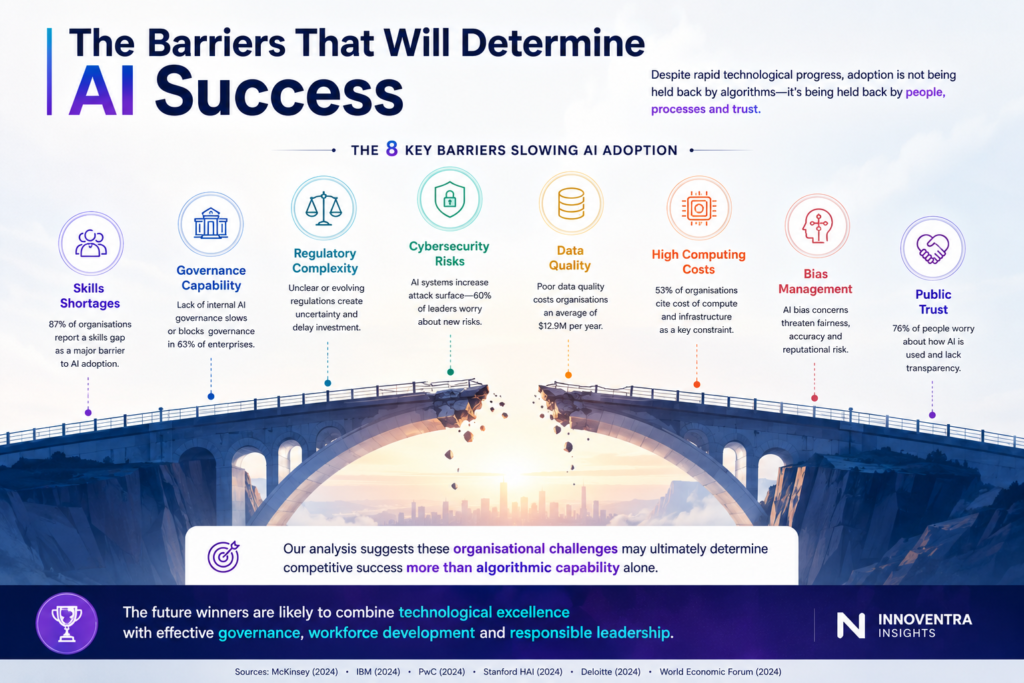
The Biggest Challenges Remain Human Rather Than Technical
Despite rapid technological progress, several barriers continue slowing AI adoption.
These include:
- Skills shortages
- Governance capability
- Regulatory complexity
- Cybersecurity risks
- Data quality
- High computing costs
- Bias management
- Public trust
Our analysis suggests these organisational challenges may ultimately determine competitive success more than algorithmic capability alone.
The future winners are likely to combine technological excellence with effective governance, workforce development and responsible leadership.
Innoventra Perspective
Artificial intelligence is rapidly evolving into a foundational economic platform, comparable to electricity, the internet and cloud computing. Yet history demonstrates that breakthrough technologies rarely create lasting competitive advantage on their own. Organisations that dominated previous technology waves were not necessarily those that invented the underlying innovations, but those that integrated them into new operating models, business processes and organisational capabilities.
Evidence increasingly points to a similar pattern emerging in AI. While frontier models continue to improve at unprecedented speed, independent research consistently finds that only a small proportion of organisations have successfully scaled AI to generate measurable enterprise-wide value. The constraint is no longer algorithmic capability—it is organisational capability. Data quality, workforce skills, governance, leadership and operational redesign have become the primary determinants of AI success.
The organisations most likely to lead the next decade will therefore be those that view AI as an enterprise transformation programme rather than a technology initiative. They will combine trusted data, responsible governance, AI-ready talent and disciplined execution to embed intelligence across decision-making, operations and customer value creation. In this emerging landscape, competitive advantage will depend less on access to the most advanced models and more on an organisation’s ability to deploy them responsibly, securely and at scale.
Innoventra Insight
“The defining advantage of the AI era will not belong to the organisations with the most powerful models. It will belong to those that build the strongest capability ecosystem where technology, trusted data, skilled people and effective governance reinforce one another to create sustainable competitive advantage.”
For organisations preparing for this transition, understanding where AI is heading is only the first step. The greater challenge is identifying which technologies will deliver measurable business outcomes, which capabilities must be developed today, and how leadership teams can build organisations that remain competitive as AI becomes embedded across every sector of the economy.
Executive Takeaways
- Multimodal AI, autonomous agents and reasoning models are moving AI beyond content generation towards autonomous enterprise execution.
- Scientific AI is compressing research and innovation cycles across pharmaceuticals, biotechnology, advanced manufacturing and energy, unlocking entirely new sources of competitive advantage.
- The United States, European Union and United Kingdom are pursuing distinct AI strategies, highlighting that long-term leadership depends on the strength of innovation ecosystems rather than technology alone.
- Governance, trust and AI assurance are rapidly becoming strategic differentiators, with responsible deployment increasingly influencing customer confidence, regulatory compliance and investment decisions.
- The highest-performing organisations will be those that invest simultaneously in technology, workforce capability, trusted data, cyber resilience and leadership transforming AI from a productivity tool into a sustainable enterprise capability.