
Top AI Companies in the UK and USA in 2026: An Evidence-Based Ranking of 20 Industry Leaders
Artificial-intelligence companies attracted extraordinary levels of capital during 2025. Global corporate AI investment reached approximately $581.7 billion, more than doubling in one year, while private investment increased to $344.7 billion. The United States alone accounted for $285.9 billion—more than 23 times the tracked private AI investment recorded in China.
Yet investment alone does not reveal which companies are genuinely winning.
Some businesses possess enormous valuations but limited evidence of sustainable revenue. Others receive less attention while generating hundreds of millions—or billions—of dollars from products that customers already depend on.
This ranking therefore asks a more useful question:
Which AI companies have the strongest combination of technology, commercial adoption, financial momentum, defensibility and long-term strategic importance?
To answer it, Innoventra assessed 20 leading companies across the United Kingdom and United States using publicly available information current to July 2026.
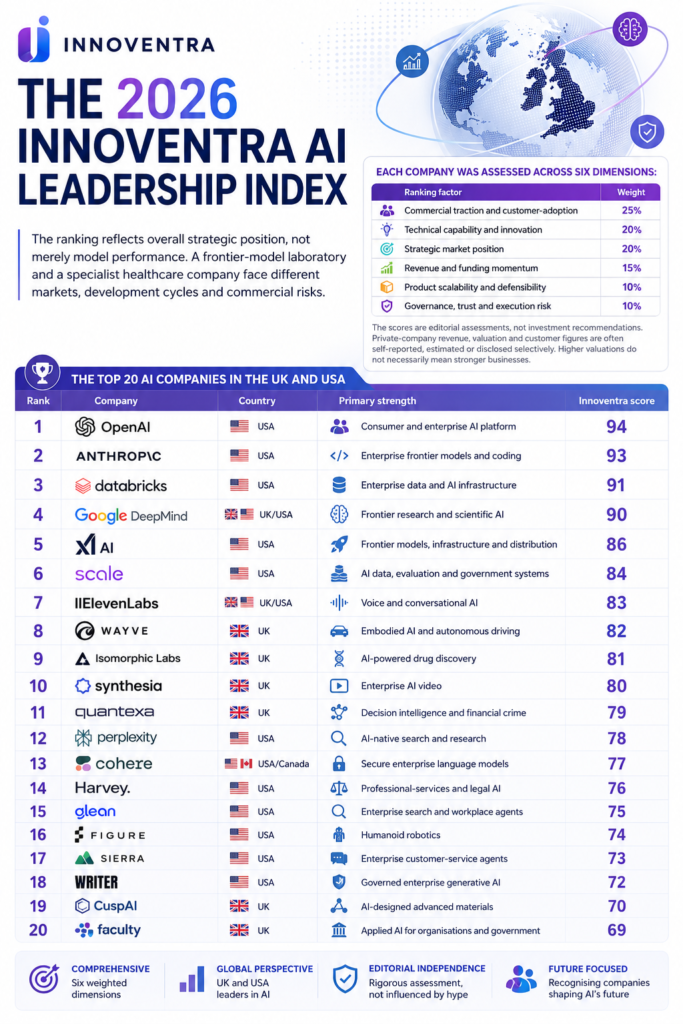
The 2026 Innoventra AI Leadership Index
Each company was assessed across six dimensions:
| Ranking factor | Weight |
|---|---|
| Commercial traction and customer adoption | 25% |
| Technical capability and innovation | 20% |
| Strategic market position | 20% |
| Revenue and funding momentum | 15% |
| Product scalability and defensibility | 10% |
| Governance, trust and execution risk | 10% |
The scores are editorial assessments, not investment recommendations. Private-company revenue, valuation and customer figures are often self-reported, estimated or disclosed selectively. Higher valuations do not necessarily mean stronger businesses.
1. OpenAI: The Largest AI Product Ecosystem
OpenAI ranks first because no independent AI company currently matches its combination of consumer reach, developer adoption, revenue and product breadth.
By February 2026, OpenAI reported more than 900 million weekly ChatGPT users and over 50 million consumer subscribers. It said annual recurring revenue had increased from approximately $2 billion in 2023 to more than $20 billion in 2025. By March 2026, the company reported generating around $2 billion in monthly revenue.
Its advantage is no longer limited to ChatGPT. OpenAI reported that enterprise activity represented more than 40% of revenue by April 2026, while its APIs processed over 15 billion tokens per minute. More than one million organisations had already become paying business customers by November 2025.
Why OpenAI leads
OpenAI benefits from:
- exceptional consumer recognition;
- a large paid subscription base;
- extensive developer distribution;
- enterprise products, APIs and coding tools;
- the capacity to spread research costs across multiple revenue streams.
Its biggest risk is economic rather than technological. Frontier AI requires enormous spending on computing infrastructure, data centres, chips and model development. Revenue can grow rapidly while cash requirements grow even faster.
Verdict: OpenAI currently has the strongest overall AI platform, but maintaining first place will depend on converting scale into durable margins and organisational stability.
2. Anthropic: The Strongest Enterprise Challenger
Anthropic has evolved from an AI-safety laboratory into one of the fastest-growing enterprise-software companies ever created.
The company reported run-rate revenue of more than $5 billion in August 2025, approximately $9 billion by the end of that year and over $30 billion by April 2026. Claude Code alone exceeded a reported $2.5 billion revenue run rate in February 2026.
In May 2026, Anthropic announced a $65 billion funding round at a $965 billion post-money valuation. That valuation reflects immense investor expectations and should not be treated as proof of future profitability. Nevertheless, its disclosed revenue growth provides stronger commercial evidence than most highly valued AI startups can demonstrate.
Why Anthropic ranks second
Anthropic has built a differentiated position around:
- coding and agentic software development;
- long-context enterprise workflows;
- security-conscious deployment;
- partnerships with major cloud and computing providers;
- a reputation for safety and controlled model behaviour.
Its challenge is concentration. A substantial proportion of its momentum is connected to Claude, Claude Code and access through large infrastructure partners. OpenAI currently has a broader consumer ecosystem.
Verdict: Anthropic may be the strongest enterprise-focused frontier AI company, but OpenAI retains the more diversified platform.
3. Databricks: The Company Enterprises May Find Hardest to Replace
Databricks receives less consumer attention than ChatGPT or Claude, but its commercial position may be more defensible.
In December 2025, the company reported a $4.8 billion revenue run rate, year-on-year growth exceeding 55% and positive free cash flow over the preceding 12 months. Its AI products and data-warehousing division had each exceeded $1 billion in revenue run rate. Databricks also announced fundraising at a $134 billion valuation.
Its central advantage is proximity to enterprise data. Businesses cannot create reliable AI agents merely by purchasing access to a powerful model. They must connect models securely to databases, operational systems, governance controls and proprietary information.
Databricks is positioned at that intersection.
Verdict: It may not create the world’s most famous chatbot, but it could become one of the most indispensable enterprise AI companies.
4. Google DeepMind: The Scientific Powerhouse
Google DeepMind ranks highly because commercial revenue is not the only meaningful measure of AI leadership.
Its work has influenced reinforcement learning, frontier models, protein-structure prediction, weather forecasting and scientific discovery. Its strategic strength comes from integration with Alphabet’s cloud infrastructure, consumer products, research talent and global distribution.
Unlike most independent laboratories, DeepMind does not need to create a standalone commercial relationship for every innovation. Its technologies can strengthen Google Search, Gemini, Android, Workspace, Cloud and scientific partnerships.
The disadvantage is visibility. Because financial results are consolidated within Alphabet, it is difficult to separate DeepMind’s commercial performance from the wider group.
Verdict: DeepMind remains one of the most technically consequential AI organisations, even where its direct revenue is less transparent.
5. xAI: Exceptional Infrastructure, Exceptional Risk
xAI has expanded at a speed few companies could reproduce.
In January 2026, it announced a $20 billion Series E round, exceeding its original $15 billion target. The company has also developed the Colossus computing cluster and expanded Grok across text, coding, voice, search, image and video generation.
Its strategic advantage is distribution. Connections with X and the wider companies associated with Elon Musk may provide access to users, real-time information, computing capacity and potential deployment channels.
However, xAI carries greater governance, concentration and execution risk than several competitors. Raising large sums and building vast infrastructure do not automatically produce enterprise retention or sustainable unit economics.
Verdict: xAI has one of the highest potential ceilings in the industry and one of the widest possible ranges of outcomes.
6. Scale AI: The Infrastructure Behind AI Systems
Scale AI helps laboratories, governments and large organisations develop, evaluate and improve AI systems.
Its strategic value lies in an easily overlooked reality: models are only as reliable as the training data, evaluations and operational controls surrounding them. Scale serves frontier laboratories, government customers and Fortune 500 organisations across data preparation, model assessment and deployment.
The main risk is that major model developers may increasingly build these capabilities internally. Scale must continue moving from labour-intensive data services towards higher-value evaluations, software and critical-decision infrastructure.
Verdict: Scale remains an important part of the AI supply chain, but its long-term moat depends on becoming more than a data-labelling provider.
7. ElevenLabs: Britain’s Fastest-Growing Generative AI Company
ElevenLabs is one of the clearest examples of a UK-founded AI company turning specialist technology into a global commercial platform.
The company announced a $500 million Series D in February 2026 at an $11 billion valuation, bringing total funding to $781 million. In May, it reported that annual recurring revenue had risen from $350 million at the end of 2025 to more than $500 million within the first four months of 2026.
Its products extend beyond voice cloning. ElevenLabs is developing speech generation, dubbing, conversational agents, accessibility tools and enterprise voice infrastructure.
Voice is attractive because it can become an interface across customer service, entertainment, gaming, education, healthcare and digital assistants.
Verdict: ElevenLabs is arguably the strongest near-term UK generative AI scale-up because it combines technical differentiation with measurable revenue.
8. Wayve: The UK’s Most Strategically Ambitious AI Company
Wayve is developing end-to-end embodied AI for assisted and autonomous driving.
In February 2026, it raised $1.2 billion in a Series D round at an $8.6 billion post-money valuation, with total capital commitments of up to $1.5 billion. Its backers and strategic participants include major technology, semiconductor, mobility and automotive businesses.
Wayve’s thesis differs from heavily mapped, rule-based autonomous-driving systems. It aims to build driving intelligence that learns from data and can operate across different vehicles and locations.
This could become a substantial advantage—but automotive deployment is slow, safety-critical and capital intensive. Technical progress must ultimately become manufacturer contracts, approved systems and scaled deployment.
Verdict: Wayve may be Britain’s most strategically significant AI company, but commercial validation will take longer than it does in software.
9. Isomorphic Labs: The Highest Scientific Upside
Isomorphic Labs applies AI to drug design and biological discovery.
It raised $600 million in its first external financing round in March 2025. Its collaborations with Eli Lilly and Novartis have potential milestone values approaching $3 billion, excluding possible royalties from successful medicines.
The opportunity is enormous: a successful drug can generate billions in revenue and create substantial public-health value.
However, drug discovery has long timelines, high failure rates and strict regulatory requirements. AI may improve target identification and molecular design without eliminating clinical-development risk.
Verdict: Isomorphic Labs has greater scientific and economic upside than most software startups, but evidence of success must ultimately come from medicines—not model demonstrations.
10. Synthesia: Enterprise AI With Proven Revenue
Synthesia produces AI-generated video for training, communication, customer support and learning.
In April 2025, it announced that it had exceeded $100 million in annual recurring revenue and received an investment from Adobe Ventures. Its focus on enterprise use cases gives it a clearer commercial purpose than many general consumer video generators.
The company’s moat rests on workflow integration, corporate trust, language coverage and ease of deployment rather than video quality alone. As generative video becomes commoditised, those enterprise relationships will become increasingly important.
Verdict: Synthesia demonstrates that a focused AI application can become a substantial business without competing directly to build the largest foundation model.
11. Quantexa: One of Britain’s Most Commercially Mature AI Firms
Quantexa uses decision intelligence, entity resolution and network analytics to help organisations detect fraud, financial crime and operational risk.
The company exceeded $100 million in annual recurring revenue in 2024. In March 2025, it raised $175 million at a valuation of approximately $2.6 billion.
Its strength is that it solves expensive, regulated and persistent problems. Banks and governments have strong incentives to identify hidden relationships, improve compliance and reduce fraud.
Quantexa receives less media coverage than frontier-model developers, but its recurring enterprise revenue provides evidence of commercial usefulness.
Verdict: Quantexa may be one of the UK’s most underrated AI companies.
Which Is the Biggest AI Company in 2026?
The answer depends on what “biggest” means.
- Largest consumer reach: OpenAI
- Highest disclosed private valuation among the ranked independents: Anthropic
- Strongest disclosed enterprise data revenue: Databricks
- Largest scientific research ecosystem: Google DeepMind
- Strongest UK generative AI revenue momentum: ElevenLabs
- Most ambitious UK embodied-AI company: Wayve
No single metric produces a definitive winner.
Valuation measures investor expectations. Revenue measures commercial activity. User numbers measure distribution. Research performance measures technical capability. None should be considered in isolation.
Which AI Company Is Growing Fastest?
Among companies reporting comparable figures, Anthropic and ElevenLabs demonstrated particularly rapid revenue expansion.
Anthropic reported run-rate revenue increasing from around $9 billion at the end of 2025 to more than $30 billion by April 2026. ElevenLabs reported ARR rising from $350 million to more than $500 million during the first four months of 2026.
Those figures are company disclosures rather than audited public-company accounts. They nevertheless indicate strong demand—provided the revenue is recurring, diversified and economically sustainable.
Which AI Companies Have the Strongest Competitive Moats?
The strongest moats are not necessarily built around the “best” model.
OpenAI has consumer distribution, subscriptions, developers and brand recognition.
Anthropic has enterprise momentum, coding adoption and trust-oriented positioning.
Databricks is embedded in enterprise data architecture.
Google DeepMind combines research with Alphabet’s infrastructure and distribution.
Scale AI sits within the training and evaluation supply chain.
Quantexa is integrated into difficult regulated workflows.
Wayve and Isomorphic Labs are attempting to solve technically complex problems that require years of specialist knowledge and validation.
A model advantage may disappear within months. Data access, workflow integration, regulatory credibility, customer switching costs and distribution can remain valuable for years.
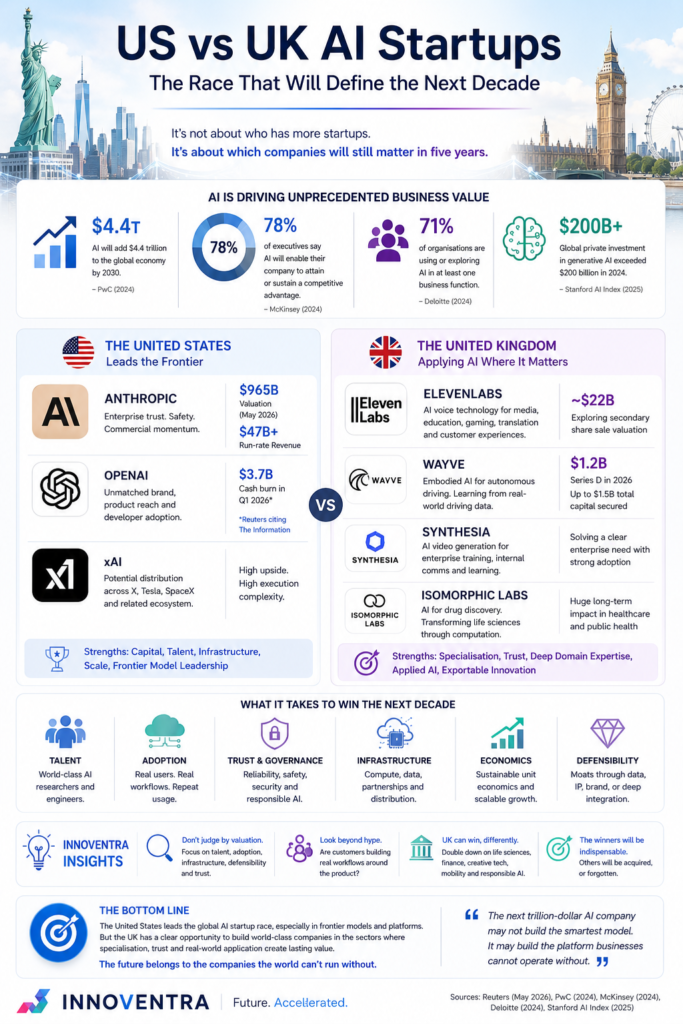
Is the United States or United Kingdom Winning the AI Race?
The United States leads decisively in capital, infrastructure and frontier-model development.
Stanford’s 2026 AI Index reported that the US attracted $285.9 billion in private AI investment during 2025 and produced 1,953 newly funded AI companies—more than ten times the number recorded by the next-closest country.
The United Kingdom cannot realistically match that scale.
Its more credible opportunity is specialisation.
UK companies are becoming influential in:
- voice AI through ElevenLabs;
- autonomous mobility through Wayve;
- drug discovery through Isomorphic Labs;
- enterprise video through Synthesia;
- financial crime and decision intelligence through Quantexa;
- advanced materials through CuspAI;
- applied organisational AI through Faculty.
The distinction is important:
The United States is building much of the global AI infrastructure and intelligence layer. Britain’s strongest companies are applying that intelligence to commercially valuable, scientifically difficult and highly regulated problems.
Which AI Companies Are Most Likely to Lead by 2030?
Based on present evidence, five companies occupy especially strong positions.
OpenAI
Most likely to remain the leading mass-market AI platform, provided it controls infrastructure costs and maintains organisational stability.
Anthropic
Best positioned to lead enterprise frontier AI, particularly coding, agents and knowledge work.
Databricks
Most likely to become the data and governance layer supporting AI applications across large businesses.
Google DeepMind
Best placed to translate frontier AI into scientific breakthroughs and deploy them across a global technology ecosystem.
Wayve or Isomorphic Labs
The leading UK candidates for transformational impact beyond conventional software—although both face longer development and commercialisation cycles.
What Investors and Business Leaders Should Learn
The central lesson is that valuation is not the same as value.
A durable AI business needs several reinforcing strengths:
- technology that solves a meaningful problem;
- customers willing to pay repeatedly;
- access to sufficient computing capacity;
- proprietary data or workflow integration;
- reliable governance and security;
- revenue growth that can eventually exceed infrastructure costs.
Companies that possess only one of those advantages may struggle as foundation models improve and AI features become easier to reproduce.
The likely winners will not necessarily be the businesses producing the most impressive demonstrations. They will be the organisations that become embedded in daily work, scientific research, transport, healthcare, financial systems and enterprise decision-making.
Final Verdict
OpenAI ranks as the strongest overall AI company in 2026 because of its unmatched combination of users, subscriptions, developers, revenue and enterprise adoption.
Anthropic is its closest independent challenger and may already hold the stronger position in some enterprise and software-development markets.
Databricks has one of the industry’s most defensible commercial foundations because it connects AI to the data and governance systems companies already use.
In the United Kingdom, ElevenLabs has the strongest demonstrated generative AI revenue momentum, while Wayve and Isomorphic Labs offer the greatest long-term strategic upside.
The AI race will not be won by a single company or measured by one benchmark.
It will be won across multiple layers: models, infrastructure, enterprise data, scientific research, voice, robotics, healthcare and industry-specific applications.
The companies that endure will be those that turn intelligence into something customers can trust, deploy and repeatedly pay for.