
Estimated Reading Time: 12 minutes
Executive Summary
The world’s youngest generations are growing up in the most digitally connected society in history. Smartphones, artificial intelligence, social media and online gaming have become integral to daily life, influencing how young people learn, communicate, consume information, develop skills and prepare for employment.
Today, billions of users interact daily with platforms such as YouTube, TikTok, Instagram, Snapchat, Discord, Roblox, Minecraft, Fortnite and many others. Behind every recommendation, personalised video and suggested friend lies sophisticated artificial intelligence analysing behaviour in real time.
Yet one important question remains largely unexplored:
Which countries spend the most time engaging with social media and gaming, and what does this mean for society, economies and governments?
The answer extends far beyond entertainment.
Digital engagement increasingly influences national productivity, innovation, education, entrepreneurship, democratic participation and even geopolitical competitiveness.
This article analyses recent international evidence alongside Innoventra’s research to explain what these global patterns reveal and why policymakers, businesses, educators and parents should pay close attention.
The Global Digital Generation
Insert your infographic here.
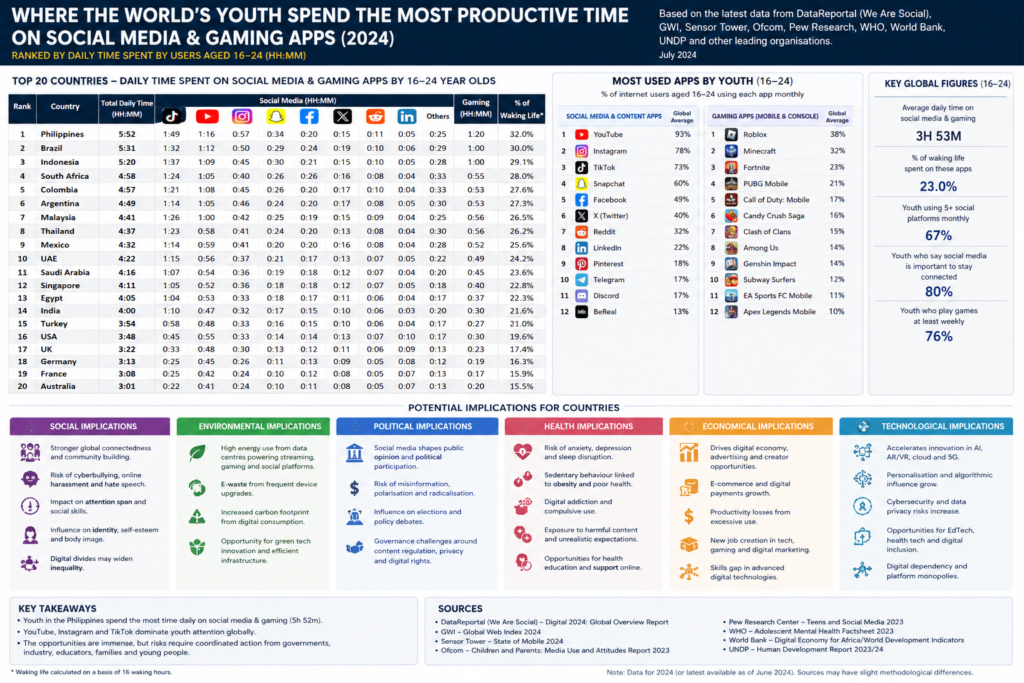
Figure 1. Global comparison of youth social media and gaming engagement, illustrating leading countries, dominant platforms and the broader societal implications.
A Digital Revolution Unlike Any Before
Every generation has been shaped by defining technologies.
The twentieth century was transformed by television.
The early internet connected the world.
Smartphones placed global knowledge in people’s pockets.Artificial intelligence is transforming education in profound ways. As we explored in our article “AI in Education: Transforming Learning for the Next Generation“, AI is reshaping how students learn, teachers teach and institutions prepare future workforces. Unlike previous technological revolutions, AI continuously learns from user behaviour.
Recommendation systems analyse viewing history, search activity, scrolling behaviour, interactions and interests to personalise content for each individual. We explored this in more detail The Future of Social Media in the Age of Artificial Intelligence. This explains why platforms have become increasingly engaging and why digital experiences differ significantly between users. Research from DataReportal shows that social media continues to expand globally, with approximately two-thirds of the world’s population now using social platforms and average daily use exceeding two hours. Recent reports also highlight AI as one of the defining forces shaping digital behaviour.¹
Which Countries Spend the Most Time Online?
The infographic highlights substantial variation between countries.
Some nations record significantly higher levels of engagement across social media and gaming platforms than others.
However, higher engagement should not automatically be interpreted as either positive or negative.
Instead, it reflects differences in:
- population demographics;
- internet access and affordability;
- digital infrastructure;
- cultural preferences;
- education systems;
- economic development;
- smartphone adoption; and
- platform availability.
Countries with younger populations, affordable mobile internet and widespread smartphone ownership generally report higher levels of digital engagement than ageing societies.
The critical question is therefore not simply how much time young people spend online, but how effectively that time contributes to learning, creativity, entrepreneurship and digital capability.
The Platforms Shaping Generation Z
Today’s digital ecosystem extends well beyond traditional social networking.
Among younger users, leading platforms include:
- YouTube
- TikTok
- Snapchat
- Discord
- X
- Roblox
- Minecraft
- Fortnite
- PUBG Mobile
- EA Sports FC
- Call of Duty
- League of Legends
These platforms increasingly serve multiple purposes.
They function simultaneously as entertainment platforms, learning environments, professional networks, marketplaces, gaming communities and AI-powered recommendation systems.
For many young people, digital platforms now represent the primary gateway to information.
Artificial Intelligence Is Quietly Driving Every Platform
Perhaps the most important development is invisible.
Artificial intelligence increasingly determines:
- what users watch;
- which posts appear first;
- which advertisements are displayed;
- which friends are recommended;
- which videos become viral;
- which products are purchased;
- and which creators gain visibility.
Every interaction improves the algorithm. The result is a highly personalised digital experience designed to maximise relevance and engagement. For businesses, this creates powerful marketing opportunities. For educators, it offers personalised learning. For governments, it raises questions about transparency, online safety and algorithmic accountability.
The Opportunities
Digital engagement has created remarkable opportunities.
Young people can now:
- access university lectures from leading institutions;
- learn programming and AI skills;
- launch businesses from home;
- build international communities;
- collaborate across borders;
- earn income through the creator economy;
- develop entrepreneurial skills; and
- access information that previous generations could only obtain through libraries or specialist training.
For developing countries in particular, digital technologies have lowered barriers to education and entrepreneurship. Developing AI capability is becoming essential for lifelong learning.
The Challenges
The same technologies also present important risks.
Researchers continue to investigate issues including:
- excessive screen time;
- cyberbullying;
- online misinformation;
- AI-generated content;
- deepfakes;
- sleep disruption;
- digital addiction;
- privacy concerns;
- online scams; and
- algorithmic amplification of harmful content.
The evidence suggests that the quality of digital engagement often matters more than the quantity. Purposeful learning, collaboration and creativity tend to be associated with more positive outcomes than passive consumption alone.²
Innoventra Insight: From Screen Time to Digital Value
One of the most common mistakes in public debate is treating all digital activity as identical. Innoventra proposes a different perspective.
The Innoventra Digital Value Framework
Digital engagement can be viewed across four broad categories:
Learn
Using digital platforms to acquire knowledge, develop AI skills, study, research and improve professional capability.
Create
Building software, producing videos, writing articles, designing products, developing games and launching businesses.
Connect
Collaborating with communities, networking professionally and maintaining meaningful relationships.
Consume
Watching entertainment, browsing content and gaming for leisure.
The most digitally successful societies will not necessarily be those that spend the most time online.
Instead, they will be those that help citizens spend a greater proportion of their digital lives learning, creating and collaborating.
Why This Matters
Artificial intelligence is transforming every aspect of modern society.
Understanding digital behaviour is therefore becoming increasingly important for:
- governments designing AI policy;
- businesses planning digital transformation;
- universities modernising education;
- employers preparing future workforces;
- parents supporting healthy digital habits; and
- technology companies developing responsible AI.
The countries that successfully convert digital engagement into innovation, productivity and lifelong learning are likely to gain significant long-term advantages.
Conclusion
Social media and gaming are no longer simply leisure activities.
They have become core components of the global digital economy and increasingly influence education, business, politics and artificial intelligence.
The infographic presented in this article illustrates an important global trend: young people are spending substantial amounts of time in digital environments. The challenge is not merely to measure this engagement but to understand how societies can channel it towards innovation, economic growth and responsible AI adoption.
For policymakers, educators and business leaders, the central question is no longer “How much time are young people spending online?”
Instead, it is:
“How can nations ensure that digital engagement develops skilled, resilient and innovative citizens ready to thrive in the age of artificial intelligence?”
The answer to that question may prove far more important than any ranking alone. Digital capability is increasingly important in employment. Our article Beyond Degrees: Why Human Capability Will Determine Success in the Age of Artificial Intelligence explores why human skills remain critical in an AI-driven economy.
References
- DataReportal. Digital 2025 Global Overview Report. https://datareportal.com/reports/digital-2025-global-overview-report
- Pew Research Center. Teens, Social Media and Mental Health (2025).
- World Health Organization. Adolescent Mental Health.
- UNICEF. The State of the World’s Children.
- OECD. Digital Economy Outlook.
- Ofcom. Children and Parents: Media Use and Attitudes Report.
- UNESCO. Guidance for Generative AI in Education and Research.