
Executive Summary
Artificial intelligence is frequently described as a race between nations. The evidence suggests something more complex. The G7 is not participating in a single AI race, but seven distinct competitions shaped by different economic structures, industrial capabilities, investment ecosystems, research strengths and national priorities.
The United States is competing through frontier innovation and commercial scale. The United Kingdom is seeking to transform world-class research into sustained economic productivity. France is positioning AI as an issue of strategic sovereignty, energy security and digital infrastructure. Germany is embedding AI within advanced manufacturing and industrial engineering. Canada is attempting to capture greater economic value from decades of internationally recognised AI research. Japan is integrating AI with robotics, demographic resilience and trusted governance, while Italy is pursuing digital transformation through its network of SMEs and specialised industrial clusters.
These differences matter because AI leadership is no longer determined solely by scientific discovery or the size of individual technology companies. Increasingly, it is determined by what Innoventra defines as an AI Capability Ecosystem: the ability to combine frontier research, compute infrastructure, investment, skilled talent, enterprise adoption, governance and commercial execution into a self-reinforcing system that generates long-term economic value.
Recent evidence illustrates why this broader perspective is essential. Stanford’s 2026 AI Index estimates that private AI investment in the United States reached $285.9 billion during 2025, exceeding twenty-three times the reported level of Chinese private investment, while American investors funded 1,953 new AI companies during the same year. These figures demonstrate an extraordinary concentration of capital and entrepreneurial activity. Yet investment alone does not explain sustained leadership. The more significant competitive advantage lies in the interaction between venture capital, hyperscale cloud infrastructure, world-leading universities, enterprise demand and rapid commercialisation, creating an innovation ecosystem that continually reinforces itself.
At the same time, the International Monetary Fund estimates that approximately 60% of jobs across advanced economies are exposed to artificial intelligence, with around half of those roles expected to benefit from higher productivity while the remainder could experience significant task substitution. AI has therefore moved beyond the technology sector. It is becoming a defining factor in labour markets, industrial competitiveness, public services, education, healthcare and national resilience. Countries that deploy AI effectively across these systems are likely to realise substantially greater economic gains than those that concentrate investment within a small number of frontier technology firms.
However, technological leadership alone is unlikely to determine the next phase of competition. OECD research highlights that AI adoption remains highly uneven, particularly between large enterprises and small and medium-sized businesses. Persistent barriers relating to digital skills, financing, organisational capability and access to AI infrastructure continue to limit diffusion across much of the economy. This finding has profound strategic implications. A country can produce globally recognised AI research and successful technology companies yet still underperform economically if adoption fails to spread across manufacturing, healthcare, financial services, public administration and SMEs.
History suggests that industrial revolutions are rarely won by those who invent breakthrough technologies alone. They are won by those who diffuse those technologies most effectively throughout the economy. The same principle is increasingly evident in artificial intelligence. Competitive advantage is shifting from creating better algorithms to building stronger capability ecosystems capable of translating innovation into productivity, resilience and sustained national prosperity.
Innoventra Executive Insight
The defining challenge of the AI economy is no longer attracting investment. It is converting investment into capability. Capital that remains concentrated within laboratories, pilot projects or a handful of technology companies generates limited national advantage. Capital that diffuses across businesses, supply chains, public services and skilled workforces transforms productivity, strengthens economic resilience and creates durable competitive advantage.
This report therefore examines a different question from most international AI rankings. Rather than asking which country has developed the most advanced AI models or announced the largest investment programme, it evaluates which G7 economies are building the strongest AI Capability Ecosystems and which are most likely to convert today’s investment into tomorrow’s productivity, industrial competitiveness and long-term prosperity.
The Innoventra AI Capability Ecosystem
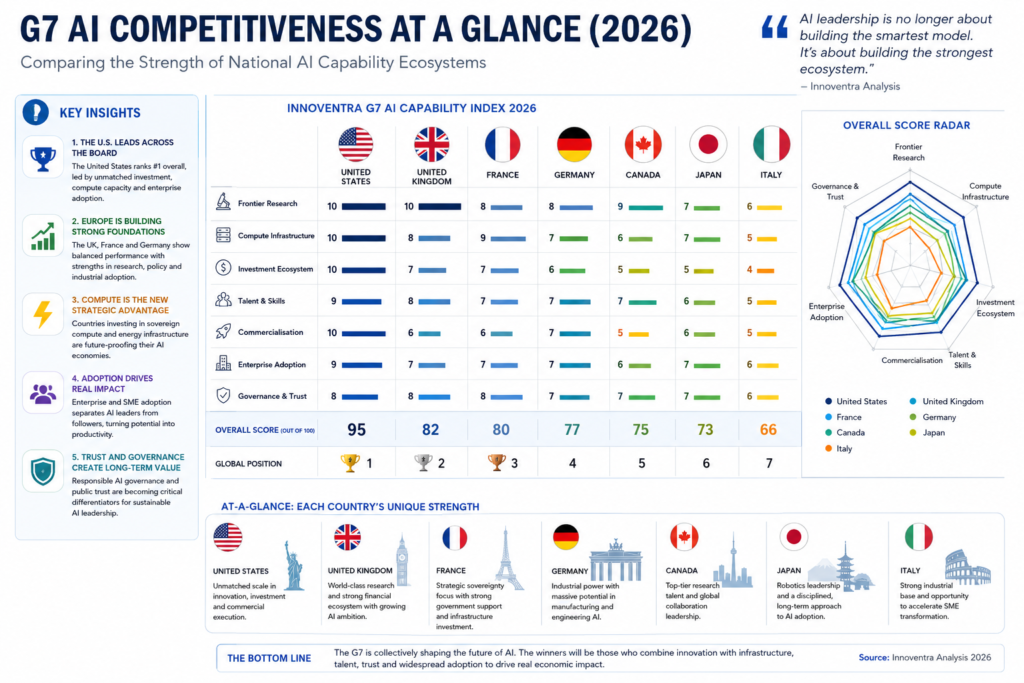
To assess G7 competitiveness, Innoventra uses seven dimensions of national AI capability:
| Capability | Why it matters |
|---|---|
| Frontier research | Generates new scientific and technical breakthroughs. |
| Compute infrastructure | Determines whether countries can train, test and deploy advanced AI systems. |
| Investment ecosystem | Enables firms to scale from research ideas into global companies. |
| Talent pipeline | Supplies researchers, engineers, managers and AI-literate workers. |
| Commercialisation | Converts innovation into competitive products and services. |
| Enterprise adoption | Determines whether AI improves productivity across the wider economy. |
| Governance and trust | Creates the conditions for responsible deployment without freezing innovation. |
This framework is important because AI competitiveness is systemic. A country may have excellent universities but insufficient venture capital. It may have strong industrial firms but weak software adoption. It may have ambitious regulation but inadequate compute. It may attract investment but fail to build domestic capability.
The UK illustrates this tension clearly. The government’s AI Opportunities Action Plan has moved from broad ambition into delivery, including five AI Growth Zones, Isambard-AI in Bristol, a commitment to expand UK compute capacity twentyfold by 2030 and up to £500 million through the Sovereign AI Unit to support UK AI companies. A later government dashboard also reported a 10x increase in UK AI compute capacity from 2024 to 2025, from 2 to 21 ExaFLOPs, with a 2030 target of 420 ExaFLOPs.
That is significant progress. But the harder question is whether compute expansion leads to commercial scale, public-sector transformation and productivity growth across regions and SMEs. Infrastructure is necessary, but it is not sufficient.
The original draft correctly identified that the G7 is not moving as a single bloc and that countries are following different strategic models. The stronger argument is that these models should be judged not by policy language, but by capability conversion: how effectively each country turns research, capital and infrastructure into economic value.
Executive Insight
AI leadership is not a technology contest alone. It is a conversion contest.
The winners will be those that convert scientific excellence into companies, companies into productivity, productivity into prosperity, and prosperity into strategic resilience.
Why the G7 AI race is entering a decisive phase
The first phase of national AI competition was dominated by research output, foundation models and public announcements. The next phase will be more demanding. It will depend on four harder questions.
First, who controls enough compute and energy to support advanced AI development? Data centres, semiconductors and electricity are becoming strategic assets. This is why France, the UK and Canada are increasingly treating compute as a sovereign capability, not just a technology-sector input.
Second, who can diffuse AI beyond elite firms? The OECD’s evidence on SMEs is crucial because most employment and business activity across advanced economies sits outside the frontier technology sector. If SMEs cannot adopt AI, national productivity gains will remain narrow.
Third, who can redesign work rather than merely buy tools? AI adoption does not automatically create productivity. Organisations need workflow redesign, data governance, leadership capability, employee trust and measurable business outcomes.
Fourth, who can govern AI without slowing innovation? The G7 faces a difficult balance: protecting citizens, workers and institutions while remaining attractive to investors, researchers and entrepreneurs.
These questions explain why the United States still leads, but also why the race is not over. America’s advantage is broad and deep: capital, frontier labs, hyperscale cloud platforms, universities, enterprise demand and venture-backed commercialisation. But even the US faces constraints around energy, regulation, market concentration and the diffusion of AI productivity beyond large technology firms.
For the UK, France, Germany, Canada, Japan and Italy, the opportunity is different. They do not need to copy Silicon Valley. They need to build defensible AI models based on their own strengths: finance and professional services in the UK, sovereign infrastructure in France, industrial manufacturing in Germany, research networks in Canada, robotics and trusted systems in Japan, and SME-led industrial renewal in Italy.
Innoventra Insight
The G7 AI race is not about becoming another United States.
It is about whether each country can build an AI economy that fits its own industrial structure, institutional strengths and strategic needs.
What senior leaders should take from this
For executives, investors, universities and policymakers, the most important lesson is that AI competitiveness should not be measured by headlines alone. Large funding announcements matter. National strategies matter. Frontier models matter. But they are only inputs.
The stronger measure is whether countries can create a full capability chain:
Research → Compute → Capital → Talent → Commercialisation → Adoption → Productivity
Any weak link reduces national competitiveness.
This is why the next stage of the report compares each G7 country against the Innoventra AI Capability Ecosystem. The aim is not to crown a symbolic winner, but to identify which countries are genuinely building durable AI advantage and where the biggest execution gaps remain.
By 2030, the most successful AI economies are unlikely to be those that simply produced the most impressive models in 2026. They will be those that embedded AI into business processes, public services, industrial systems, education, healthcare and national infrastructure.
Technology creates the opportunity.
Capability determines who captures it.
Which G7 Countries Are Building the Strongest AI Capability Ecosystems?
Executive Insight
“Artificial intelligence has entered a new phase of competition. The question is no longer which country can develop the most capable AI model, but which can build the strongest ecosystem to sustain innovation, commercialise research and diffuse AI across the wider economy.”
Innoventra Analysis
While public attention often focuses on breakthrough AI models, the evidence increasingly suggests that sustained national competitiveness depends on a much broader set of capabilities. Frontier models may capture headlines, but they represent only one component of a successful AI economy. Countries that consistently outperform are those that combine scientific excellence with abundant compute, patient investment, entrepreneurial ecosystems, skilled workforces and widespread enterprise adoption.
Recent evidence supports this shift. Stanford’s 2026 AI Index found that while the United States continued to dominate private AI investment and new AI company formation, the most significant global trend was the acceleration of enterprise AI deployment rather than model development alone. Organisations are increasingly measuring success through productivity improvements, workflow redesign and operational efficiency instead of simply experimenting with AI technologies.
Strategic Insight
“The countries most likely to lead the AI economy will not necessarily invent every breakthrough. They will be those that convert innovation into productivity faster than competitors.”
The Innoventra AI Capability Assessment
Rather than ranking countries on a single indicator such as investment or research output, this report assesses competitiveness across seven interconnected dimensions that together determine long-term AI capability.
| Capability | Strategic importance |
|---|---|
| Frontier research | Creates new scientific discoveries and foundational technologies. |
| Compute infrastructure | Enables organisations to train and deploy advanced AI systems at scale. |
| Investment ecosystem | Supports high-growth firms from early research through commercial expansion. |
| Talent | Provides researchers, engineers, business leaders and AI-literate workers. |
| Commercialisation | Converts innovation into globally competitive businesses. |
| Enterprise adoption | Determines whether AI delivers productivity across the wider economy. |
| Governance | Creates trust, regulatory certainty and responsible deployment. |
No G7 country leads every category. Instead, each has developed a distinctive competitive model shaped by its industrial structure, policy priorities and economic strengths.
United States: The World’s Most Complete AI Ecosystem
The United States continues to possess the broadest AI capability ecosystem within the G7. Its leadership extends far beyond frontier model development. Stanford’s AI Index reported approximately US$285.9 billion in private AI investment during 2025 alongside 1,953 newly funded AI companies, reinforcing America’s unmatched ability to translate research into commercial scale. The ecosystem is further strengthened by world-leading universities, hyperscale cloud providers, semiconductor innovation, defence procurement and mature venture capital markets.
The strategic advantage lies not in any single company but in the interaction between these capabilities. Research attracts investment; investment accelerates commercialisation; commercial success attracts global talent; and enterprise adoption generates the productivity gains that fund the next wave of innovation. This self-reinforcing cycle remains difficult for competitors to replicate.
Why this matters
For investors and multinational businesses, the United States remains the global benchmark for frontier AI partnerships, large-scale deployment and venture-backed innovation. However, rising energy demand, infrastructure costs and competition for specialist talent suggest that maintaining leadership will increasingly depend on expanding compute capacity and ensuring AI productivity reaches sectors beyond technology.
Executive Insight
“America’s greatest competitive advantage is not its largest AI companies. It is its ability to continuously create the next generation of AI companies.”
United Kingdom: From Research Excellence to Economic Impact
The United Kingdom occupies a distinctive position within the G7. It consistently ranks among the world’s leading producers of AI research and benefits from internationally recognised universities, sophisticated financial markets and a credible regulatory environment. Government initiatives such as AI Growth Zones, sovereign compute investment and expansion of the national AI Research Resource demonstrate a stronger emphasis on implementation than in previous strategies.
Yet Britain’s challenge has rarely been scientific capability. The greater challenge has been converting research leadership into sustained commercial scale. While UK AI companies continue to attract significant international investment, comparatively fewer grow into globally dominant technology firms than in the United States. Closing this commercialisation gap will be central to Britain’s long-term competitiveness.
The wider opportunity extends beyond technology firms. If AI adoption accelerates across financial services, healthcare, manufacturing, education and professional services, Britain could generate productivity gains that significantly exceed those achieved through research investment alone.
Why this matters
Britain’s long-term success will be measured less by the number of research papers published and more by the number of organisations successfully embedding AI into everyday decision-making, customer service, operations and product development.
France: Building Strategic Sovereignty
France has adopted one of Europe’s most distinctive AI strategies by treating artificial intelligence as strategic national infrastructure. Alongside support for AI start-ups and research, France has prioritised sovereign compute, energy-backed data centre investment and European technological resilience. This reflects an understanding that future competitiveness depends increasingly upon controlling critical digital infrastructure rather than relying entirely on external providers.
France therefore illustrates an important shift occurring across advanced economies. AI policy is becoming inseparable from industrial policy, energy policy and national resilience. Investment decisions are increasingly evaluated not only for economic return but also for strategic autonomy.
Strategic Insight
“The next decade of AI competition may be influenced as much by electricity, semiconductors and data centres as by algorithms themselves.”
Comparing National Strategies
Although public debate often frames AI as a competition between individual companies, national strategies reveal a more nuanced picture.
| Country | Primary competitive advantage |
|---|---|
| United States | Frontier innovation and commercial scale |
| United Kingdom | Research excellence and institutional credibility |
| France | Sovereign infrastructure and strategic coordination |
| Germany | Industrial manufacturing and engineering capability |
| Canada | Research networks and academic collaboration |
| Japan | Robotics, resilience and trusted deployment |
| Italy | SME transformation and industrial renewal |
Each model reflects different economic structures rather than different levels of ambition. Success will therefore depend not on copying another country’s approach but on strengthening existing national advantages while addressing structural weaknesses.
Boardroom Insight
“Countries do not become AI leaders by imitating Silicon Valley. They become leaders by applying AI to the industries where they already possess global competitive advantage.”
The Emerging Pattern
Despite significant differences between G7 economies, four common themes are becoming increasingly clear.
First, compute infrastructure has become a strategic national asset rather than simply an operational requirement.
Second, enterprise adoption is replacing experimentation as the principal measure of AI success.
Third, commercialisation has become the critical bridge between scientific excellence and economic productivity.
Finally, countries that integrate AI strategy with education, industrial policy, infrastructure and workforce development are likely to achieve more durable competitive advantage than those pursuing isolated technology initiatives.
These findings reinforce a central conclusion of this report: AI competitiveness is no longer determined by isolated breakthroughs. It is determined by the strength of the capability ecosystem that surrounds them.
Executive Insight
“The first decade of artificial intelligence rewarded countries capable of inventing breakthrough technologies. The second decade will reward those capable of embedding those technologies across entire economies.”
Innoventra Analysis
Throughout this report, one conclusion has consistently emerged: artificial intelligence is no longer primarily a technology competition. It is increasingly a competition in national execution. Frontier models, venture capital and scientific research remain essential, but they are becoming inputs rather than outcomes. The countries most likely to lead the next decade will be those that successfully integrate AI into education, healthcare, manufacturing, financial services, government and small businesses while maintaining public trust and economic resilience.
This shift has important implications. Historically, technological revolutions have generated sustained economic advantage only when innovation became widely adopted across society. Electricity, personal computing and the internet transformed economies not because they existed, but because millions of organisations redesigned the way they operated. Artificial intelligence is following the same trajectory.
Leadership Insight
“Competitive advantage increasingly depends not on access to AI, but on the ability to redesign organisations around AI.”
Four Strategic Trends Defining the Next Phase of AI Competition
1. Compute is becoming strategic national infrastructure
One of the clearest findings across the G7 is that compute capacity has become a strategic asset. Governments are increasingly investing in advanced computing infrastructure, data centres and energy systems because these now underpin scientific research, enterprise AI deployment and national resilience.
This represents a fundamental change in industrial policy. Compute is no longer viewed simply as an IT resource; it is becoming as strategically significant as transport networks, telecommunications and energy infrastructure. Countries unable to provide sufficient computing capacity may increasingly depend upon external providers, reducing strategic flexibility and potentially limiting domestic innovation.
Executive Insight
“In the AI economy, compute is becoming what electricity was to the industrial economy: an essential enabling infrastructure.”
2. Enterprise adoption is replacing experimentation
Over the past two years, many organisations have moved beyond proof-of-concept projects. AI is increasingly embedded within software development, customer service, knowledge management, fraud detection, product design and operational decision-making.
The organisations achieving the greatest returns are not necessarily deploying the most advanced models. Instead, they are redesigning workflows, improving data quality, investing in employee capability and measuring productivity outcomes. This distinction is important for governments as well as businesses. National competitiveness will increasingly depend on how rapidly AI diffuses across SMEs, public services and traditional industries rather than remaining concentrated among frontier technology firms.
3. Talent remains the most valuable long-term investment
Despite rapid advances in AI capability, evidence consistently shows that skilled people remain central to successful adoption. Organisations require leaders who understand strategic implementation, engineers capable of integrating AI into existing systems, domain specialists who can redesign business processes and educators able to prepare future workforces.
For universities, this represents both a challenge and an opportunity. Future competitiveness will depend not only on producing excellent researchers but also on developing graduates who combine technical literacy with commercial awareness, ethical judgement and interdisciplinary problem-solving.
University Insight
“The universities that shape the next decade of AI will not simply publish influential research. They will produce graduates capable of translating research into economic value.”
4. Productivity not technology will determine long-term success
Perhaps the most important finding from this analysis is that AI competitiveness should increasingly be measured through productivity rather than technology alone.
Countries investing billions in AI infrastructure will ultimately be judged by whether those investments improve healthcare outcomes, increase manufacturing efficiency, strengthen public services, accelerate scientific discovery and support sustainable economic growth. AI capability therefore becomes meaningful only when it delivers measurable value across the wider economy.
This transition from technological capability to economic capability may prove to be the defining feature of the next phase of global AI competition.
Strategic Implications
For governments
Governments should increasingly view AI as a long-term national capability programme rather than a standalone technology initiative. Investment decisions should connect compute infrastructure, skills, research, industrial strategy, energy planning and public-sector transformation. Policies that strengthen only one element of the ecosystem are unlikely to generate lasting competitive advantage.
For business leaders
The evidence suggests that competitive advantage will increasingly depend on organisational transformation rather than AI procurement. Purchasing AI tools is relatively straightforward; redesigning processes, developing employee capability and establishing effective governance are considerably more difficult. Organisations that approach AI as a strategic business transformation programme are likely to outperform those treating it as another software investment.
Boardroom Insight
“Most organisations can now access powerful AI models. Far fewer have redesigned their operating models to create sustained competitive advantage.”
For investors
Private capital is likely to remain concentrated around frontier AI companies, but long-term opportunities may extend well beyond model developers. Compute infrastructure, semiconductors, cybersecurity, industrial software, robotics, digital engineering, energy systems and enterprise AI platforms are all positioned to benefit from broader adoption. As markets mature, value creation may increasingly shift from model development towards deployment and integration.
For universities
Universities occupy a critical position within national AI ecosystems. Research excellence remains essential, but institutions also play a central role in developing talent, supporting commercialisation and partnering with industry. Strengthening entrepreneurship, interdisciplinary collaboration and applied innovation may become increasingly important alongside traditional academic outputs.
Looking Towards 2030
Forecasting technological change is inherently uncertain. However, several trends appear increasingly plausible based on current evidence.
The United States is likely to remain the global leader in frontier AI, supported by unparalleled private investment, mature venture capital markets and advanced computing infrastructure. The key question is not whether the United States will continue to innovate, but whether the benefits of innovation diffuse broadly across the wider economy.
The United Kingdom’s future competitiveness will depend on its ability to translate research excellence into globally competitive businesses while accelerating adoption across SMEs, manufacturing, healthcare and public services.
France’s emphasis on sovereign infrastructure suggests that strategic autonomy will become an increasingly important dimension of AI competitiveness within Europe.
Germany’s opportunity lies in applying AI across advanced manufacturing, engineering and industrial automation, where productivity gains could significantly influence national economic performance.
Canada, Japan and Italy each possess distinctive strengths that could support internationally competitive AI ecosystems if combined with stronger commercialisation, enterprise adoption and workforce development.
Strategic Insight
“The countries most likely to lead by 2030 will not necessarily be those developing the largest models today. They will be those embedding AI most effectively across their economies.”
Conclusion
Artificial intelligence is entering a decisive stage. The conversation is shifting away from isolated technological breakthroughs towards national capability, industrial transformation and economic resilience.
The analysis presented throughout this report indicates that no single metric adequately explains AI competitiveness. Investment, research, talent, compute, governance and commercialisation all matter—but only when they operate as an integrated system.
The United States currently possesses the broadest AI capability ecosystem, while the United Kingdom, France, Germany, Canada, Japan and Italy are each pursuing distinctive strategic pathways shaped by their economic strengths and policy priorities. Their long-term success will depend less on copying one another and more on strengthening the capabilities that best align with their own industrial structures.
For leaders across government, business and academia, the central lesson is clear. Artificial intelligence should not be viewed as a standalone technology project. It is a long-term capability agenda requiring sustained investment in people, infrastructure, institutions and organisational transformation.
History demonstrates that technological revolutions create opportunities for many nations, but enduring prosperity is captured by those capable of converting innovation into widespread productivity.
The same principle is likely to define the AI economy.
Technology creates possibility.
Capability creates lasting advantage.