
Artificial intelligence has entered a new phase of global competition. During the past three years, governments have announced record AI investment programmes, businesses have accelerated enterprise adoption, and technology companies have committed hundreds of billions of dollars to advanced computing infrastructure. Yet one of the most important strategic questions remains largely unanswered: why do some countries consistently convert AI investment into national economic advantage while others struggle to achieve comparable returns?
The evidence suggests that AI competitiveness is no longer determined solely by research excellence, the size of public investment or the number of frontier AI models. Increasingly, success depends on whether countries can transform scientific breakthroughs into globally competitive businesses, widespread enterprise adoption and sustained productivity growth.
Recent history provides compelling evidence. The United States has built an ecosystem that has enabled companies such as OpenAI, Anthropic, NVIDIA and Scale AI to grow into businesses valued in the tens or hundreds of billions of dollars, supported by deep venture capital markets, world-leading universities, hyperscale cloud infrastructure and sophisticated enterprise customers. The United Kingdom has demonstrated a different model, producing globally recognised innovators including DeepMind, Wayve, Synthesia and ElevenLabs, showing that world-class research can generate breakthrough companies. However, Britain’s continuing challenge is not invention it is scaling more of those companies into globally dominant enterprises while retaining a greater share of their long-term economic value.
The contrast highlights a broader lesson. Countries that consistently outperform in AI rarely succeed because they invest more in a single area. They succeed because they build AI Productivity Ecosystems in which research institutions, entrepreneurs, investors, compute infrastructure, skilled talent, established industries and effective governance reinforce one another. These ecosystems reduce the time between scientific discovery and commercial deployment, enabling ideas to become products, products to become industries, and industries to become long-term sources of national productivity and economic growth.
This report argues that the next phase of AI competition will not be won by the countries developing the largest AI models alone. It will be won by those that most effectively convert AI investment into measurable productivity, globally competitive businesses, industrial transformation and long-term national advantage. Understanding why some countries achieve that transition more successfully than others may prove to be one of the defining strategic questions of the AI economy.
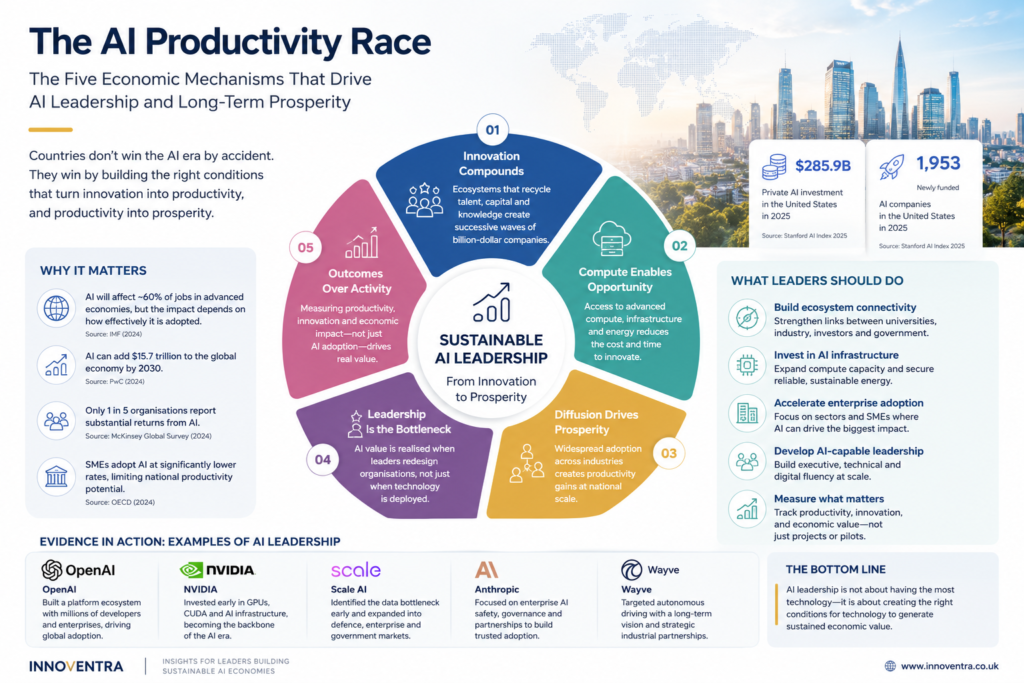
Why Some AI Economies Pull Further Ahead
Every country can buy access to AI tools. Far fewer can build the conditions that repeatedly turn AI into billion-dollar companies, higher productivity and national advantage. The emerging divide is no longer about access to AI; it is about the quality of the ecosystem surrounding it.
1. They build ecosystems that compound success
The strongest AI economies do not rely on one national champion. They create self-reinforcing ecosystems where universities, venture capital, cloud infrastructure, enterprise customers and experienced founders continuously feed one another. Stanford’s 2026 AI Index shows the scale of this advantage in the United States: private AI investment reached $285.9 billion in 2025, while the US produced 1,953 newly funded AI companies, more than ten times the next closest country.
This matters because AI leadership compounds. Successful firms create experienced employees, investors, founders and customers who then build the next generation of companies. That is why ecosystems outperform isolated champions.
Executive Insight: The strongest AI economies do not just create unicorns. They create the conditions that repeatedly produce them.
2. They treat compute and energy as economic infrastructure
AI competitiveness is increasingly shaped by infrastructure: semiconductors, cloud capacity, data centres and electricity. Stanford reports that global corporate AI investment more than doubled in 2025, with private investment growing 127.5% and generative AI funding rising by more than 200%. Much of this capital is flowing into compute-heavy systems because advanced AI cannot scale without processing power and energy resilience.
The strategic implication is clear: compute is becoming the railway, electricity grid and port system of the AI economy. Countries that underinvest in this infrastructure may still produce excellent research, but they will struggle to convert it into industrial capability at scale.
3. They diffuse AI beyond elite firms
The biggest AI productivity gains will not come from a handful of frontier labs. They will come when thousands of firms embed AI into operations, logistics, customer service, manufacturing, finance, healthcare and public administration.
OECD research shows why this is difficult. SME AI adoption remains lower than adoption of other digital technologies and lower than adoption among larger firms. In an OECD survey across four G7 countries, 50% of SMEs said employees lacked the skills to use generative AI. The OECD also highlights barriers around skills, finance, connectivity and access to AI-enabling inputs.
This is the hidden productivity gap. Countries may lead in AI research yet still underperform economically if AI remains concentrated in large firms and technology clusters.
Executive Insight: The next AI race is not only about invention. It is about diffusion.
4. They redesign organisations, not just workflows
Most organisations are now using AI in some form, but far fewer are capturing enterprise-wide value. McKinsey’s 2025 Global Survey describes a landscape where AI use is widening, yet the move from pilots to scaled impact remains difficult for most organisations. Its research identifies six management practices associated with AI value: strategy, talent, operating model, technology, data, and adoption at scale.
That finding matters for national competitiveness. Countries do not gain lasting advantage simply because employees use AI tools. They gain advantage when businesses and public institutions redesign operating models around AI.
Innoventra Insight: AI creates value when organisations change how they operate, not merely when workers gain access to new tools.
5. They measure productivity, not activity
A country can announce investment, launch pilots and publish strategies without creating measurable economic value. The stronger test is whether AI improves productivity, innovation, service quality and industrial competitiveness.
The IMF estimates that around 60% of jobs in advanced economies are exposed to AI, with roughly half likely to benefit from AI integration and the other half facing potential task substitution. This means the productivity race will be shaped not only by technology, but by how countries manage skills, job redesign, regulation and institutional adaptation.
The first AI race rewarded experimentation. The second rewarded adoption. The third will reward measurable productivity.
The Real Success Factors
The countries pulling ahead are not simply those spending the most. They are those that combine seven capabilities into one system:
| Success factor | Why it matters |
|---|---|
| Research strength | Creates scientific breakthroughs. |
| Venture capital | Converts ideas into scalable companies. |
| Compute and energy | Enables experimentation and deployment at scale. |
| Enterprise adoption | Turns AI into productivity across the economy. |
| SME diffusion | Prevents AI gains from staying concentrated in large firms. |
| Leadership capability | Redesigns organisations around AI rather than adding tools. |
| Trusted governance | Builds confidence while enabling innovation. |
Artificial intelligence is rapidly becoming a technology whose economic value depends less on invention alone and more on integration. The countries defining the next decade will not necessarily build the smartest algorithms. They will build the strongest systems for converting algorithms into productivity, innovation and long-term national advantage.
Mechanism One
Mechanism 1: Innovation Compounds Through Ecosystems, Not Individual Companies
Perhaps the greatest misconception surrounding AI competitiveness is that it depends upon creating a single breakthrough company.
The evidence suggests something fundamentally different.
The world’s strongest AI economies build ecosystems where each successful company increases the probability of producing the next.
Silicon Valley demonstrates this process exceptionally well. Researchers move between universities, start-ups, hyperscale cloud providers and venture capital firms, carrying technical knowledge, commercial experience and professional networks with them. Former employees of Google helped establish companies including Anthropic, Character.AI and Adept. Early OpenAI researchers later founded Safe Superintelligence (SSI), Thinking Machines Lab and other frontier ventures. Rather than competing as isolated organisations, these firms form part of a continuously evolving innovation network.
The same pattern can be observed in investment. Successful exits generate experienced founders who become angel investors, venture capital partners or repeat entrepreneurs. Knowledge therefore compounds in much the same way as financial capital. Each generation of successful companies strengthens the ecosystem that produces the next generation.
NVIDIA illustrates the long-term value of ecosystem thinking. Originally known primarily for graphics processors serving the gaming industry, the company invested for more than a decade in GPU computing, CUDA software and developer ecosystems before generative AI became mainstream. That sustained investment positioned NVIDIA as the critical infrastructure provider for the AI economy rather than simply another semiconductor manufacturer. Today its market capitalisation is measured in trillions of dollars, demonstrating how ecosystem strategy can create extraordinary long-term value.
Scale AI provides a different lesson. Founded in 2016 to solve the growing shortage of high-quality training data, the company recognised an emerging bottleneck within machine learning. Rather than remaining a specialist data-labelling business, it expanded into enterprise AI, defence technology and government partnerships, becoming one of the world’s most valuable privately held AI companies. Its success illustrates that competitive advantage often comes from identifying the constraints limiting AI adoption rather than competing directly to build foundation models.
These examples reveal a broader economic principle. Successful AI economies rarely depend upon isolated technological breakthroughs. They create environments where knowledge, capital, talent and commercial demand continuously reinforce one another, allowing innovation to compound over time.
Executive Insight
The world’s strongest AI economies do not compete by producing one billion-dollar company.
They compete by building ecosystems capable of producing successive generations of billion-dollar companies.
Why this mechanism matters
For governments, the implication is clear. Policies designed solely to increase research funding or attract one flagship AI company are unlikely to produce lasting competitive advantage. The stronger strategy is to strengthen the links between universities, investors, cloud providers, established industries and entrepreneurs so that success becomes cumulative rather than exceptional.
For business leaders, the lesson is equally important. Sustainable competitive advantage increasingly depends upon participating in innovation ecosystems rather than relying exclusively on internal R&D. Organisations that collaborate with universities, start-ups, venture investors and strategic partners are often better positioned to identify emerging technologies and commercial opportunities before they become mainstream.
Mechanism 2: Compute Has Become the New Economic Infrastructure
For much of the twentieth century, economic competitiveness depended upon access to railways, ports, electricity and telecommunications. These infrastructures reduced the cost of moving goods, people and information, enabling businesses to innovate faster than their competitors.
Artificial intelligence is creating a similar structural shift.
Today, the critical infrastructure is no longer limited to transport or communications. It increasingly consists of advanced semiconductors, hyperscale cloud platforms, high-performance computing (HPC), secure data ecosystems and abundant, reliable electricity. Together, these assets determine how quickly countries can develop, train and deploy AI systems at scale.
This explains why AI infrastructure investment has accelerated at an unprecedented pace. Microsoft announced plans to invest approximately US$80 billion in AI-enabled data centres during fiscal 2025, while Amazon, Google and Meta have collectively committed well over US$250 billion in AI infrastructure and cloud expansion. These investments are not simply increasing computing capacity; they are creating the digital foundations upon which future industries will operate.
The strategic implications extend far beyond technology companies.
Every AI model trained, every autonomous system deployed and every enterprise AI application depends upon enormous computational resources. Training a frontier foundation model can require tens of thousands of advanced GPUs operating continuously for weeks or months. Inferencing—the process of running those models millions of times every day creates a second wave of demand that is expected to place sustained pressure on global data-centre capacity and electricity grids throughout the coming decade.
Consequently, compute is becoming an economic multiplier rather than a technical asset. Countries with abundant AI infrastructure reduce the cost of experimentation, accelerate innovation cycles and enable businesses of all sizes to access capabilities that would otherwise remain prohibitively expensive.
The United States illustrates this advantage particularly well. Rather than viewing cloud infrastructure as a supporting technology, hyperscale providers have transformed it into a strategic platform upon which thousands of AI start-ups can build products without constructing their own computing environments. This dramatically lowers barriers to entry and allows entrepreneurs to concentrate on solving commercial problems instead of building infrastructure from scratch.
France has recognised a similar opportunity from a different perspective. Its recent strategy has emphasised sovereign computing capability and energy-backed data-centre expansion, reflecting the growing recognition that AI competitiveness increasingly depends upon infrastructure resilience as much as scientific excellence. Likewise, the United Kingdom’s AI Opportunities Action Plan places significant emphasis on expanding national compute capacity and establishing AI Growth Zones to improve access to advanced computing resources.
These examples illustrate an important shift in policy thinking.
Countries are no longer competing only to develop better algorithms.
They are competing to build the infrastructure that allows thousands of organisations to innovate simultaneously.
Executive Insight
During previous industrial revolutions, electricity enabled factories.
During the AI revolution, compute enables innovation.
Countries that democratise access to advanced computing will generally create stronger innovation ecosystems than those where compute remains scarce or prohibitively expensive.
Why Compute Alone Does Not Create Competitive Advantage
Despite its growing importance, compute should not be confused with competitiveness itself.
History demonstrates that infrastructure creates opportunity rather than guaranteed success.
Highways do not automatically generate prosperous businesses.
Airports do not automatically create successful exporters.
Likewise, AI infrastructure creates potential, but its economic value depends upon how effectively organisations exploit it.
This distinction explains why some countries possessing sophisticated digital infrastructure continue to experience relatively modest productivity gains.
Infrastructure must be accompanied by complementary investments in leadership capability, digital skills, high-quality data, entrepreneurial finance and organisational transformation.
Economists have long referred to these as complementary assets the organisational capabilities required to unlock the value of general-purpose technologies. Artificial intelligence appears to reinforce this principle rather than overturn it.
Mechanism 3: Diffusion, Not Invention, Determines Long-Term Prosperity
Perhaps the most persistent misconception surrounding AI competitiveness is that technological leadership belongs to the countries developing the largest language models.
History suggests otherwise.
Economic history repeatedly demonstrates that general-purpose technologies create their greatest value through diffusion, not invention.
Electricity transformed economies only after factories redesigned production systems around electric motors. The internet reshaped global commerce only after businesses fundamentally reinvented supply chains, customer engagement and operating models.
Artificial intelligence is following the same trajectory.
The challenge facing governments is therefore no longer ensuring that frontier laboratories continue to innovate.
It is ensuring that AI reaches manufacturers, hospitals, banks, logistics providers, universities, retailers, public services and, critically, millions of small and medium-sized enterprises.
Research increasingly suggests this remains one of the largest barriers to national competitiveness.
Across OECD economies, SMEs continue to adopt AI at substantially lower rates than larger organisations. Surveys consistently identify shortages of digital skills, access to finance, organisational capability and confidence in AI deployment as major constraints. This matters because SMEs account for the overwhelming majority of businesses and employment in most advanced economies. If AI remains concentrated within large technology firms, national productivity gains are likely to remain similarly concentrated.
The economic consequences are profound.
When only frontier companies adopt AI, productivity improves at the frontier while the rest of the economy falls further behind.
When AI diffuses across supply chains, healthcare systems, financial services, manufacturing, education and public administration, productivity improvements become cumulative and reinforce national competitiveness.
The countries most likely to lead the next decade therefore face a different challenge from the first generation of AI leaders.
The objective is no longer simply producing the world’s most capable AI models.
It is ensuring that thousands of organisations use those models to redesign products, services, workflows and decision-making.
Innoventra Executive Insight
The defining question of the next AI decade is no longer:
“Who builds the smartest AI?”
It is:
“Who enables the greatest number of organisations to create measurable economic value from AI?”
Mechanism 4: Leadership Has Become the Largest Constraint on AI Productivity
For much of the past decade, AI policy focused on algorithms, researchers and engineers. Today, the evidence increasingly points towards a different bottleneck.
Leadership.
The greatest challenge facing most organisations is no longer obtaining access to artificial intelligence. Foundation models have become increasingly accessible through cloud platforms and enterprise software providers. Instead, the limiting factor is whether leaders possess the capability to redesign organisations around AI rather than simply deploying another technology tool.
This distinction helps explain one of the biggest puzzles emerging from international AI research. Despite record investment and widespread deployment, productivity gains remain highly uneven across organisations and countries.
Recent enterprise research provides important clues. McKinsey’s latest global AI survey found that while AI adoption has accelerated significantly, only a relatively small proportion of organisations have fundamentally redesigned operating models to capture enterprise-wide value. Organisations achieving the strongest returns consistently combine AI with leadership commitment, governance, workforce capability, high-quality data and organisational redesign rather than relying on technology deployment alone.
Microsoft’s 2025 Work Trend Index reaches a similar conclusion. Drawing upon research involving 31,000 employees across 31 countries alongside trillions of Microsoft 365 productivity signals, the report concludes that organisations are entering what Microsoft describes as the era of the “Frontier Firm.” Rather than simply automating isolated tasks, leading organisations are redesigning decision-making, creating AI-enabled teams and integrating intelligent agents into everyday operations. Importantly, 82% of business leaders expected to use digital labour to expand workforce capacity within the following 12 to 18 months, illustrating a shift from experimentation towards organisational transformation.
The implication extends well beyond individual businesses.
Countries capable of producing AI-literate executives, public-sector leaders and policymakers may gain greater economic advantage than those producing larger numbers of technical specialists alone.
History supports this conclusion.
The organisations that benefited most from electricity did not simply purchase electric motors.
They redesigned factories.
The companies that created the greatest value from the internet did not simply launch websites.
They reinvented supply chains, customer relationships and business models.
Artificial intelligence follows exactly the same economic principle.
Technology creates opportunity.
Leadership determines whether opportunity becomes productivity.
The New Competitive Advantage: Organisational Intelligence
Leading AI companies increasingly compete through organisational capability rather than model capability alone.
OpenAI’s success extends beyond developing advanced foundation models. It has built strategic partnerships with Microsoft, enterprise customers, software developers and governments, creating an ecosystem that continuously expands commercial applications.
Anthropic has pursued a different strategy. Rather than competing primarily on consumer adoption, it positioned itself around enterprise AI, constitutional AI research and partnerships with organisations demanding higher levels of safety and governance.
NVIDIA provides perhaps the strongest illustration of organisational foresight. Nearly fifteen years before generative AI entered mainstream discussion, NVIDIA invested heavily in CUDA, developer tools and AI computing infrastructure. Rather than responding to demand, it anticipated how the market would evolve.
The lesson for governments is clear.
Countries should not simply produce more AI engineers.
They must also produce more AI-capable leaders capable of redesigning industries, public services and institutions around intelligent systems.
Innoventra Executive Insight
Artificial intelligence is increasingly becoming a management revolution rather than a software revolution.
Countries producing AI-capable leaders at scale will create greater economic value than countries focusing exclusively on technical capability.
Mechanism 5: The World’s AI Leaders Measure Economic Value, Not AI Activity
One of the most common mistakes in national AI strategies is measuring inputs rather than outcomes.
Governments frequently announce billions of pounds in investment.
Businesses proudly report hundreds of AI pilot projects.
Technology vendors celebrate increasing adoption.
Yet none of these measures necessarily indicates economic success.
Investment represents intent.
Deployment represents activity.
Productivity represents value.
This distinction is becoming increasingly important.
The International Monetary Fund estimates that around 60% of jobs across advanced economies will be affected by AI, but emphasises that productivity gains will depend upon complementary investments in human capital, institutions and organisational adaptation rather than technology alone.
Similarly, OECD analysis suggests that firms adopting AI generate stronger performance only when AI is combined with workforce capability, managerial quality and complementary digital investment. Organisations introducing AI without changing underlying processes often realise significantly smaller benefits.
The countries creating the greatest long-term value therefore measure very different outcomes.
Instead of asking:
“How many AI systems have we deployed?”
they increasingly ask:
“Has AI improved productivity?”
“Has innovation accelerated?”
“Have new companies emerged?”
“Have exports increased?”
“Has healthcare improved?”
“Have public services become more efficient?”
These questions fundamentally change policy.
They move governments away from technology programmes towards economic transformation.
The same applies to businesses.
Recent studies consistently show that organisations measuring AI through financial performance, customer outcomes, innovation and workforce productivity significantly outperform organisations measuring deployment alone.
This represents the next phase of AI competition.
The first wave rewarded experimentation.
The second rewarded adoption.
The third will reward measurable economic impact.
Executive Insight
AI investment should never be viewed as the finish line.
It is simply the starting point.
The countries that prosper will be those that systematically convert AI investment into higher productivity, stronger companies and greater national resilience.
Bringing the Evidence Together
Taken together, these five mechanisms explain why countries with similar scientific capability frequently produce very different economic outcomes.
The difference rarely lies in research quality alone.
Instead, successful AI economies build systems in which:
- Universities generate frontier knowledge.
- Venture capital transforms ideas into globally competitive companies.
- Compute infrastructure reduces the cost of innovation.
- Businesses redesign operations around intelligent systems.
- Governments create trusted regulatory environments.
- SMEs adopt AI alongside large enterprises.
- Leaders continuously measure productivity rather than technology deployment.
These capabilities reinforce one another.
Weakness in any single component reduces the effectiveness of every other investment.
Countries that repeatedly generate globally significant AI companies—from OpenAI, Anthropic and NVIDIA in the United States to DeepMind, Wayve and ElevenLabs in the United Kingdom—demonstrate that sustained competitive advantage rarely emerges from isolated technological breakthroughs. It emerges from ecosystems capable of repeatedly transforming scientific discovery into commercial innovation, productivity and long-term economic growth.
Innoventra Perspective
Artificial intelligence is no longer primarily a technology race.
It is becoming an economic capability race.
The countries most likely to define the next decade will not necessarily be those building the largest language models or announcing the biggest investment programmes.
They will be those that most effectively convert research into companies, companies into productivity, productivity into prosperity and prosperity into sustained national advantage.
That is the real AI Productivity Race.