Category: AI Strategy | Software Development | Enterprise Technology
Estimated reading time: 10 minutes
By Innoventra Insights
Executive Summary
Artificial intelligence is transforming software development faster than almost any other business function.
Only three years ago, AI coding assistants were primarily autocomplete tools capable of suggesting a few lines of code. Today, they review pull requests, understand entire repositories, generate applications, refactor legacy systems and increasingly act as autonomous software engineering partners.
For CIOs, CTOs and technology leaders, the question is no longer whether developers should use AI.
The question is which AI coding assistant delivers the greatest business value.
Choosing incorrectly can lead to fragmented workflows, duplicated software costs and inconsistent development practices.
Choosing correctly can accelerate software delivery, improve developer productivity and strengthen competitive advantage.
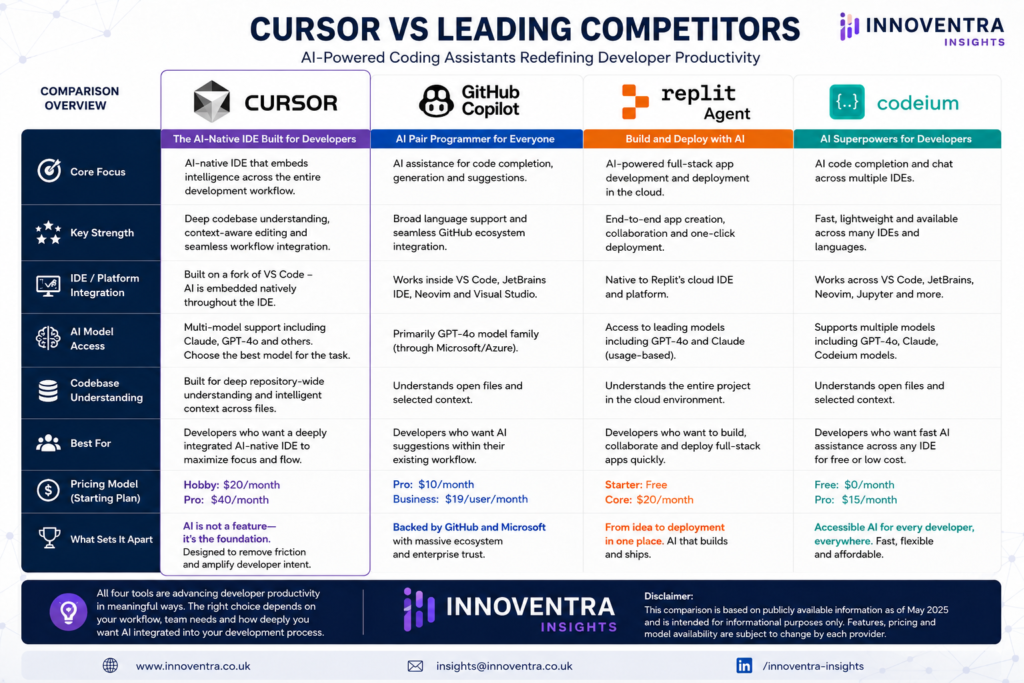
This analysis compares four of the market’s leading AI coding assistants—Cursor, GitHub Copilot, Replit Agent and Codeium—using business-focused criteria rather than feature lists. It explains where each platform excels, where its limitations remain and which organisations are most likely to benefit.
Why AI Coding Assistants Have Become a Boardroom Issue
Software development has become one of the highest-return use cases for generative AI.
Unlike many AI initiatives that require extensive organisational change, coding assistants can often deliver measurable productivity improvements within weeks.
Recent industry research also indicates that adoption of AI coding agents has accelerated rapidly across open-source software projects, with agent-assisted development becoming increasingly common.
For business leaders this matters because software is no longer confined to technology companies.
Banks build software.
Retailers build software.
Manufacturers build software.
Government builds software.
Almost every organisation is now becoming a software organisation.
What People Are Searching For
This article naturally targets high-value search terms including:
- Best AI coding assistant
- Cursor vs GitHub Copilot
- Best AI code editor
- AI coding tools
- AI IDE
- Cursor review
- GitHub Copilot review
- Codeium vs Cursor
- Replit AI review
- AI software development tools
- Best AI tools for developers
- AI coding assistant comparison
- AI code generation
- AI programming assistant
These keywords have consistently strong commercial intent because users are actively evaluating products rather than simply researching AI.
Innoventra Evaluation Framework
Rather than scoring products by the number of features they offer, Innoventra assessed each platform against the factors executives care about most.
| Evaluation Area | Weight |
|---|---|
| Developer Productivity | 25% |
| Enterprise Readiness | 20% |
| Codebase Understanding | 15% |
| AI Capability | 15% |
| Workflow Integration | 10% |
| Ease of Adoption | 10% |
| Cost Effectiveness | 5% |
This reflects a simple principle.
Technology only creates value when employees actually use it.
Cursor: Best Overall for Professional Engineering Teams
Overall Score: 92/100
Cursor has fundamentally changed expectations of what an AI coding assistant should be.
Instead of adding AI into an existing IDE, Cursor rebuilt the development experience around AI from the ground up.
Its greatest strengths include:
- Deep repository understanding
- Multi-file editing
- Agent workflows
- Native AI integration
- Multiple frontier models
- Intelligent refactoring
For organisations developing complex enterprise software, these capabilities can significantly reduce repetitive engineering work.
Best for
- Software companies
- Enterprise engineering teams
- Product engineering
- SaaS businesses
- Scale-ups
Potential limitation
Teams accustomed to traditional IDE workflows may require some onboarding before realising the full benefits.
GitHub Copilot: The Enterprise Standard
Overall Score: 85/100
GitHub Copilot remains one of the safest enterprise investments.
Its greatest advantage is not necessarily raw AI capability.
Its advantage is ecosystem integration.
For organisations already invested in GitHub Enterprise, Azure DevOps and Microsoft technologies, Copilot fits naturally into existing engineering workflows.
This significantly reduces implementation friction.
Best for
- Large enterprises
- Microsoft customers
- Existing GitHub users
- Governance-focused organisations
Replit Agent: The Fastest Route from Idea to Application
Overall Score: 78/100
Replit represents a different philosophy.
Instead of helping developers write better code, it helps organisations produce working software faster.
Its cloud-native environment makes application deployment remarkably simple.
This makes it attractive for:
- startups
- education
- hackathons
- rapid MVP development
- citizen developers
However, organisations managing large enterprise codebases may eventually outgrow its workflow.
Codeium: Outstanding Value for Smaller Teams
Overall Score: 80/100
Codeium has positioned itself as the affordability leader.
It provides strong AI assistance while maintaining generous free offerings.
For many SMEs this creates an excellent entry point into AI-assisted software development without substantial software expenditure.
Its strengths include:
- wide IDE compatibility
- fast performance
- low cost
- broad language support
The Strategic Difference Most Buyers Miss
Many comparison articles focus on features.
Business leaders should instead focus on workflow.
Ask:
Which platform reduces the most expensive engineering bottlenecks?
Not:
Which platform has the longest feature list?
That distinction changes procurement decisions entirely.
Which Tool Should Different Organisations Choose?
| Organisation | Recommended Platform | Why |
|---|---|---|
| Enterprise software company | Cursor | Deep repository intelligence and advanced AI workflows |
| Microsoft organisation | GitHub Copilot | Seamless integration with Microsoft and GitHub |
| Startup | Replit Agent | Fast application delivery and deployment |
| SME | Codeium | Excellent value and low adoption costs |
| Freelance developer | Cursor | Maximum productivity |
| Student | Codeium | Strong free tier |
Five Trends Every Technology Leader Should Watch
1. AI IDEs will replace AI plugins
Developers increasingly prefer AI-native environments over standalone assistants.
2. Repository understanding is becoming the differentiator
Simple autocomplete is no longer enough.
Understanding entire software systems creates significantly more business value.
3. AI agents are replacing autocomplete
Developers increasingly delegate complete implementation tasks rather than requesting code suggestions.
4. Productivity gains are becoming measurable
Early enterprise evidence suggests well-deployed coding agents can materially increase engineering output, although outcomes vary by workflow and governance.
5. Ecosystems are becoming more important than models
The winning vendors are embedding AI across the entire software development lifecycle rather than competing solely on model quality.
Innoventra Recommendation
There is no universally “best” AI coding assistant.
There is only the platform that best matches your organisation’s objectives.
Our recommendation is:
- Choose Cursor if software engineering is a strategic competitive capability.
- Choose GitHub Copilot if your organisation already operates within the Microsoft ecosystem.
- Choose Replit Agent if speed of prototyping and deployment is the priority.
- Choose Codeium if affordability and accessibility matter most.
The organisations creating the greatest return from AI are not those adopting the largest number of tools.
They are the organisations standardising around one platform, investing in developer capability and embedding AI into everyday engineering workflows.
Final Thoughts
AI coding assistants are rapidly evolving from productivity tools into strategic software engineering platforms.
The competitive advantage will increasingly come not from writing code faster, but from enabling developers to spend more time solving business problems and less time performing repetitive engineering tasks.
For technology leaders, the decision is no longer whether to adopt AI-assisted development.
It is which platform will become the foundation of your engineering strategy over the next five years.