
By Innoventra Insights
Executive Summary
Artificial intelligence is no longer a feature of social media it has become its foundation. Every day, billions of people interact with platforms such as YouTube, TikTok, Instagram, Facebook, Snapchat, LinkedIn and X. Behind every recommended video, suggested post, personalised advertisement and trending topic are increasingly sophisticated AI systems analysing vast amounts of behavioural data in real time.
These systems determine much of what users watch, read, purchase and discuss. They influence education, consumer behaviour, business growth, political communication and public opinion at an unprecedented scale.
The rapid evolution of generative AI is accelerating this transformation even further. AI now creates text, images, videos, translations, captions and increasingly personalised digital experiences. As a result, the future of social media is becoming inseparable from the future of artificial intelligence.
This article examines how AI is reshaping social media, the opportunities it creates, the challenges it introduces and what governments, businesses, educators and individuals should do to prepare for the next phase of digital transformation.
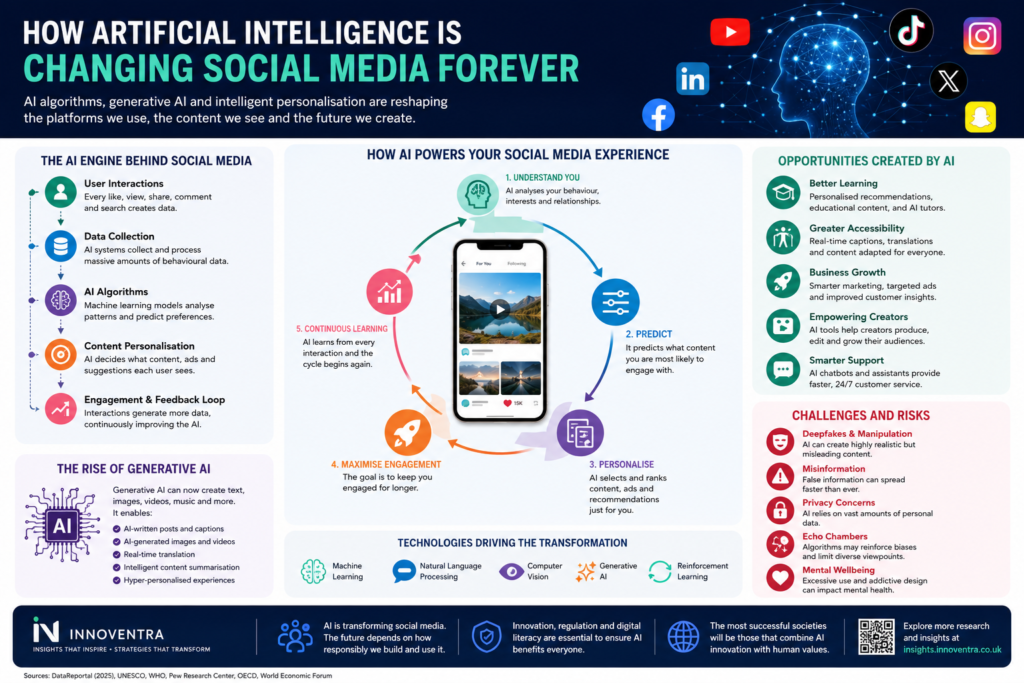
Artificial Intelligence Has Quietly Become the Engine Behind Social Media
Many users think they choose what they see online.
In reality, AI increasingly determines the content presented to them.
Modern recommendation systems continuously analyse:
- viewing history;
- watch time;
- scrolling behaviour;
- likes;
- comments;
- shares;
- searches;
- location;
- device type;
- previous interactions.
Every action improves the algorithm.
The result is a personalised experience unique to every individual.
According to DataReportal, AI-driven personalisation has become one of the defining trends shaping digital platforms, contributing to continued growth in user engagement and content consumption.
Readers interested in broader global trends should also explore our article Which Countries Spend the Most Time on Social Media? Global Rankings, Trends and What They Mean, which examines how digital engagement varies around the world.
From Social Networks to AI Ecosystems
Today’s major platforms are no longer simply communication tools.
They increasingly operate as AI ecosystems.
YouTube
AI recommends videos, generates captions, improves accessibility and supports creators with content insights.
TikTok
Its recommendation algorithm rapidly learns user preferences, making content discovery highly personalised.
AI determines much of what appears in Reels, Stories, Explore and users’ feeds.
Artificial intelligence increasingly recommends jobs, learning opportunities and professional connections.
Machine learning powers advertising, content ranking and moderation.
The distinction between search engines, AI assistants and social media continues to blur.
The Rise of Generative AI
The arrival of generative AI marks one of the most significant developments in the history of social media.
Content that once required photographers, designers, editors and writers can increasingly be created using AI.
Businesses now use AI to:
- write posts;
- generate images;
- edit videos;
- translate content;
- personalise marketing;
- improve customer support;
- analyse audience behaviour.
For creators, AI can increase productivity.
For consumers, it creates increasingly personalised experiences.
However, it also raises important questions about authenticity, copyright and trust.
This complements our earlier research in Beyond Degrees: Why Human Capability Will Determine Success in the Age of Artificial Intelligence, where we explore why human judgement, creativity and ethical reasoning remain essential despite rapid AI progress.
The Opportunities Created by AI
Artificial intelligence is enabling social media to become:
- more accessible;
- more educational;
- more personalised;
- more inclusive;
- more efficient.
Examples include:
Education
Students can receive personalised learning recommendations.
Accessibility
Automatic captions and translations improve access for millions of users.
Small Businesses
AI reduces marketing costs and enables entrepreneurs to compete globally.
Customer Service
Intelligent assistants provide faster support.
Content Discovery
Users are more likely to discover information relevant to their interests.
The Challenges
AI also introduces significant risks.
These include:
Deepfakes
Highly realistic synthetic images and videos can be used to deceive audiences.
Misinformation
AI can rapidly generate large volumes of persuasive but inaccurate content.
Echo Chambers
Recommendation algorithms may reinforce existing viewpoints by prioritising similar content.
Privacy
AI depends upon enormous quantities of behavioural data.
Mental Wellbeing
Highly engaging algorithms may encourage excessive platform use for some individuals.
Research from organisations such as the World Health Organization, UNESCO and Pew Research Center highlights the importance of responsible AI development and digital literacy to address these challenges.
The Future of Social Media
The next generation of social media is likely to include:
- AI companions;
- real-time translation;
- personalised education;
- intelligent search;
- augmented reality;
- virtual reality;
- immersive collaboration;
- AI-generated video.
Platforms may increasingly function as personalised digital assistants rather than simply social networks.
What Governments Should Do
Governments should prioritise:
- AI literacy;
- transparent regulation;
- online safety;
- digital education;
- cybersecurity;
- responsible innovation.
What Businesses Should Do
Businesses should:
- adopt AI responsibly;
- improve digital capability;
- invest in workforce training;
- strengthen AI governance;
- maintain human oversight.
These themes are explored further in Artificial Intelligence and the Future of Work, which examines how AI is reshaping employment and organisational strategy.
Innoventra Insight
Artificial intelligence is transforming social media from a platform that simply connects people into one that increasingly shapes how people learn, communicate, consume information and make decisions.
The long-term winners will not necessarily be the platforms with the most users.
They will be those that build the greatest levels of trust, transparency and responsible innovation.
Similarly, the countries best positioned for future success will not simply be those with the highest levels of digital engagement, but those that equip their citizens with the skills needed to collaborate effectively with AI.
Conclusion
Artificial intelligence is fundamentally redefining social media.
Recommendation systems, generative AI and intelligent personalisation are transforming how information is created, distributed and consumed.
For businesses, these technologies present extraordinary opportunities for innovation.
For governments, they require thoughtful regulation.
For educators, they demand new approaches to digital literacy.
For individuals, they reinforce the importance of critical thinking and responsible technology use.
The future of social media will therefore be determined not only by advances in artificial intelligence but by how societies choose to develop, govern and use these increasingly powerful technologies.
Further Reading & Sources
This article draws upon research and publicly available data from internationally recognised organisations, including:
- DataReportal – Digital 2025 Global Overview Report
- World Economic Forum – Future of Jobs Report 2025
- OECD – Digital Economy Outlook
- UNESCO – Guidance for Generative AI in Education and Research
- World Health Organization – Adolescent Mental Health
- Pew Research Center – Teens, Social Media and Mental Health
- Ofcom – Children and Parents: Media Use and Attitudes Report