
Digital Capability, Not Screen Time: Why the AI Economy Will Reward What People Do Online
Executive Summary
More than 5.3 billion people now use social media globally, representing almost 65% of the world’s population, while the average user spends 2 hours and 21 minutes each day on social platforms, according to DataReportal’s Digital 2025 Global Overview Report. At the same time, artificial intelligence is becoming embedded across search engines, productivity software, education platforms and social media, fundamentally changing how people interact with digital technology.
This convergence is reshaping one of the most familiar debates of the digital age.
For years, policymakers, educators and parents have focused on reducing screen time. While concerns around mental health, online safety and excessive digital use remain important, they address only part of the picture.
The more significant strategic question is how digital time is being used.
A growing proportion of online activity now involves learning new skills, collaborating with colleagues, building businesses, creating digital products or working alongside AI assistants. In this environment, measuring hours spent online tells us little about the economic value those hours generate.
As governments seek stronger productivity growth and organisations redesign work around AI, competitive advantage is increasingly shifting from digital access towards digital capability.
The countries and businesses most likely to prosper in the AI era may not be those with the highest levels of connectivity, but those that transform digital engagement into knowledge, innovation and human capability.
A Different Question
Imagine two countries.
Both report that young adults spend around six hours each day using digital platforms.
In the first, most of that time is devoted to passive entertainment, short-form videos and algorithmically recommended content.
In the second, many of the same digital platforms are used to learn programming, experiment with generative AI, develop businesses, collaborate on research and acquire professional skills.
On paper, both countries appear equally connected.
Economically, they are developing very different capabilities.
This distinction lies at the centre of one of the defining strategic questions of the AI economy.
The next decade is unlikely to reward countries simply because their populations spend more time online. It is more likely to reward those that convert digital engagement into productivity, innovation and workforce capability.
The World Has Become Digital First
Digital technology is no longer a separate activity. It has become the environment in which much of modern life takes place.
People increasingly work, study, communicate, shop, bank, consume entertainment and access public services through digital platforms. AI assistants are rapidly becoming part of everyday workflows, helping people research information, write documents, analyse data, generate software and solve complex problems.
According to DataReportal, there are now more than 5.6 billion internet users worldwide, representing almost 69% of the global population, while more than 5.3 billion social media identities are active globally.
This scale matters because digital platforms have evolved beyond communication tools. They now form part of the infrastructure supporting education, commerce, labour markets and innovation.
For many organisations, social platforms increasingly compete not only with traditional media but also with search engines, customer service functions, learning environments and productivity software.
The boundaries between social media, education, work and artificial intelligence are becoming progressively less distinct.
Why Screen Time Alone Is a Poor Measure
Screen time has become one of the most widely discussed measures of digital wellbeing.
Yet, by itself, it reveals remarkably little.
Two professionals may each spend four hours online.
One spends that time watching entertainment content.
The other completes an AI certification, develops software using generative AI, builds professional networks, analyses business data and launches an online business.
Their screen time is identical.
Their economic contribution is not.
This illustrates an increasingly important limitation in public debate.
Digital exposure does not automatically translate into digital capability.
For governments seeking productivity growth and businesses investing in workforce development, the more meaningful measure is not how long people remain connected, but how effectively they use digital technologies to create value.
Artificial Intelligence Is Transforming Digital Engagement
Artificial intelligence is changing the purpose of digital platforms.
Recommendation systems influence what billions of people discover every day. Generative AI is now embedded within productivity software, search engines, customer support systems and educational tools, enabling individuals to complete tasks that previously required specialist expertise.
Microsoft’s 2025 Work Trend Index found that 46% of business leaders report their organisations are already using AI agents, while 82% expect digital labour to expand workforce capacity within the next 12 to 18 months.
Similarly, the World Economic Forum’s Future of Jobs Report 2025 found that 86% of employers expect AI and information-processing technologies to transform their businesses by 2030, while 77% plan to reskill employees to work more effectively alongside AI.
These findings point towards an important shift.
Digital engagement is increasingly about augmenting human capability rather than simply consuming information.
The smartphone is evolving from a communication device into a portable platform for learning, decision-making, creativity and productivity.
From Digital Access to Digital Capability
Over the past two decades, governments have invested heavily in expanding internet access.
That objective remains essential.
However, widespread connectivity is rapidly becoming a baseline requirement rather than a source of competitive advantage.
The next stage of economic development depends upon what individuals and organisations are capable of doing once connected.
Digital capability encompasses far more than technical proficiency.
It includes AI literacy, critical thinking, creativity, problem solving, entrepreneurship, collaboration and the ability to integrate intelligent technologies into everyday work.
As AI becomes increasingly accessible, these human capabilities become progressively more valuable.
Competitive advantage is therefore shifting away from exclusive access to technology towards the ability to deploy technology effectively.
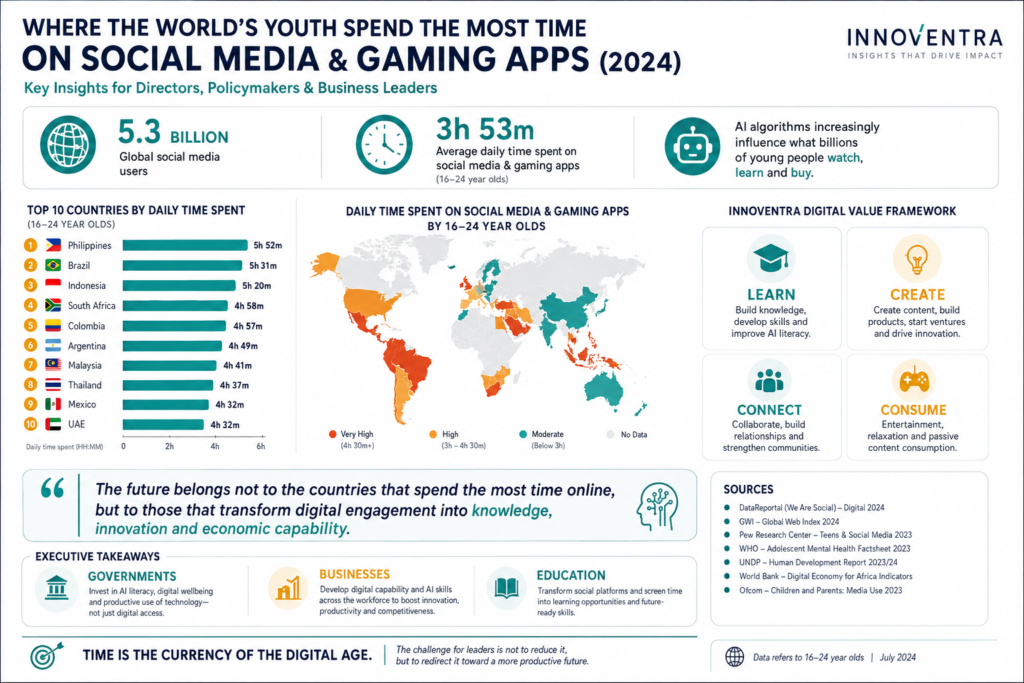
More Useful Framework for Measuring Digital Value
Rather than measuring digital engagement primarily through hours spent online, organisations and policymakers should consider the outcomes that digital activity produces.
Four broad categories illustrate this distinction.
Learning develops knowledge, AI literacy and professional capability.
Creating generates software, research, businesses, intellectual property and digital products.
Connecting enables collaboration, knowledge exchange and professional networking.
Consuming provides entertainment, leisure and information.
All four have legitimate roles.
However, societies that allocate a greater proportion of digital engagement towards learning, creation and collaboration are likely to generate stronger long-term economic returns than those dominated by passive consumption.
The strategic question is therefore not how much people connect, but what they accomplish while connected.
Why This Matters for Business Leaders
For senior executives, the implications extend well beyond technology investment.
Employees increasingly expect AI-powered tools, personalised learning and digitally enabled workflows. Customers expect faster, more intelligent and more responsive services. Competitors are redesigning processes around AI rather than simply automating existing tasks.
Organisations that continue to treat digital platforms purely as communication channels risk missing a much larger opportunity.
Leaders should instead ask:
- Are we developing AI capability across the workforce?
- Are we encouraging employees to create more value rather than simply consume more information?
- Do we measure productivity outcomes rather than digital activity?
- Have managers been equipped to lead AI-enabled teams?
- Are our digital investments improving organisational capability as well as operational efficiency?
These questions are likely to prove more valuable than simply purchasing the latest technology.
Increasingly, sustainable competitive advantage will depend upon organisational capability rather than software alone.
The Emerging Productivity Divide
Throughout history, major technological revolutions have rewarded adaptation more than invention.
The Industrial Revolution created lasting advantage for organisations that redesigned production rather than simply acquiring steam engines.
The internet rewarded businesses that reinvented operating models rather than those that merely launched websites.
Artificial intelligence appears to be following the same pattern.
Leading economies are investing not only in AI infrastructure but also in workforce skills, digital education, research capability and lifelong learning.
The long-term winners are unlikely to be those with the highest levels of screen time or even the largest AI budgets.
They are more likely to be those that develop adaptable workforces capable of using AI to solve increasingly complex problems.
Innoventra Insight
The conversation around digital technology should move beyond measuring exposure and towards measuring capability.
Connectivity remains essential, but connectivity alone no longer creates competitive advantage.
As AI becomes embedded across education, work and everyday life, the organisations and nations that succeed will be those that transform digital engagement into learning, creativity, innovation and productivity.
In the AI economy, human capability not screen time may become the most valuable asset of all.
Final Thought
For much of the past decade, the central question has been:
“How much time are people spending online?”
Artificial intelligence is changing that question.
The more important measure is becoming:
“How much value are people creating while they are online?”
That distinction changes how governments approach education, how organisations invest in workforce development and how societies prepare for the future of work.
The AI era is unlikely to be defined by the countries with the highest levels of digital engagement.
It will be defined by those that convert digital attention into knowledge, innovation, productivity and long-term economic resilience.