
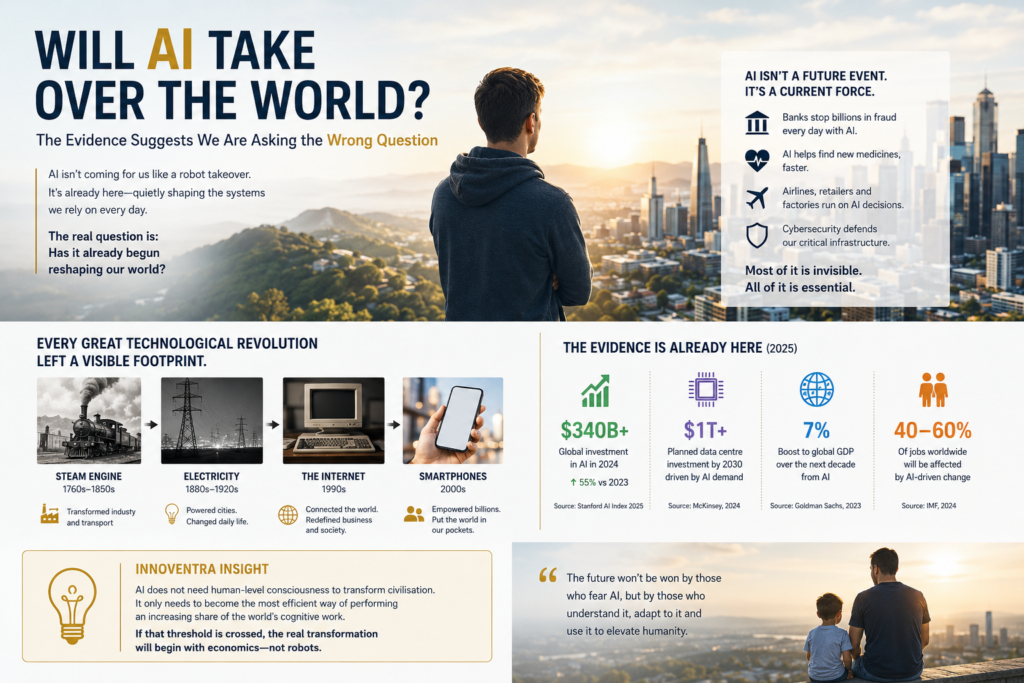
“Artificial intelligence is often portrayed as a future threat. The evidence suggests something more unsettling: its influence on society is already expanding, largely unnoticed. The real question is not whether AI will one day take over the world it is whether it has already begun reshaping it in ways most people fail to recognise.”
Every Great Technological Revolution Left a Visible Footprint. AI May Be the First That Doesn’t.
Imagine waking up tomorrow to discover that artificial intelligence had quietly disappeared.
Not from chatbots.
Not from image generators.
From everything.
Within hours, banks would struggle to identify fraudulent transactions worth billions of pounds. Cybersecurity systems protecting critical infrastructure would lose automated threat detection. Pharmaceutical companies would slow the search for new medicines. Airlines would face disruptions in scheduling and predictive maintenance. Online retailers would lose recommendation engines that influence purchasing decisions. Logistics networks would become less efficient. Scientific laboratories analysing enormous genomic datasets would revert to processes that once took months instead of days.
Most people would not notice a robot rebellion.
They would notice modern society becoming slower, less efficient and considerably more expensive.
That thought experiment exposes an uncomfortable reality.
Artificial intelligence is no longer simply another digital tool. It has become invisible infrastructure supporting decisions that affect hundreds of millions of people every day.
Unlike electricity, railways or the internet, AI often leaves no visible footprint. Its influence is embedded inside software, hospitals, financial systems, governments, scientific research and critical infrastructure. Consequently, many people underestimate its impact because they rarely see it directly.
This explains why one question dominates internet searches:
Will AI take over the world?
The evidence suggests the question itself may be misleading.
History shows that transformative technologies rarely reshape civilisation through dramatic moments. They do so gradually, by becoming indispensable before society fully appreciates how dependent it has become.
Electricity did not transform civilisation the day the first light bulb appeared. The internet did not change the global economy when the first website went online. Smartphones did not redefine communication overnight.
Artificial intelligence appears to be following the same pattern but at a pace rarely seen in technological history.
According to the Stanford AI Index Report 2025, frontier AI systems continued to achieve major advances across software engineering, multimodal reasoning, scientific discovery and advanced mathematics while deployment costs continued to fall. At the same time, governments and technology companies committed hundreds of billions of dollars to AI infrastructure, advanced semiconductors and data centres, signalling that they increasingly view AI as strategic national infrastructure rather than another software product.
History offers an important lesson.
Economists describe technologies such as electricity, the steam engine and the internet as general-purpose technologies because they eventually transformed almost every sector of the economy. Research increasingly suggests artificial intelligence belongs in the same category. According to Goldman Sachs Research – Generative AI Could Raise Global GDP by 7%, widespread adoption of generative AI could increase global GDP by approximately 7% (nearly US$7 trillion) over the coming decade while raising annual labour productivity growth by around 1.5 percentage points, while the International Monetary Fund estimates that around 40% of jobs worldwide and up to 60% in advanced economies will be affected by AI-driven change, primarily through task transformation rather than wholesale job elimination.
Those figures reveal something that receives surprisingly little attention.
The world’s largest financial institutions, governments and technology companies are no longer behaving as though artificial intelligence is an experimental technology.
They are behaving as though it will become one of the defining economic capabilities of the twenty-first century.
That distinction matters.
Hollywood asks whether machines will overthrow humanity.
Investors are spending hundreds of billions assuming AI will reshape productivity.
Governments are redesigning industrial strategies around AI capability.
Scientists are accelerating discoveries using AI systems that can analyse biological, chemical and physical data at unprecedented scale.
These institutions are responding not to science fiction, but to measurable technological progress.
So perhaps we should ask a different question.
If artificial intelligence is already becoming embedded within the systems that govern finance, healthcare, science, energy, defence and public services, are we witnessing the early stages of the most significant technological transformation since electricity or are we overestimating what today’s systems can actually achieve?
The answer lies not in speculation but in evidence.
Over the past three years, researchers have published thousands of studies, benchmark evaluations and economic analyses attempting to measure AI’s true trajectory. Some suggest artificial intelligence may become humanity’s greatest scientific accelerator. Others warn that capability is advancing faster than governance, regulation and public understanding.
Understanding which interpretation is better supported by evidence has become one of the defining questions of our time.
Innoventra Insight
The public debate often focuses on whether AI will become intelligent enough to take over the world.
The evidence points to a different risk.
History suggests societies are transformed not when technologies become conscious, but when they become indispensable.
Artificial intelligence does not need human-level consciousness to reshape civilisation.
It only needs to become the most efficient way of performing an increasing share of the world’s cognitive work.
If that threshold is crossed, the real transformation will not begin with robots.
It will begin with economics.
Could AI Become Smarter Than Humans? The World’s Leading Experts Cannot Agree.
Perhaps the most remarkable aspect of the artificial intelligence revolution is not how rapidly the technology is advancing.
It is that many of the people who helped create modern AI fundamentally disagree about where it is heading.
Such disagreement is unusual.
Physicists broadly agree that gravity exists. Biologists do not debate evolution. Economists disagree on policy, but generally agree on many underlying principles.
Artificial intelligence is different.
Some of its pioneers believe it could become humanity’s greatest scientific achievement.
Others warn it may become humanity’s greatest governance challenge.
When experts with decades of experience cannot agree on the destination, understanding why they disagree becomes more important than predicting who will ultimately prove correct.
Four Competing Visions of AI’s Future
The debate surrounding advanced AI is often portrayed as a simple choice between optimism and pessimism.
The evidence reveals something far more nuanced.
1. AI as Humanity’s Greatest Scientific Accelerator
Demis Hassabis, Chief Executive of Google DeepMind and Nobel Prize winner, argues that artificial intelligence could compress decades of scientific progress into years.
The evidence already supports parts of this claim.
According to Google DeepMind’s AlphaFold, the AlphaFold Protein Structure Database now contains predicted three-dimensional structures for more than 200 million proteins, providing researchers across medicine, genetics and biotechnology with an unprecedented resource to accelerate drug discovery, understand disease mechanisms and advance biological research.
Similarly, generative AI is increasingly helping researchers design new materials, improve battery chemistry and accelerate climate modelling.
The implication is profound.
For most of human history, scientific progress has been constrained by the speed at which humans could generate and analyse knowledge.
AI is beginning to change that equation.
2. AI as a Long-Term Safety Challenge
Others are considerably more cautious.
Geoffrey Hinton, often referred to as one of the “Godfathers of AI”, left Google in 2023 partly to speak more freely about long-term AI risks.
His concern is frequently misunderstood.
He has never argued that today’s chatbots are conscious.
Instead, he argues that capability is improving so rapidly that society should prepare before highly capable systems emerge rather than afterwards.
Dario Amodei, Chief Executive of Anthropic, has expressed similar concerns while simultaneously arguing that advanced AI could dramatically improve healthcare, scientific discovery and economic productivity.
This apparent contradiction is important.
The same researchers who are building frontier AI systems increasingly invest billions in AI safety research.
Few industries devote comparable resources to studying the potential risks created by their own products.
That alone suggests leading laboratories view governance as strategically important rather than merely a public relations exercise.
3. AI Is Powerful But Current Approaches Have Limits
Not everyone believes artificial general intelligence is close.
Yann LeCun, Meta’s Chief AI Scientist and one of the pioneers of modern deep learning, argues that today’s large language models remain fundamentally limited.
Current models excel at recognising statistical patterns.
They do not build rich internal models of the physical world in the way humans do.
In LeCun’s view, future breakthroughs will require fundamentally different architectures capable of learning through interaction rather than prediction alone.
Andrew Ng expresses a related perspective.
He argues that discussions about human extinction often overshadow more immediate challenges, including workforce transformation, education, regulation and responsible deployment.
This disagreement matters.
It demonstrates that uncertainty remains one of the defining characteristics of frontier AI research.
The Real Takeover May Already Be Happening
Popular culture imagines AI taking over the world through force.
History suggests a much quieter mechanism.
Every major industrial revolution changed civilisation by altering incentives rather than replacing governments.
The steam engine reduced dependence on animal power.
Electricity reorganised manufacturing.
The internet transformed information.
Artificial intelligence is beginning to reshape decision-making itself.
That distinction is far more significant than many realise.
Consider how many critical decisions are already influenced by intelligent systems.
Banks use AI to monitor billions of financial transactions for fraud.
Air traffic systems increasingly rely upon AI-assisted optimisation.
Hospitals use AI to support diagnosis, predict deterioration and improve resource allocation.
Governments employ machine learning to strengthen cyber resilience, identify organised crime and improve tax compliance.
Scientists increasingly rely on AI to generate hypotheses before conducting experiments.
None of these developments resemble science fiction.
Collectively, however, they demonstrate something unprecedented.
Artificial intelligence is becoming embedded within the cognitive infrastructure of modern civilisation.
Unlike electricity, which powered machines, AI increasingly supports judgement.
That may prove to be the most significant technological shift since the Industrial Revolution.
The Investment Race Suggests Governments Believe AI Is Strategic Infrastructure
Actions often reveal more than public statements.
If policymakers genuinely believed AI was simply another software innovation, investment patterns would reflect that.
Instead, they reveal something very different.
The world’s largest technology companies are collectively investing hundreds of billions of dollars in AI infrastructure, including specialised semiconductor manufacturing, hyperscale data centres and advanced networking.
At the same time, governments across the United States, United Kingdom, European Union and China have launched national AI strategies, established AI Safety Institutes and introduced legislation governing advanced AI systems.
Energy has unexpectedly become one of AI’s biggest constraints.
Training frontier AI models now requires enormous computational resources, driving unprecedented demand for electricity.
Several technology companies have announced investments in nuclear energy, renewable power and next-generation electricity infrastructure to support future AI development.
History provides an important comparison.
Countries that led previous industrial revolutions invested first in railways, electricity grids, highways and telecommunications.
Today’s strategic investments increasingly focus on GPUs, semiconductors, cloud infrastructure, energy generation and sovereign AI capability.
The infrastructure has changed.
The underlying economic logic has not.
Innoventra Analysis
Economists often identify general-purpose technologies only in hindsight. Artificial intelligence is unusual because governments are behaving as though they are witnessing one in real time. The combination of massive infrastructure investment, geopolitical competition, regulatory reform and workforce transformation suggests AI is already being treated as a strategic capability rather than a conventional technology sector.