
Every Google search begins with a gap: something a person does not know, fears may happen or wants to do next.
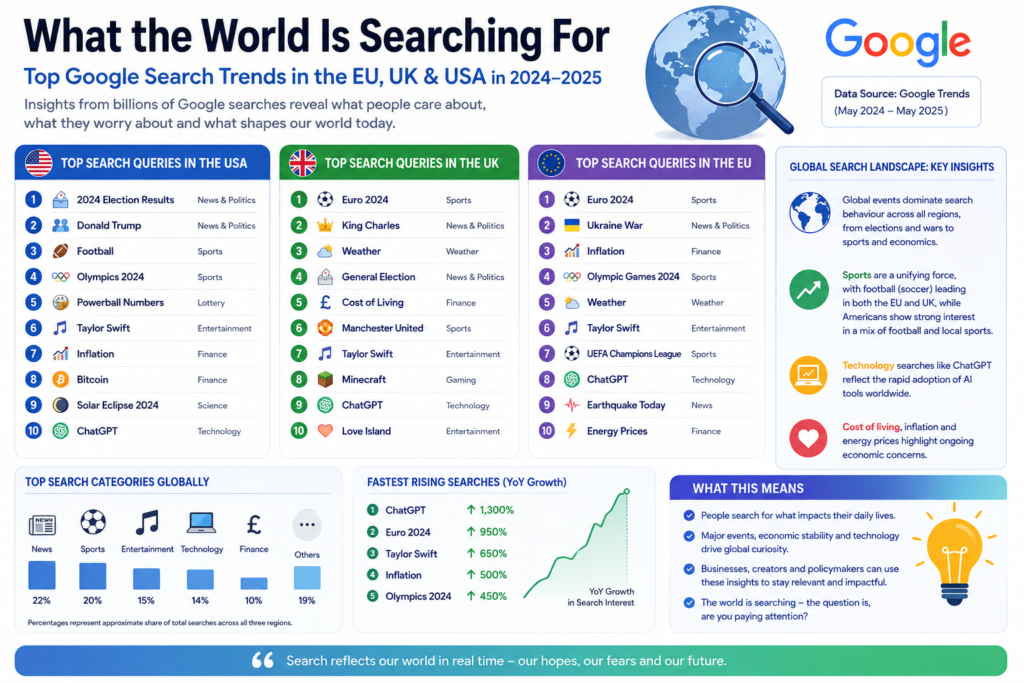
When similar searches rise across millions of users, those individual questions can become a collective signal. Elections, inflation, artificial intelligence, wars and major sporting events can all generate sudden changes in public attention.
Google Trends offers an unusually timely view of those changes. But it also creates a tempting and potentially dangerous assumption: if a topic is trending, does that tell us what society genuinely cares about, or merely what has captured attention for a few hours?
The answer matters to governments, businesses, journalists and content creators. Used carefully, search data can reveal emerging needs before conventional reports are available. Used badly, it can turn momentary curiosity into a misleading claim about public opinion.
What Does Google Trends Actually Measure?
Google Trends does not publish the exact number of searches made for a term. Its scores represent relative search interest, not absolute search volumes.
Google divides a term’s search activity by all searches conducted in the selected place and period. It then scales the results from 0 to 100. A score of 100 marks the point of greatest relative interest within that comparison it does not mean that 100 searches occurred or that every person was interested in the topic. Google Trends Help
This distinction is essential when comparing the United States, the United Kingdom and European countries. A smaller country can record a higher Trends score than a larger one even when its total number of searches is much lower.
Search data therefore answers a focused question:
How prominent was this search topic relative to other Google searches in a particular place and period?
It does not directly measure public approval, emotional sentiment or the percentage of the population holding a particular view.
Why Does Google Search Data Matter More Than Ever?
Traditional surveys remain essential, but they take time to design, collect and analyse. Search behaviour can change within minutes of a major announcement, sporting result, product launch or public emergency.
That speed makes it valuable as a real-time attention indicator.
The OECD has used Google Trends data to build high-frequency economic indicators. Its Weekly Tracker combined search patterns relating to consumption, employment, housing, business conditions and uncertainty to estimate economic activity across 46 OECD, G20 and partner countries. The model performed well in simulations covering the severe disruption caused by COVID-19. OECD: Tracking Activity in Real Time with Google Trends
More recent OECD work has also examined how search data can support timely estimates of ICT-sector growth and subjective well-being. In one study, incorporating Google Trends improved out-of-sample predictions of subjective well-being compared with using economic variables alone. OECD: Nowcasting Subjective Well-being with Google Trends
This does not make search data more reliable than official statistics. It makes it useful for a different purpose: detecting changes while they are still unfolding.
Can Google Searches Reveal What People Are Really Thinking?
Search data can reveal what people want to investigate, but not necessarily what they believe.
Someone searching for “inflation forecast” may be worried about prices, studying economics or writing a news article. A search for a political candidate could indicate support, opposition or simple curiosity. Searches for an AI tool may come from prospective users, critics, students or competitors.
The safest interpretation is therefore that search activity measures attention and information demand.
It can reveal:
- Which questions are becoming more prominent
- When public interest begins to accelerate
- Where interest is geographically concentrated
- How long attention remains elevated
- Which related questions people investigate
- Whether an event creates only a brief spike or sustained demand
It cannot establish motivation without additional evidence.
This creates the article’s central tension: search data may show society’s questions earlier than surveys do, but those questions still require careful interpretation.
Why Do Politics and the Economy Generate So Much Search Interest?
Political and economic events directly affect household decisions. Elections can change taxation, public services and regulation. Inflation influences spending power. Interest rates affect mortgages, borrowing and business investment.
When conditions change quickly, people search for explanations.
Queries about election results, energy prices, inflation, mortgages and the cost of living can therefore rise around major announcements or periods of uncertainty. The OECD found that search topics including “economic crisis”, “bankruptcies”, “investment” and “mortgage” carried useful predictive information within its economic tracking model. OECD Weekly Tracker
However, a spike in searches for “inflation” should not automatically be presented as evidence that economic anxiety has increased. The rise could be driven by a new statistical release, government announcement or news event.
A stronger analysis compares the search pattern with:
- Official inflation and employment data
- Consumer-confidence surveys
- Interest-rate decisions
- News coverage
- The timing of government announcements
- Related and rising search queries
Search data becomes more valuable when it is treated as one part of an evidence system, rather than proof on its own.
Why Do Sporting Events Produce Such Powerful Search Surges?
Major sporting events compress attention into a particular moment.
Fixtures, results, player injuries and controversial decisions create immediate questions. Unlike many political or economic topics, sporting interest can rise sharply around a known schedule and then fall soon after the event.
This makes sport a useful illustration of the difference between temporary attention and lasting behavioural change.
A tournament may generate an enormous short-term search spike without creating sustained interest after the final. By contrast, steady growth in searches for a technology, skill or professional concern may indicate a deeper change.
For businesses and publishers, the commercial lesson is important. Event-led content can attract rapid traffic, but it often has a short lifespan. Evergreen analysis usually grows more slowly but may continue attracting readers for months or years.
The best content strategy combines both:
- Timely coverage that captures a current surge
- Authoritative evergreen content that answers enduring questions
- Internal links that move event-driven visitors towards deeper analysis
Why Has Artificial Intelligence Become a Mainstream Search Topic?
Artificial intelligence has moved from specialist research into everyday work, education and consumer life.
People are no longer searching only for definitions of machine learning. They are investigating AI tools, career risks, automation, productivity, regulation and the reliability of AI-generated information.
This wider curiosity reflects AI’s expanding relevance. Students use generative tools to explore ideas. Employees use them to draft and analyse material. Businesses investigate automation. Governments consider regulation and public-service applications.
The International Labour Organization’s 2025 analysis estimated that approximately one in four jobs worldwide has some exposure to generative AI, although transformation is considered more likely than complete job replacement. International Labour Organization
That helps explain why AI-related search demand extends beyond technology enthusiasts. The subject now carries practical consequences for employment, education and business competitiveness.
Readers concerned about those consequences can explore Innoventra’s analysis of which jobs face the greatest AI risk and why professionals may need to reinvent their skills before 2030.
But one unresolved question remains: is growing search interest evidence of meaningful AI adoption—or simply growing anxiety about it?
Search data alone cannot settle that question. Adoption figures, workplace surveys and productivity evidence are also needed.
Can Search Behaviour Reveal Economic Anxiety Before Surveys Do?
It can provide an early signal, but it should not be described as a direct measure of anxiety.
Searches relating to bills, benefits, mortgage payments, redundancies and energy costs may increase when households face financial pressure. Because these searches occur immediately, they can surface changing information needs before monthly or quarterly statistics are released.
The OECD’s work demonstrates that carefully selected Google Trends variables can contribute to economic nowcasting. It has used search data to support estimates of GDP activity, services trade and ICT-sector performance. OECD Digital Economy Outlook
However, search behaviour should be validated against conventional indicators. A celebrity interview, viral video or widely reported announcement can produce a search surge unrelated to a lasting economic shift.
The strongest approach combines three layers:
- Search data to identify a possible change quickly.
- Survey evidence to examine attitudes and motivations.
- Official statistics to establish what is happening in the economy.
Together, they provide a more complete picture than any single source.
Can Google Trends Predict What Will Happen Next?
Google Trends is better at detecting emerging attention than predicting the future with certainty.
A sharp rise in searches may precede increased demand, but correlation does not prove causation. People may search because an event has already happened. Search activity can also be influenced by news coverage, platform changes, seasonal behaviour and differences in internet access.
Google additionally explains that Trends uses a sample of searches and filters much irregular activity. Its results should therefore be treated as an analytical indicator, not a complete record of human behaviour. Google Trends methodology
Used responsibly, search data can help organisations ask better questions:
- Is a new customer problem emerging?
- Are people struggling to understand a policy?
- Is interest sustained or temporary?
- Which related questions remain unanswered?
- Does the pattern appear in several countries?
- Is search behaviour supported by other evidence?
The purpose is not to claim perfect foresight. It is to reduce the time between a change occurring and an organisation recognising it.
What Does Search Intelligence Mean for Businesses?
For businesses, search data can reveal changes in language, priorities and demand.
A company may discover that customers are searching for a problem rather than the product designed to solve it. Search patterns can also expose regional differences, seasonal needs and questions competitors have not answered effectively.
Businesses can use these insights to:
- Test demand before developing a new service
- Identify emerging customer concerns
- Improve website and content strategy
- Monitor changes in product terminology
- Compare interest across markets
- Develop useful resources around unanswered questions
Small businesses can also benefit. Innoventra’s guide to using AI to strengthen struggling SMEs examines how organisations can combine accessible technology with better customer insight.
Search data is most valuable when it shapes real decisions. Collecting trend charts without changing strategy creates information, not intelligence.
How Can Governments and Researchers Use Search Data Responsibly?
Governments can use search patterns to identify areas where public guidance may be unclear or urgently needed. Researchers can use them to develop hypotheses and monitor emerging behaviour.
Potential applications include:
- Detecting changing information needs during emergencies
- Improving the timing of public communications
- Monitoring labour-market and economic signals
- Identifying geographic differences in public attention
- Supporting high-frequency economic estimates
- Evaluating whether a campaign generated sustained interest
Safeguards remain essential. Search data can underrepresent people with limited internet access or different platform preferences. Researchers must also avoid treating search activity as a direct substitute for population-level opinion.
The correct question is not “What does Google say society believes?” It is “What change in information-seeking behaviour does this data reveal, and what other evidence could explain it?”
How Should Content Creators Respond to Search Trends?
Content creators should use search trends to identify real questions not manufacture shallow articles around every spike.
A strong search-led article should:
- Answer the main question early
- Use related questions as clear headings
- Distinguish evidence from interpretation
- Cite original and authoritative sources
- Explain limitations
- Link to relevant supporting analysis
- Update time-sensitive claims when conditions change
This approach supports both readers and search engines. It also creates stronger topic clusters, particularly when related articles are connected through meaningful internal links.
Publishers covering employment, for example, can link trend analysis to detailed resources on AI-resilient careers rather than repeating the same general claims across several pages.
Is Google Search Becoming a Global Barometer of Society?
Google search behaviour can function as a powerful barometer of public attention but not as a perfect map of public opinion.
Each search represents an information need. When those needs are aggregated, they can reveal how attention responds to elections, economic disruption, technological change and shared cultural events.
The real strategic value lies in detecting the distance between a passing spike and a lasting shift.
A football final may dominate searches for one evening. An election may command attention for several weeks. But a sustained rise in questions about AI, employment or household costs may signal a more fundamental change in how people understand their future.
That leaves organisations with one final question:
Are they using search data merely to describe what attracted attention yesterday or to recognise the needs that will shape tomorrow?
Key Takeaways
- Google Trends measures relative search interest, not exact search volumes or public opinion.
- Search data can reveal emerging attention faster than many traditional reports.
- Political, economic, sporting and technological events can generate very different search patterns.
- Growing AI interest reflects wider questions about work, education, productivity and regulation.
- Search trends are strongest when assessed alongside surveys, official statistics and contextual evidence.
- Businesses, governments and publishers can use search intelligence to identify needs earlier.
- The most valuable insight is not simply what is trending, but whether that interest represents a temporary reaction or a lasting social change.