
The First Generation Growing Up With Artificial Intelligence
Artificial intelligence is not simply changing the future of work. It is changing childhood itself.
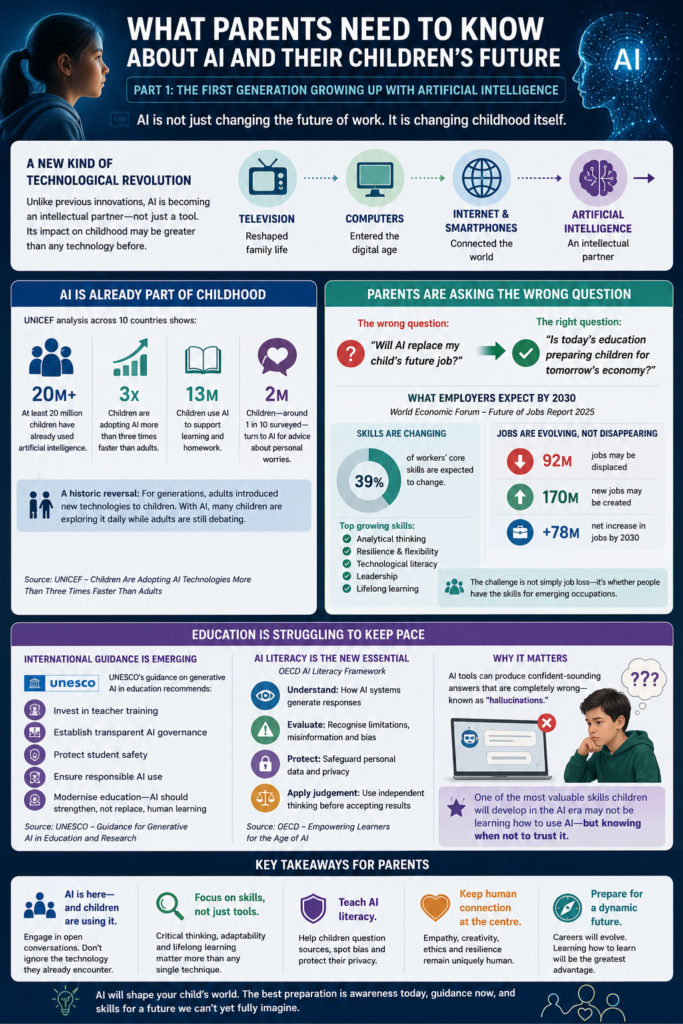
For decades, each generation has experienced a defining technological revolution. Today’s grandparents witnessed television reshape family life. Their children entered the computer age. Millennials grew up alongside the internet and smartphones.
Today’s children are experiencing something fundamentally different.
Artificial intelligence is the first widely adopted technology capable of performing tasks once considered uniquely human: reasoning, writing, coding, analysing information, creating images and increasingly supporting decision-making. Unlike previous digital innovations, AI is becoming an intellectual partner rather than simply another tool. That distinction makes its impact on childhood potentially more profound than any previous technological shift.
Recent evidence suggests this transformation is occurring far faster than many parents realise. According to UNICEF, analysis of nationally representative surveys across ten countries estimates that at least 20 million children have already used artificial intelligence. Children are adopting AI more than three times faster than adults, while an estimated 13 million children already use AI to support learning and homework. More concerningly, more than two million children around one in ten surveyed reported turning to AI for advice about personal worries, highlighting that AI is increasingly being used not only as an educational assistant but also as a source of emotional support. UNICEF – Children Are Adopting AI Technologies More Than Three Times Faster Than Adults
These findings reveal a historic reversal.
For generations, adults introduced new technologies to children and determined how they should be used. Artificial intelligence is beginning to reverse that relationship. Many children are exploring conversational AI daily while parents, teachers and policymakers continue debating its benefits and risks. As UNICEF observed, “a generation is growing up inside a global experiment,” with evidence on AI’s long-term impact on cognitive development, emotional wellbeing and learning only beginning to emerge.
Parents Are Asking the Wrong Question
Public discussion about AI often centres on a single concern:
“Will AI replace my child’s future job?”
It is an understandable question, but the evidence suggests it is the wrong place to start.
The more important question is:
“Is today’s education preparing children for tomorrow’s economy?”
The World Economic Forum’s Future of Jobs Report 2025 surveyed more than 1,000 global employers, collectively representing over 14 million workers across 55 economies. Rather than predicting widespread unemployment, the report concludes that AI, automation and digital transformation will fundamentally reshape how work is performed. By 2030, employers expect 39% of workers’ core skills to change, while analytical thinking, resilience, technological literacy, leadership and lifelong learning become increasingly valuable across almost every sector. World Economic Forum – Future of Jobs Report 2025
Equally important, the report forecasts significant labour market churn rather than simple decline. It estimates that technological and economic change could displace around 92 million jobs globally while creating approximately 170 million new roles, resulting in a net increase of 78 million jobs by 2030. The challenge therefore is not simply job loss—it is whether people possess the skills needed for emerging occupations.
This distinction matters enormously for parents.
Previous generations could often rely on education providing a relatively stable pathway from school to university and into long-term employment. Increasingly, careers are becoming dynamic, requiring workers to continually learn new technologies while strengthening the distinctly human capabilities that AI struggles to replicate.
Education Is Struggling to Keep Pace
Artificial intelligence is advancing faster than many education systems can adapt.
Recognising this challenge, UNESCO became the first United Nations agency to publish comprehensive guidance on generative AI in education. Rather than recommending blanket bans or unrestricted classroom adoption, UNESCO argues that governments should prioritise teacher training, transparent AI governance, student safety and responsible use. The organisation warns that education systems must modernise rapidly while ensuring AI strengthens, rather than replaces, human learning. UNESCO – Guidance for Generative AI in Education and Research
This balanced approach reflects a growing international consensus.
Artificial intelligence is unlikely to disappear from classrooms. Students will continue using it for research, revision, coding, writing assistance and language learning regardless of whether schools encourage or discourage its use. Consequently, the educational challenge is shifting from deciding whether children should encounter AI to ensuring they understand how to evaluate it critically.
That same conclusion underpins the OECD’s AI Literacy Framework, which deliberately moves beyond technical skills such as programming. Instead, it argues that every learner should understand how AI systems generate responses, recognise their limitations, identify misinformation and bias, protect personal data, and apply independent judgement before accepting AI-generated content as accurate. OECD – Empowering Learners for the Age of AI
The significance of this shift cannot be overstated.
Large language models can produce convincing explanations that are entirely incorrect. Researchers commonly refer to these errors as hallucinations. Because the answers often appear fluent and authoritative, younger users may struggle to recognise inaccuracies unless they have developed strong critical thinking and source-evaluation skills.
In other words, one of the most valuable skills children will develop during the AI era may not be learning how to use artificial intelligence but learning when not to trust it.
What Parents Need to Know About AI and Their Children’s Future
Part 2: The Skills That Will Matter Most in an AI Economy
Artificial intelligence is changing not only what children need to learn, but also why they learn it. The evidence increasingly suggests that future success will depend less on accumulating knowledge and more on applying judgement, creativity and adaptability alongside intelligent machines.
AI Is Increasing the Value of Human Skills Not Reducing It
One of the most persistent misconceptions surrounding artificial intelligence is that human skills will become less important as machines become more capable.
Current labour market evidence suggests the opposite.
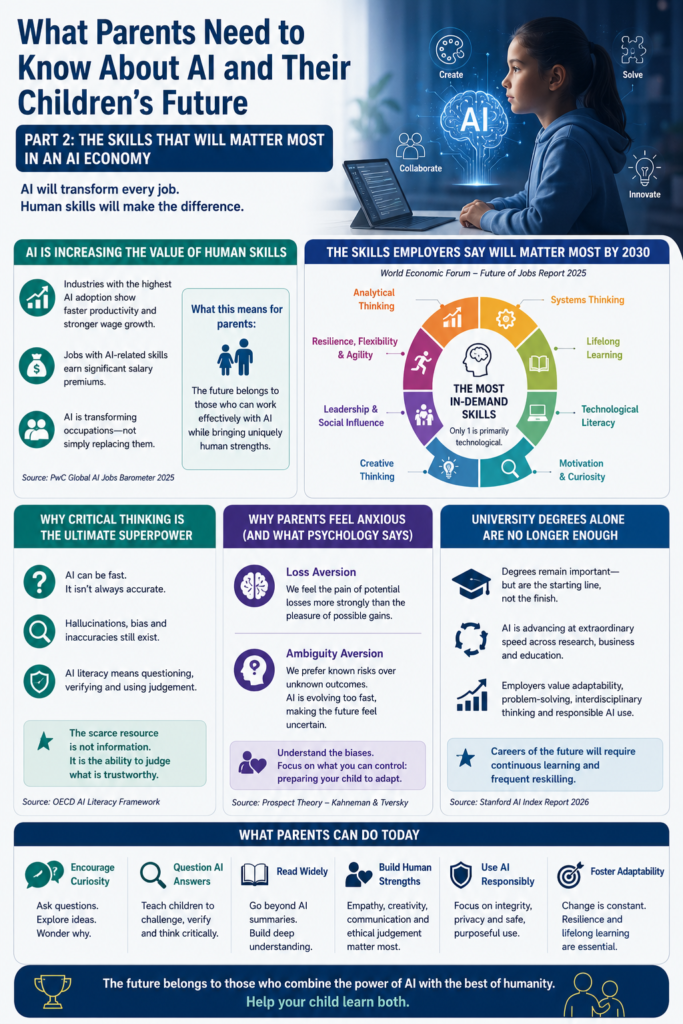
The PwC Global AI Jobs Barometer 2025, based on analysis of nearly one billion job advertisements across six continents, found that industries with the highest levels of AI adoption are experiencing faster productivity growth and stronger wage growth than less AI-intensive sectors. Importantly, jobs requiring AI-related skills continue to attract significant salary premiums, while employers increasingly seek workers who can combine technical understanding with communication, judgement and leadership. The report concludes that AI is transforming occupations rather than simply replacing them, with tasks evolving far more rapidly than entire professions disappearing.
Source: https://www.pwc.com/gx/en/issues/artificial-intelligence/publications/artificial-intelligence-study.html
For parents, this finding changes the conversation completely.
The future is unlikely to belong exclusively to software engineers or AI specialists. Instead, it will increasingly reward individuals who understand how to work effectively with AI while contributing capabilities that machines still struggle to replicate.
Why Employers Are Recruiting for Different Capabilities
Historically, entry-level employees developed expertise by performing routine tasks before progressing to more strategic responsibilities.
Artificial intelligence is disrupting this traditional career pathway.
Generative AI can now draft reports, summarise lengthy documents, analyse spreadsheets, generate software code and answer technical questions within seconds. These activities previously helped graduates develop professional judgement through repetition and experience.
As AI increasingly performs these routine cognitive tasks, employers are beginning to expect junior employees to contribute higher-value capabilities much earlier in their careers.
The World Economic Forum’s Future of Jobs Report 2025 identifies analytical thinking as the world’s most important workplace skill, followed by resilience, flexibility and agility, leadership and social influence, creative thinking, motivation, curiosity, technological literacy and lifelong learning. Together, these competencies are expected to become increasingly valuable across almost every major economy by 2030.
Source: https://www.weforum.org/reports/the-future-of-jobs-report-2025
Notice something remarkable.
Only one of these capabilities relates directly to technology.
The majority are deeply human.
This reinforces an increasingly important conclusion emerging across labour market research: AI is raising the economic value of uniquely human judgement rather than reducing it.
Why Critical Thinking May Become the Most Valuable Skill of All
Artificial intelligence can generate answers within seconds.
That does not mean those answers are always correct.
Large language models occasionally produce fabricated information, inaccurate citations and confident explanations unsupported by evidence. Researchers commonly refer to these outputs as hallucinations. While technical improvements continue to reduce their frequency, no leading AI developer claims they have been eliminated.
Recognising this challenge, the OECD AI Literacy Framework argues that AI literacy is fundamentally about developing the ability to evaluate AI outputs critically rather than accepting them automatically. Learners should understand how AI systems generate responses, recognise potential bias, verify information against reliable sources and understand when human expertise remains essential.
Source: https://www.oecd.org/en/publications/empowering-learners-for-the-age-of-ai_65cd27d4-en.html
This represents an important shift in education.
For decades, schools primarily focused on helping students locate information.
In the AI era, information has become abundant.
The scarce resource is increasingly the ability to judge whether that information is trustworthy.
Parents who encourage children to question evidence, compare multiple sources and understand uncertainty may therefore be strengthening one of the most valuable long-term capabilities in the modern economy.
Behavioural Psychology Explains Why Parents Feel So Anxious
Parents’ concerns about AI are entirely understandable, but behavioural science suggests our perceptions of technological change are influenced by predictable cognitive biases.
One of the best-established findings comes from Prospect Theory, developed by psychologists Daniel Kahneman and Amos Tversky, who demonstrated that people generally experience the pain of potential losses more intensely than the satisfaction of equivalent gains. This phenomenon, known as loss aversion, helps explain why headlines predicting job losses often receive far more attention than evidence describing new opportunities.
AI amplifies this effect.
When parents hear that automation could disrupt careers, many naturally imagine the professions they know today disappearing before considering entirely new occupations that may emerge over the coming decades.
A second psychological factor is ambiguity aversion.
People generally prefer known risks over uncertain outcomes. Previous technological revolutions unfolded over decades. Artificial intelligence is evolving within months, making long-term predictions unusually difficult. This uncertainty itself contributes to anxiety, even when the eventual outcomes remain unclear.
Understanding these biases does not diminish legitimate concerns.
Instead, it encourages families to distinguish between evidence-based risks and emotionally compelling speculation.
The objective should not be to eliminate uncertainty an impossible task but to prepare children to adapt successfully regardless of how technology evolves.
University Degrees Alone Are No Longer Enough
Higher education remains one of the strongest predictors of lifetime earnings across most developed economies.
However, the relationship between education and employability is changing.
According to the Stanford Human-Centred AI Institute’s AI Index Report 2026, artificial intelligence continues to accelerate across research, business and education simultaneously. Investment in AI infrastructure, scientific publications, foundation models and enterprise adoption all increased substantially during the past year, reinforcing that AI capability is advancing at extraordinary speed.
Source: https://hai.stanford.edu/ai-index
The implication is not that university has become obsolete.
Rather, degrees increasingly represent the starting point of continuous professional development rather than its conclusion.
Employers are placing greater emphasis on evidence of adaptability, practical problem-solving, interdisciplinary thinking and the ability to integrate AI responsibly into everyday work.
Children entering university during the next decade are therefore likely to experience careers requiring repeated reskilling rather than a single qualification supporting an entire working life.
For parents, this means encouraging curiosity, resilience and lifelong learning may prove just as important as helping children achieve high examination grades.
Preparing Your Child for an AI-Driven Future
The evidence presented by UNICEF, the World Economic Forum, PwC, OECD and UNESCO points to one consistent conclusion: artificial intelligence will not determine children’s futures—how they learn to use it will.
Parents should therefore focus on developing capabilities that complement AI rather than compete with it. Encourage children to question AI-generated answers, verify information using reliable sources, read widely beyond digital summaries, and continue developing creativity, communication, empathy and ethical judgement. These are not simply desirable qualities; they are increasingly recognised by employers and education experts as the foundations of long-term success in an AI-enabled economy.
Sources: https://www.oecd.org/en/publications/empowering-learners-for-the-age-of-ai_65cd27d4-en.html | https://www.weforum.org/reports/the-future-of-jobs-report-2025
History shows that every technological revolution has created uncertainty before creating opportunity. Artificial intelligence is unlikely to be different. While some occupations will evolve rapidly, entirely new industries, professions and ways of working will also emerge. The children most likely to thrive will not necessarily be those who know the most about AI today, but those who remain curious, adaptable and capable of thinking independently throughout their lives.
The future belongs neither to humans nor to artificial intelligence alone. It belongs to those who can combine the strengths of both. That is perhaps the most important lesson parents can teach the next generation.