
Artificial intelligence has entered a more demanding phase. Leadership is no longer determined by releasing a powerful model or attracting temporary publicity. The strongest AI companies are building integrated systems combining frontier research, computing infrastructure, proprietary data, distribution, developer ecosystems and the financial capacity to invest through several technology cycles.
That distinction matters because AI competition has become extraordinarily capital intensive. Stanford’s 2026 AI Index reports that global corporate AI investment more than doubled in 2025, while private investment increased by 127.5%. Generative AI attracted nearly half of all private AI funding. US private AI investment alone reached $285.9 billion more than 23 times China’s reported $12.4 billion, although China’s government-backed investment means private funding does not provide a complete comparison.
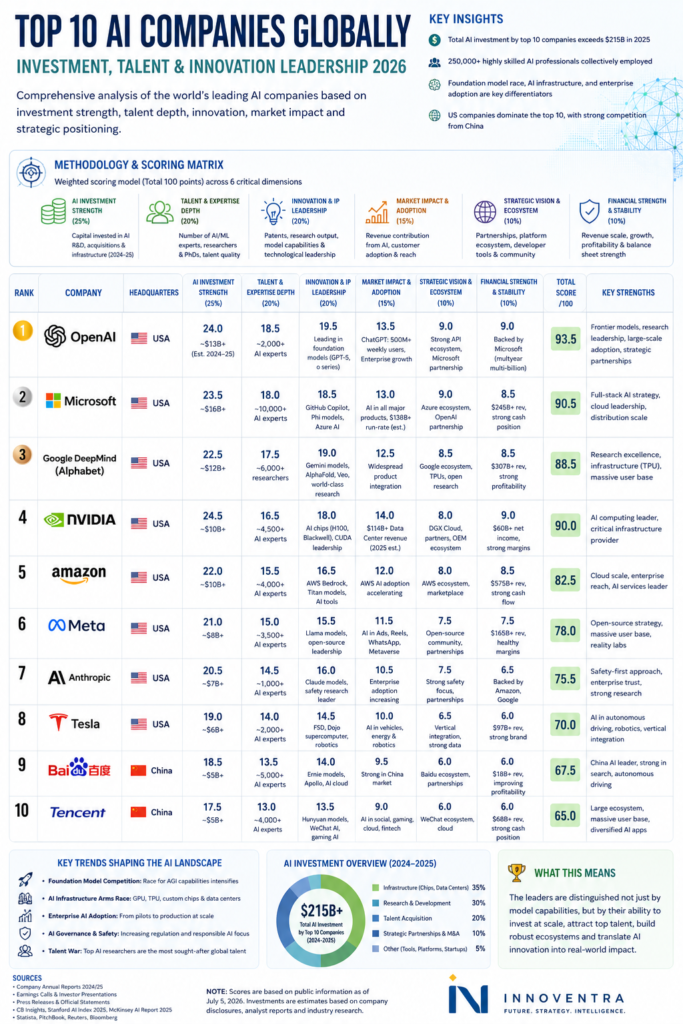
Our assessment of OpenAI, Microsoft, Alphabet, NVIDIA, Amazon, Meta, Anthropic, Tesla, Baidu and Tencent therefore examines six interconnected dimensions:
AI investment, research capability, innovation, market adoption, ecosystem strength and financial resilience.
The central conclusion is clear: the AI race is no longer simply a model competition. It is a contest to control the full technology stack.
Four Different Models of AI Leadership
The companies in the ranking do not compete in identical ways.
OpenAI and Anthropic represent the frontier-laboratory model. Their advantage comes from advanced models, specialist research talent, developer adoption and rapidly expanding enterprise platforms. Their central challenge is structural: training and operating frontier systems require immense capital, computing capacity and dependable infrastructure partners.
Microsoft, Alphabet and Amazon follow the integrated-platform model. They can develop or access advanced models, operate global cloud infrastructure and distribute AI directly through software already used by millions of organisations. Microsoft can embed AI in Azure, Microsoft 365 and GitHub; Alphabet can integrate it across Search, Workspace, Android, Cloud and YouTube; Amazon can commercialise models and infrastructure through AWS.
This distribution advantage may ultimately prove as important as model quality. A technically superior system does not automatically win when a competitor can place a sufficiently capable alternative inside established customer workflows.
NVIDIA occupies the enabling-infrastructure position. Its importance is demonstrated by financial performance rather than publicity: NVIDIA reported fiscal 2026 revenue of $215.9 billion, up 65%, with data-centre revenue reaching approximately $194 billion. This indicates that demand is not limited to individual AI products; organisations across the market are purchasing the computing foundations required to build them.
Meta, Tesla, Baidu and Tencent demonstrate applied ecosystem strategies. Meta combines large-scale consumer distribution, advertising data, open-model development and infrastructure investment. Tesla applies AI to vehicles, robotics and physical-world automation. Baidu and Tencent combine substantial domestic user bases with cloud services, digital platforms and access to China’s broader technology ecosystem.
Computing Power Is Becoming a Strategic Barrier
The strongest evidence of the changing competitive landscape is the scale of infrastructure spending.
Microsoft said it was on course to invest approximately $80 billion in AI-enabled data centres during its 2025 financial year. Amazon recorded $128.3 billion in cash capital expenditure during 2025, mainly for technology infrastructure supporting AWS and fulfilment capacity. Meta invested $72.22 billion, while Alphabet has projected 2026 capital expenditure of between $175 billion and $185 billion.
These figures reveal a critical shift. The competitive moat around AI is increasingly physical as well as digital. It includes:
- data centres and energy supply;
- GPUs and proprietary processors;
- high-speed networking;
- cloud capacity;
- access to training data;
- the ability to finance infrastructure before revenue is realised.
This makes it progressively harder for standalone laboratories and smaller challengers to compete without strategic partnerships. It also strengthens the influence of cloud providers and chip manufacturers over the direction and economics of AI development.
Infographic ranking the world’s top 10 AI companies in 2026 based on AI investment, talent, innovation, market adoption, ecosystem strength and financial resilience.
Investment Is Necessary but Commercial Conversion Is Decisive
Capital expenditure alone does not establish leadership. It creates capacity, but organisations must still convert that capacity into products customers will use and pay for.
This is where many corporate AI programmes remain weak. McKinsey reported that 78% of surveyed organisations were using AI in at least one business function in its 2025 study, up from 55% one year earlier. Yet adoption ranged from limited experimentation to genuine redesign of business processes. The gap between using AI and generating enterprise-wide value remains substantial.
The leading companies have stronger conversion mechanisms:
- Microsoft connects models to enterprise productivity and development tools.
- Amazon sells infrastructure and model access through AWS.
- Alphabet can improve and monetise search, advertising and cloud services.
- Meta applies AI directly to recommendation systems and advertising performance.
- NVIDIA earns revenue regardless of which application or model provider ultimately succeeds.
This suggests that the most resilient AI companies will not necessarily own the single highest-scoring model. They will control several points where AI value is created and captured.
Talent Remains Scarce, but Systems Matter More Than Individuals
Elite researchers remain important, particularly at the frontier. However, concentrating exclusively on prominent scientists can obscure the wider capabilities required to commercialise AI.
Leadership also depends on semiconductor engineers, data-centre specialists, product managers, cybersecurity teams, energy experts, regulatory professionals and industry specialists who can translate models into reliable services.
The real advantage is therefore not simply possessing talent. It is building an organisational system in which research, infrastructure, product development, governance and distribution reinforce one another.
Trust Is Becoming a Commercial Capability
As AI moves into banking, healthcare, government and critical infrastructure, performance alone will be insufficient. Enterprise customers increasingly need evidence of security, data protection, reliability, monitoring and regulatory compliance.
Trust should therefore be treated as part of product quality rather than a separate ethics exercise. Providers capable of demonstrating effective governance may achieve stronger adoption in regulated markets, even where competitors offer marginally better benchmark performance.
Innoventra Perspective
The defining feature of AI leadership in 2026 is system-level strength.
OpenAI and Anthropic demonstrate the value of frontier research. Microsoft, Alphabet and Amazon demonstrate the power of infrastructure and distribution. NVIDIA shows that supplying the foundational layer can be more commercially powerful than competing for consumer attention. Meta, Tesla, Baidu and Tencent illustrate how proprietary data, existing platforms and specialised applications create alternative routes to leadership.
For business leaders, the lesson is not to imitate their expenditure. It is to adopt the same strategic logic: identify where AI creates measurable value, secure dependable infrastructure, redesign workflows, develop workforce capability and establish governance before scaling.
The organisations that succeed will not be those conducting the largest number of AI experiments. They will be those that build the strongest system for converting AI capability into sustained economic value.