
Top AI Companies 2026: The World’s 20 Most Powerful Artificial Intelligence Leaders, Ranked Using 50 Evidence-Based Indicators (Part 1)
Category: AI Strategy | Enterprise Technology | Digital Transformation
Reading time: 8–10 minutes
Executive Summary
Artificial intelligence has become the largest corporate technology investment cycle in modern history.
In 2026 alone, Amazon, Microsoft, Alphabet and Meta are collectively expected to invest approximately $650 billion in AI infrastructure, representing one of the largest coordinated technology investment programmes ever undertaken by the private sector. Forecasts suggest this could rise towards $725 billion as infrastructure demand continues to accelerate.
This is no longer simply a race to build better AI models.
It is a competition to build the world’s most powerful AI ecosystems.
Companies are competing across:
- frontier AI research
- semiconductor leadership
- hyperscale cloud infrastructure
- proprietary datasets
- enterprise software
- robotics
- cybersecurity
- scientific discovery
- AI talent
- responsible governance
The organisations leading in these areas will shape global productivity, economic growth and technological innovation throughout the next decade.
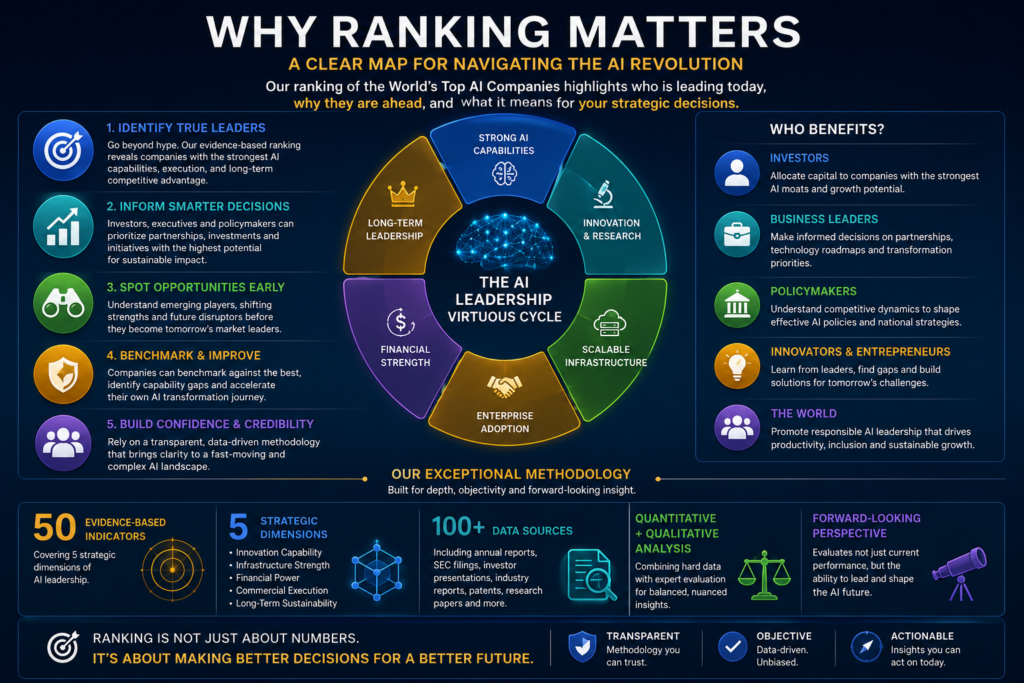
Rather than ranking companies purely by market capitalisation or investor sentiment, Innoventra developed a structured assessment using 50 evidence-based indicators covering innovation capability, financial resilience, AI infrastructure, commercial execution and long-term strategic positioning.
The results reveal an important insight.
The next generation of AI winners will not necessarily be those building the largest language models. They will be organisations capable of integrating research, infrastructure, products, talent and governance into sustainable competitive ecosystems.
1. NVIDIA
Overall Score: 98/100
No company has benefited more from the AI revolution than NVIDIA.
Its GPUs power much of the world’s frontier AI training infrastructure, while CUDA has evolved into one of the strongest software ecosystems in enterprise computing.
NVIDIA’s competitive advantage extends beyond hardware.
It combines:
- GPUs
- networking
- software platforms
- AI libraries
- developer ecosystems
- enterprise partnerships
This creates exceptionally high switching costs.
Innoventra Insight
The real competitive advantage is no longer GPU performance.
It is ecosystem lock-in.
Competitors can manufacture chips.
Replicating NVIDIA’s software ecosystem is significantly harder.
2. Microsoft
Overall Score: 97/100
Microsoft has arguably commercialised AI more effectively than any other organisation.
Unlike many competitors, it has integrated AI across:
- Microsoft 365
- GitHub
- Azure
- Dynamics
- Security
- Windows
Its strategic relationship with OpenAI accelerated enterprise adoption while strengthening Azure’s competitive position.
The company’s AI strategy is less about creating individual products and more about embedding AI across an existing software ecosystem used by hundreds of millions of customers.
Innoventra Insight
Microsoft’s greatest strength is not AI research.
It is enterprise distribution.
Very few organisations possess comparable access to enterprise customers.
3. Alphabet
Overall Score: 95/100
Alphabet remains one of the world’s strongest AI research organisations.
DeepMind continues producing pioneering research across:
- multimodal AI
- scientific discovery
- reinforcement learning
- medicine
- robotics
Combined with Google Cloud and Search, Alphabet possesses one of the world’s largest AI deployment platforms.
Its challenge has never been scientific capability.
It has been converting research leadership into commercial leadership faster than competitors.
Innoventra Insight
Alphabet possesses arguably the strongest scientific AI capability in the world.
The next competitive battleground is commercial execution.The Next Generation of AI Leaders (Ranks 4–20)
4. Amazon
Overall Score: 94/100
Amazon’s AI strategy extends far beyond generative AI. AWS remains one of the world’s largest AI infrastructure providers, while AI increasingly underpins logistics, fulfilment, robotics, supply chain optimisation and customer experience.
Amazon’s scale allows it to commercialise AI simultaneously across cloud services, retail and operations—creating a competitive advantage that few organisations can replicate.
Innoventra Insight
Amazon’s greatest strength is operational AI. It is quietly embedding AI into one of the world’s largest physical and digital ecosystems.
5. Meta
Overall Score: 92/100
Meta has rapidly emerged as one of the largest investors in frontier AI, developing increasingly capable open-weight models while investing heavily in AI infrastructure.
Unlike many competitors, Meta is using AI to strengthen advertising, content recommendation, creator tools and emerging consumer experiences.
Its willingness to open-source parts of its AI stack has also accelerated global adoption.
6. Apple
Overall Score: 90/100
Apple has adopted a different strategy.
Rather than competing to build the largest AI models, Apple focuses on privacy-preserving, on-device intelligence integrated tightly with hardware.
As edge AI becomes increasingly important, Apple’s vertically integrated ecosystem could become a significant competitive advantage.
7. OpenAI
Overall Score: 89/100
OpenAI fundamentally changed public awareness of generative AI.
Its leadership in foundation models accelerated enterprise adoption worldwide.
The challenge now is maintaining research leadership while scaling commercially in an increasingly competitive market.
8. Oracle
Overall Score: 87/100
Oracle has repositioned itself as a major AI infrastructure provider by expanding cloud capabilities and enterprise AI partnerships.
Its strengths lie in enterprise applications, databases and regulated industries where trust and security remain essential.
9. AMD
Overall Score: 85/100
AMD continues strengthening its AI accelerator portfolio.
Although it trails NVIDIA in ecosystem maturity, growing enterprise demand for alternative AI hardware creates significant opportunities.
10. Broadcom
Overall Score: 84/100
Broadcom has become increasingly important in AI networking, connectivity and custom silicon.
As AI clusters continue expanding, networking performance may become almost as important as processor performance.