
Top Universities for Artificial Intelligence are becoming increasingly important as artificial intelligence reshapes economies, industries and careers. Universities are under growing pressure to produce graduates capable of designing, governing and applying intelligent technologies responsibly.. As organisations race to adopt AI, universities are under increasing pressure to produce graduates capable of designing, governing and applying intelligent technologies responsibly. Yet one question is becoming increasingly important for students worldwide: will simply earning a university degree be enough in an AI-driven economy? Current evidence suggests the answer is no. The future will belong not only to graduates from world-class institutions but also to those who continuously develop practical AI capabilities, interdisciplinary knowledge and uniquely human skills.
Artificial Intelligence Is Redefining Higher Education
Universities have always played a central role in preparing future scientists, engineers, entrepreneurs and public leaders. Today, artificial intelligence is fundamentally changing what students need to learn and how universities must prepare them.
According to the World Economic Forum’s Future of Jobs Report 2025, technological change, AI adoption and digital transformation will reshape a substantial proportion of workplace skills by 2030, making analytical thinking, AI literacy, resilience and lifelong learning among the fastest-growing competencies demanded by employers. Likewise, the OECD, International Monetary Fund (IMF) and Stanford AI Index Report conclude that AI is becoming a foundational technology across almost every sector of the global economy.
This means universities are no longer simply competing to educate graduates. They are competing to produce future AI researchers, engineers, policymakers, entrepreneurs and innovators capable of leading technological transformation.
Which Universities Are Leading AI Research?
While no universally accepted ranking exists for “AI graduate production,” several institutions consistently appear among global leaders in artificial intelligence research, publications, citations and academic reputation.
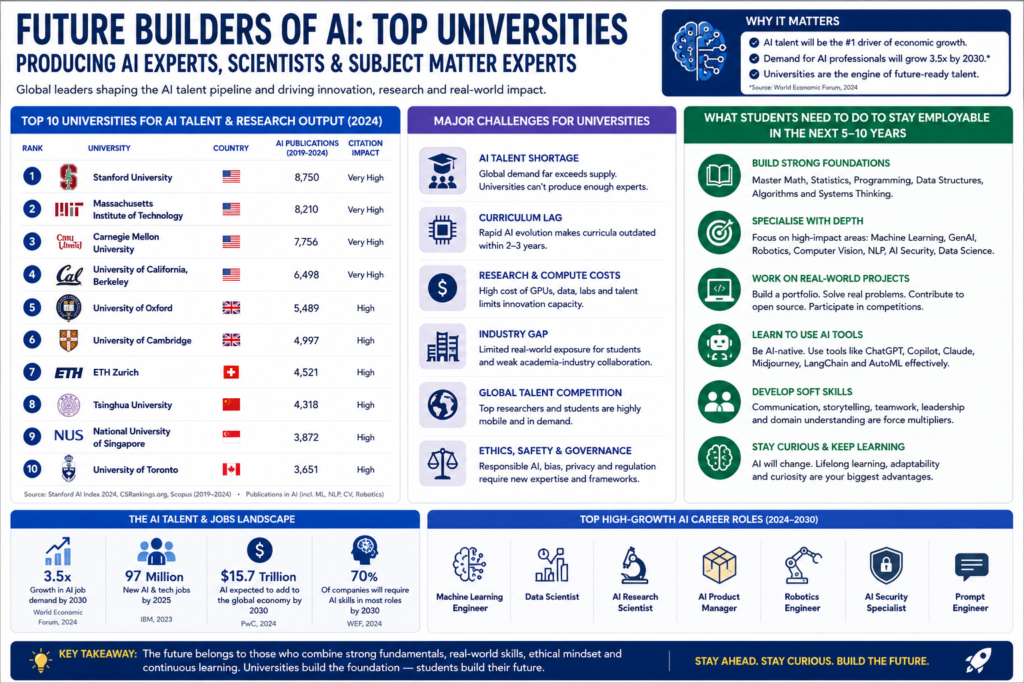
Universities such as Stanford University, Massachusetts Institute of Technology (MIT), Carnegie Mellon University, University of California, Berkeley, University of Oxford, University of Cambridge, ETH Zurich, Tsinghua University, National University of Singapore and the University of Toronto regularly feature prominently across internationally recognised assessments of AI research strength, including the Stanford AI Index, CSRankings, Scopus, and global university rankings.
These institutions share several characteristics:
- World-leading AI researchers.
- Strong interdisciplinary collaboration.
- Significant investment in computing infrastructure.
- Close partnerships with technology companies.
- Access to large-scale research funding.
- Strong publication and citation performance.
However, their greatest advantage is not simply prestige it is their ability to integrate research, industry and education into a single innovation ecosystem.
Why Many Universities Face Growing Challenges
Artificial intelligence is evolving much faster than traditional university curricula.
Developing a new degree programme often takes several years, while AI technologies can change dramatically within months. This creates a widening gap between what students learn and what employers increasingly expect.
The challenge extends beyond curriculum design. Universities must also compete for world-class researchers, invest in expensive computing infrastructure and provide students with opportunities to apply AI in real-world settings.
The World Economic Forum highlights persistent shortages of AI talent across many sectors, while reports from organisations including McKinsey & Company and IBM indicate that employers increasingly struggle to recruit professionals with practical AI capabilities despite growing numbers of technology graduates.
The issue is therefore not simply producing more graduates, but producing graduates with the right combination of technical knowledge, adaptability and practical experience.
Why Degrees Alone Will No Longer Guarantee Employment
For decades, a university degree represented one of the strongest predictors of career success. In the AI era, that relationship is becoming more complex.
Large language models, generative AI systems and intelligent automation can already assist with software development, data analysis, report writing, coding, research and administrative tasks. Employers are therefore placing increasing emphasis on what graduates can actually do rather than which modules they completed.
Professional portfolios, open-source contributions, internships, research projects, AI certifications and practical problem-solving increasingly complement traditional academic qualifications.
Graduates who combine formal education with demonstrable real-world experience are likely to enjoy a significant competitive advantage in future recruitment.
The Skills Employers Will Value Most
Although technical expertise remains important, evidence increasingly suggests that future employability will depend on a broader combination of capabilities.
Employers are seeking professionals who can understand AI while also applying judgement, creativity and communication.
The most valuable skills over the next decade are likely to include:
- Artificial intelligence literacy.
- Machine learning fundamentals.
- Data science and statistics.
- Cloud computing.
- Cybersecurity.
- Responsible AI and AI governance.
- Critical thinking.
- Communication and collaboration.
- Leadership.
- Ethical decision-making.
- Systems thinking.
- Adaptability and continuous learning.
The World Economic Forum consistently identifies analytical thinking, resilience, curiosity and lifelong learning among the fastest-growing workplace competencies.
In other words, future graduates will need to develop both technical expertise and human capabilities that AI cannot easily replicate.
Innoventra Insight: The Rise of the AI-Native Graduate
Innoventra believes higher education is entering a new era characterised by what can be described as the AI-Native Graduate.
Just as digital literacy became an essential skill during the internet age, AI literacy is rapidly becoming a baseline expectation across professions.
Future graduates are unlikely to succeed by avoiding AI. Instead, they will distinguish themselves through their ability to work alongside intelligent systems, evaluate AI-generated outputs critically and apply technology responsibly.
Employers are increasingly seeking individuals who understand not only how AI works but also where its limitations lie and how it can be governed ethically.
The AI-native graduate therefore combines technical capability with sound judgement, creativity and continuous learning.
Practical Steps Every Student Should Take Today
Regardless of which university students attend, there are several practical actions that can significantly improve long-term employability.
Students should:
- Build a strong foundation in mathematics, statistics and programming.
- Learn how modern AI tools are used professionally.
- Develop expertise in high-growth areas such as machine learning, cybersecurity, cloud computing or AI governance.
- Participate in internships and industry placements.
- Build an online portfolio demonstrating practical work.
- Contribute to open-source projects where appropriate.
- Develop communication and leadership skills.
- Continue learning through professional certifications and independent study.
Perhaps most importantly, students should cultivate curiosity. AI technologies are evolving so rapidly that lifelong learning is becoming a professional necessity rather than an optional advantage.
Governments and Universities Must Adapt Together
Preparing future generations for AI requires collaboration beyond individual institutions.
Governments should continue investing in digital infrastructure, research funding and AI education. Universities should modernise curricula more rapidly, strengthen partnerships with industry and expand interdisciplinary AI programmes that combine technology with ethics, business, law, healthcare and public policy.
Equally important is widening access. AI education should not become the preserve of a small number of elite institutions. Expanding opportunities for students from diverse backgrounds will help ensure that AI innovation benefits society as a whole.
Conclusion: Universities Build Foundations—Students Build Futures
Artificial intelligence is transforming higher education, but it is also transforming the definition of career readiness.
The world’s leading universities will continue producing exceptional researchers and innovators. Yet the future is unlikely to belong exclusively to graduates from prestigious institutions. Instead, it will belong to those who embrace continuous learning, combine technical excellence with human judgement and remain adaptable throughout their careers.
A university degree remains an important foundation. However, in an AI-driven economy, employability will increasingly depend on curiosity, practical experience, ethical responsibility and the willingness to learn continuously.
The future builders of artificial intelligence will not simply be those who attend the world’s best universities.
They will be those who never stop building themselves.