
Evidence-Based Analysis Using the Innoventra AI Resilience Index
Estimated reading time: 8 minutes
Executive Summary
Artificial intelligence is transforming the global labour market faster than any previous digital technology. From autonomous software engineering and AI-powered legal research to medical diagnostics and intelligent manufacturing, organisations are redesigning work around increasingly capable AI systems. As a result, one question has become one of the most searched career topics worldwide:
Which jobs are safe from AI?
The answer, however, is more nuanced than many headlines suggest.
While artificial intelligence will automate millions of individual tasks over the coming decade, the latest evidence indicates that far fewer occupations are likely to disappear entirely. Instead, most careers will evolve, with AI assuming routine and predictable activities while increasing the value of uniquely human capabilities such as judgement, creativity, leadership and trust.
This distinction is supported by a growing body of international research.
The World Economic Forum’s Future of Jobs Report 2025 estimates that 22% of today’s jobs will experience structural change by 2030, equivalent to around 1.2 billion workers worldwide. Yet, contrary to widespread fears, employers expect technological change to create 170 million new jobs, while displacing approximately 92 million, resulting in a net gain of 78 million jobs globally. The same report found that 85% of employers plan to prioritise workforce upskilling, while around 70% expect to recruit people with AI-related capabilities, highlighting that adaptation not replacement is becoming the defining workforce challenge.
This is reinforced by research from the OECD, which concludes that AI exposure should not be confused with job loss. Occupations with high AI exposure often experience task redesign rather than elimination, particularly where professionals retain responsibility for judgement, ethics, client relationships or regulatory accountability. Likewise, Goldman Sachs Research argues that AI’s long-term economic impact will depend less on replacing workers and more on augmenting human productivity across knowledge-intensive industries.
In other words, the careers most likely to thrive are not those untouched by AI. They are the careers where AI enhances professional performance while people remain responsible for decisions, accountability and outcomes.
That distinction underpins this analysis.
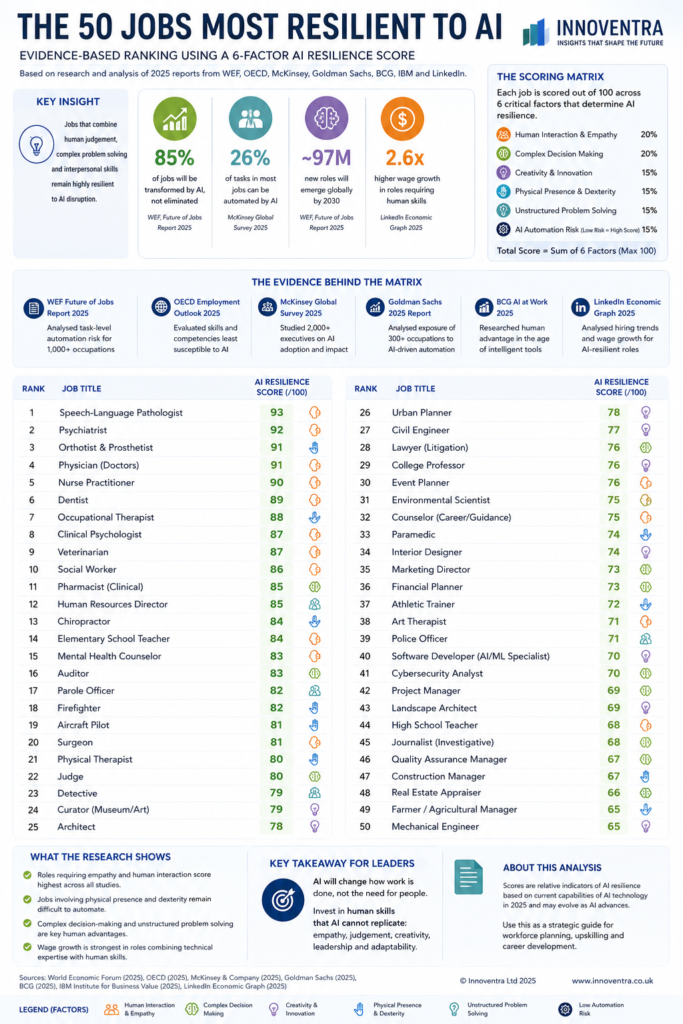
Rather than dividing occupations into simplistic categories of “safe” and “unsafe”, Innoventra has developed an AI Resilience Index that evaluates careers against six characteristics consistently identified in international research as reducing automation risk and increasing long-term labour-market resilience.
Why Some Careers Are Becoming More Valuable in the Age of AI
The public debate surrounding artificial intelligence has largely focused on replacement. Yet the evidence increasingly points towards transformation.
Historically, technological revolutions have automated repetitive work while increasing demand for higher-value human skills. Artificial intelligence appears to be following a similar pattern—but at unprecedented speed.
Microsoft’s 2025 Work Trend Index, based on surveys of 31,000 employees across 31 countries and trillions of Microsoft 365 productivity signals, found that organisations are rapidly moving from AI assistants towards autonomous AI agents capable of completing increasingly sophisticated business tasks. However, the report also concluded that leaders are redesigning organisations around “human-agent teams” rather than fully autonomous enterprises.
Similarly, LinkedIn’s Economic Graph research shows that hiring demand is increasingly shifting towards professionals who combine technical capability with communication, leadership and strategic thinking. Jobs requiring only routine information processing are becoming more exposed, while occupations demanding judgement across uncertain, high-consequence environments continue to command wage premiums.
The implication is clear.
Artificial intelligence excels when problems are predictable, rules are explicit and success can be measured objectively.
Human professionals remain indispensable when situations involve uncertainty, ethics, empathy, negotiation, accountability or creative problem-solving.
That explains why surgeons, psychologists, engineers, emergency responders, skilled trades, teachers and cybersecurity specialists continue to rank highly despite rapid advances in AI.
The Innoventra AI Resilience Framework
To move beyond speculation, Innoventra reviewed occupational research, workforce forecasts and enterprise AI adoption studies published by organisations including the World Economic Forum, OECD, McKinsey & Company, Goldman Sachs, Microsoft, LinkedIn, IBM Institute for Business Value, Stanford HAI and Anthropic.
From this evidence, six characteristics consistently emerged as the strongest indicators of long-term career resilience.
Human Judgement and Ethical Accountability (20%)
Occupations requiring professionals to make complex decisions with legal, ethical or societal consequences remain difficult to automate because responsibility cannot easily be delegated to AI.
Complex Decision-Making Under Uncertainty (20%)
Careers involving incomplete information, changing environments or competing priorities continue to rely heavily on human reasoning rather than algorithmic optimisation.
Interpersonal Trust and Emotional Intelligence (15%)
Professions built upon empathy, persuasion, coaching, negotiation and long-term relationships remain significantly more resilient than transactional roles.
Creativity and Innovation (15%)
Although generative AI accelerates ideation, organisations continue to depend upon human originality, strategic insight and contextual creativity to solve novel challenges.
Physical Adaptability and Dexterity (15%)
Many occupations involving unpredictable physical environments, fine motor skills or real-world adaptation remain technically difficult and economically expensive to automate.
Professional Accountability and Regulation (15%)
Healthcare, law, public services, engineering and other regulated professions require qualified individuals to remain accountable for decisions, regardless of how much AI contributes to the process.
Together, these six dimensions form the Innoventra AI Resilience Score, providing a comparative framework for evaluating how occupations are likely to evolve as AI capabilities continue to improve.
Key Insight
The infographic accompanying this report reveals an important pattern that many discussions about AI overlook.
The highest-ranked careers are not necessarily the most technical.
Instead, they combine multiple forms of human expertise simultaneously.
Healthcare professionals dominate the highest resilience scores because they combine clinical judgement, empathy, ethical accountability and complex decision-making. Skilled engineers remain resilient because they solve novel real-world problems under changing conditions. Cybersecurity professionals continue to gain importance because AI increases both defensive capability and the sophistication of cyber threats.
Perhaps the most surprising finding is that human capability not technical complexity alone has become the strongest predictor of long-term career resilience.
Artificial intelligence is undoubtedly transforming work. Yet the evidence increasingly suggests that its greatest impact will not be replacing professionals wholesale, but elevating the importance of the skills that remain uniquely human.
The Most Resilient Careers Have Four Characteristics in Common
At first glance, the rankings reveal a diverse mix of healthcare professionals, engineers, educators, emergency responders, skilled trades, legal professionals and technology specialists. However, beneath this diversity lies a remarkably consistent pattern.
The occupations that scored highest within the Innoventra AI Resilience Index combine four characteristics that today’s AI systems continue to struggle to replicate reliably:
- sophisticated judgement under uncertainty;
- accountability for high-consequence decisions;
- interpersonal trust and communication; and
- adaptability in complex physical or social environments.
This finding aligns closely with international labour-market research. The OECD’s occupational AI exposure framework concludes that jobs involving interpersonal interaction, decision-making and responsibility for outcomes are generally less susceptible to automation than occupations centred on routine information processing. Similarly, the World Economic Forum identifies analytical thinking, resilience, leadership and creative problem-solving among the fastest-growing workplace capabilities expected by employers through 2030.
Rather than replacing these professions, artificial intelligence is increasingly becoming a powerful decision-support tool.
Healthcare Dominates the Rankings For Good Reason
One of the clearest findings from the analysis is the dominance of healthcare professions.
Speech-language pathologists, psychiatrists, physicians, occupational therapists, clinical psychologists, nurses, physiotherapists and veterinarians all achieve exceptionally high resilience scores.
This is not because healthcare is immune to AI.
In fact, healthcare is becoming one of the world’s largest adopters of artificial intelligence.
AI systems are already demonstrating remarkable capability in medical imaging, clinical documentation, pathology, drug discovery and administrative workflows. Research published by major technology companies and healthcare institutions shows that AI can improve diagnostic accuracy in specific domains while reducing administrative burden for clinicians.
Yet diagnosis represents only one component of healthcare.
The highest-value activities involve understanding incomplete information, balancing competing risks, communicating uncertainty, gaining patient trust, making ethical decisions and assuming legal responsibility for outcomes. These capabilities remain fundamentally human.
The consequence is that AI is expected to increase the productivity of clinicians rather than eliminate the professions themselves.
Engineering Is Becoming More Valuable Not Less
Many people assume engineering faces significant automation because of advances in generative design and AI-assisted software.
The evidence suggests the opposite.
Civil engineers, architects and mechanical engineers continue to score highly because modern engineering extends far beyond technical calculations.
Major infrastructure programmes require professionals to balance safety, environmental regulation, stakeholder interests, commercial constraints and long-term resilience.
Artificial intelligence can rapidly evaluate design options and identify optimisation opportunities.
Engineers determine which solution should actually be implemented.
As governments worldwide invest heavily in energy infrastructure, semiconductor manufacturing, transport networks and climate adaptation, demand for experienced engineers is expected to remain strong despite increasing automation.
Skilled Human Interaction Has Become an Economic Advantage
Perhaps the most significant insight from the rankings is that human interaction is rapidly becoming an economic differentiator rather than simply a social skill.
Psychologists.
Teachers.
Counsellors.
Social workers.
Human resource leaders.
Financial advisers.
These professions depend upon trust.
Large language models can provide information.
They cannot genuinely understand personal circumstances, negotiate conflicting priorities or accept professional accountability for advice that changes someone’s life.
LinkedIn’s workforce analysis increasingly shows that communication, leadership and relationship management remain among the most valuable capabilities employers seek as AI adoption accelerates.
Ironically, the more organisations automate routine work, the greater the value placed on professionals who excel at working with people.
Cybersecurity Illustrates Why AI Creates New Jobs
Cybersecurity appears only once within the top rankings, yet it provides one of the strongest examples of how AI reshapes employment rather than simply reducing it.
Artificial intelligence enables organisations to identify threats faster than ever before.
At the same time, attackers are using AI to create increasingly sophisticated phishing campaigns, malware variants and automated reconnaissance.
Every improvement in defensive capability is matched by advances in offensive capability.
This creates a continuous cycle of innovation requiring experienced analysts capable of interpreting intelligence, managing incidents and making strategic decisions under pressure.
Rather than replacing cybersecurity professionals, AI is increasing the scale and complexity of the work they perform.
The Fastest-Growing Skills Are Changing
The infographic demonstrates that occupations scoring highly share another important characteristic.
They require capabilities that consistently appear across global employer surveys.
According to the World Economic Forum, the fastest-growing skills include analytical thinking, resilience, flexibility, leadership, creative thinking, AI literacy and lifelong learning.
Notice what is absent from that list.
Specific software.
Programming languages.
Individual AI tools.
Technical tools will continue to evolve.
Human capability compounds over decades.
That is why organisations increasingly recruit professionals who combine domain expertise with AI capability rather than AI expertise alone.
In other words, employers are no longer asking:
“Can you use AI?”
They are asking:
“Can you produce better decisions because you understand both AI and your profession?”
AI Will Transform Every Career in This Ranking
One important clarification should accompany every discussion about AI-proof careers.
None of the occupations in this report will remain unchanged.
Doctors will increasingly work alongside diagnostic AI.
Lawyers will use AI-assisted legal research.
Teachers will rely upon personalised learning platforms.
Architects will generate design concepts using AI.
Engineers will collaborate with intelligent simulation tools.
Software developers will increasingly supervise AI-generated code.
Artificial intelligence is therefore becoming a universal productivity technology rather than a substitute for professional expertise.
The competitive advantage will belong to professionals who learn to integrate AI into their daily practice while strengthening the capabilities that machines cannot easily replicate.
What This Means for Individuals, Employers and Governments
The implications extend far beyond career planning.
For individuals, the findings suggest that investing in judgement, communication, leadership and domain expertise may provide greater long-term resilience than focusing solely on technical tools that evolve rapidly.
For employers, competitive advantage is increasingly determined by how effectively organisations redesign work around collaboration between people and AI, rather than viewing automation simply as a mechanism for reducing headcount.
For universities and policymakers, the evidence reinforces the need to redesign education around interdisciplinary thinking, ethical reasoning, AI literacy and lifelong learning. Producing graduates who can work effectively alongside intelligent systems is likely to become more important than teaching proficiency in any single technology.
Conclusion
The question should never have been “Which jobs will AI replace?”
The more important question is:
“Which human capabilities become more valuable as AI becomes more capable?”
The evidence reviewed throughout this report provides a remarkably consistent answer.
Careers built upon judgement, trust, creativity, accountability and complex decision-making continue to demonstrate the greatest resilience.
Artificial intelligence will undoubtedly reshape every profession represented in the Innoventra AI Resilience Index.
However, the highest-ranked occupations share one defining characteristic.
They place humans not machines at the centre of the decisions that matter most.
That may ultimately prove to be the most valuable career advantage of the AI era.