Category: AI Healthcare | Digital Health | Artificial Intelligence
Reading time: 8 minutes
Executive Summary
At 11:47 p.m., a young mother notices her two-year-old daughter has developed a rash across her chest. The GP surgery is closed. NHS 111 is busy. Searching Google returns thousands of conflicting results, ranging from harmless viral infections to life-threatening meningitis.
Instead, she opens ChatGPT.
Within seconds, the AI asks follow-up questions, explains possible causes in plain English and advises which symptoms would require urgent medical attention.
This scenario is no longer unusual.
Millions of people are now turning to conversational AI before contacting a doctor, creating one of the most significant behavioural shifts in healthcare since the rise of internet search. What began as an experimental technology is rapidly becoming the world’s newest source of health information.
The numbers illustrate the scale of this transformation. Researchers analysing more than 500,000 anonymised health conversations with Microsoft Copilot found that nearly one in five involved personal symptom assessment or discussion of a medical condition. Health-related conversations increased significantly during evenings and overnight the very periods when access to traditional healthcare is most limited.
Yet the real story is not simply that people are using AI.
It is why.
Healthcare has always suffered from three persistent problems: uncertainty, waiting and accessibility. Artificial intelligence appears to reduce all three.
But can it replace clinical judgement?
Not even its creators claim that.
Instead, a more important question is emerging:
Could AI become the world’s first healthcare assistant, while doctors remain its final decision-makers?
The Rise of AI as the First Stop for Health Questions
Title: How Patients Are Changing Their Healthcare Journey
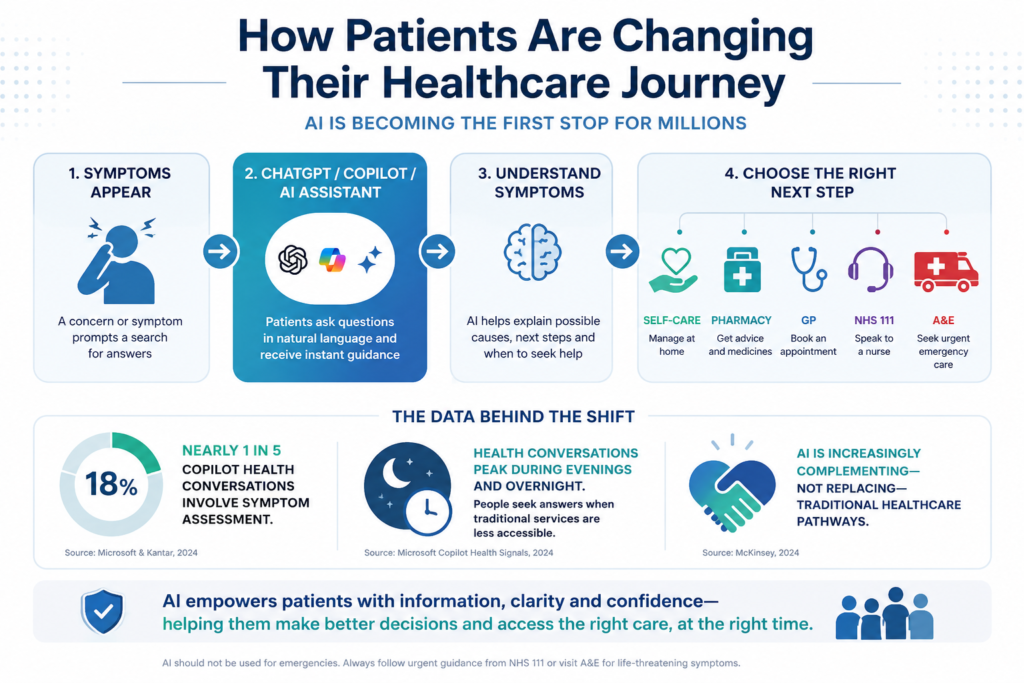
Why Millions Are Asking AI Before Their Doctor
Healthcare decisions are rarely made in hospitals.
They begin in kitchens.
Living rooms.
Bedrooms.
Cars.
At work.
Psychologists have long recognised that uncertainty creates anxiety, particularly when it involves personal health. Research in behavioural science shows people naturally seek information that reduces uncertainty as quickly as possible. In the past, that often meant asking family members or searching Google. Today, conversational AI offers something previous technologies could not: an interactive dialogue that feels immediate, personalised and available at any hour.
Unlike a traditional search engine, AI does not simply provide a list of websites.
It asks questions.
It remembers previous answers.
It explains unfamiliar medical terminology.
It can adapt its responses based on new information.
That conversational experience fundamentally changes how people seek reassurance.
Researchers from Microsoft found that symptom questions, emotional wellbeing and healthcare navigation dominate many AI health conversations, particularly on mobile devices where people are more likely to discuss their own health concerns. Desktop users, by contrast, are more likely to use AI for academic or professional medical work.
This distinction matters because it reveals something much deeper than technology adoption.
It reveals a change in human behaviour.
People are no longer searching for information.
They are searching for conversation.
A Healthcare System Under Pressure
The growth of AI health assistants is not occurring in isolation.
It reflects growing pressure on healthcare systems around the world.
Across many countries, patients face increasing demand for primary care, ageing populations, workforce shortages and longer waiting times. In the UK, NHS England has responded by accelerating investment in digital technologies, including AI-powered triage within the NHS App, designed to help patients reach the most appropriate service more quickly.
Early trials have produced encouraging results.
A pilot in Sussex reported a 29% reduction in telephone queues after introducing AI-supported triage, while maintaining patient satisfaction. The wider NHS digital programme is expected to generate approximately £41 billion in benefits over the coming decade through improved efficiency and productivity.
These developments illustrate an important shift.
Healthcare organisations are no longer asking whether AI has a role.
They are deciding where it can safely deliver the greatest value.
The New Patient Journey
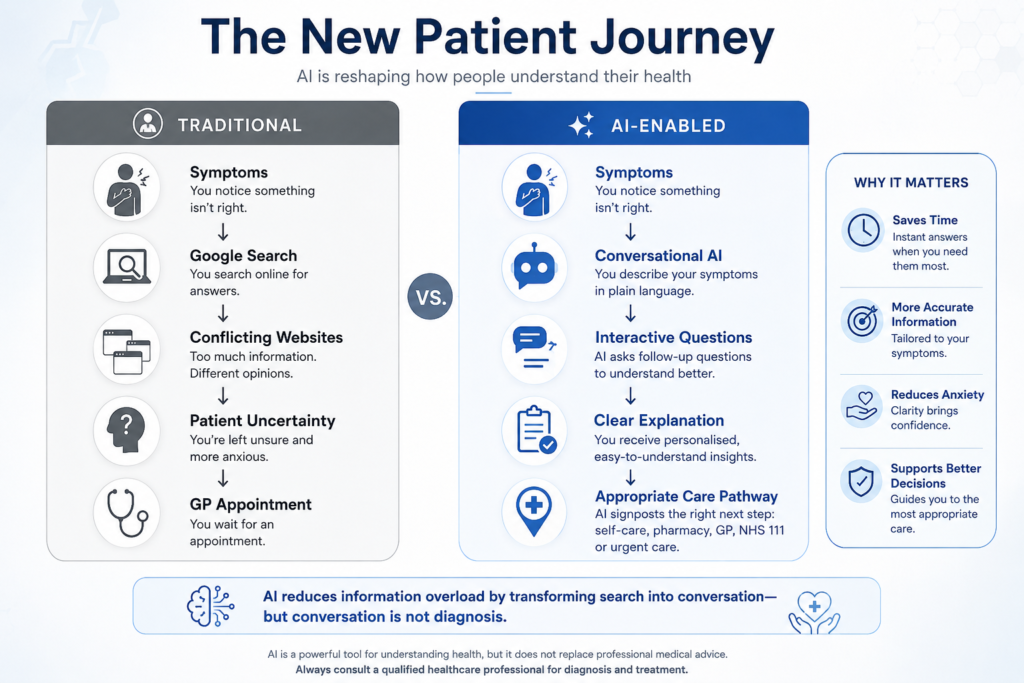
Can AI Actually Understand Your Symptoms?
Perhaps surprisingly, the answer is becoming more complicated.
Over the past two years, large language models have demonstrated remarkable performance in structured medical examinations and clinical reasoning benchmarks. However, real-world healthcare is very different from answering exam questions.
Patients rarely describe symptoms clearly.
Important details are omitted.
Medical histories are incomplete.
Descriptions are emotional rather than clinical.
That distinction matters enormously.
Recent research involving nearly 14,000 real-world participants evaluating an AI symptom assessment system found that conversational AI achieved significantly better diagnostic performance when it first conducted a structured symptom interview rather than immediately attempting to generate possible diagnoses. The findings suggest that asking better questions not simply providing faster answers may be one of AI’s greatest strengths in healthcare.
In other words, artificial intelligence performs best when it behaves less like a search engine and more like an experienced clinician taking a medical history.
That insight aligns closely with decades of clinical practice.
Doctors rarely diagnose patients within seconds.
They ask questions first.
Why AI Feels Different From Google
Google transformed healthcare by making information universally accessible.
Artificial intelligence is transforming healthcare by making information conversational.
This distinction helps explain why so many people report preferring AI for their first health query.
Instead of choosing between ten blue links, patients can describe symptoms naturally:
“I’ve had stomach pain for three days, feel nauseous after eating and now have a temperature.”
The AI can ask:
- Where exactly is the pain?
- When did it begin?
- Have you vomited?
- Do you have any existing medical conditions?
- Are you pregnant?
- Have you noticed blood?
Each answer changes the conversation.
Psychologists refer to this as interactive reassurance a process in which uncertainty is gradually reduced through dialogue rather than passive information consumption. While AI cannot replace professional diagnosis, its ability to engage in structured questioning helps explain why millions of people increasingly perceive it as more helpful than conventional search.
That perception, however, raises another question.
Where AI Already Adds Real Value
Much of the public debate focuses on whether AI can diagnose disease.
In reality, its greatest value may lie elsewhere.
Healthcare professionals spend a significant proportion of their working day documenting consultations, reviewing records, explaining investigations and answering routine patient questions. These are important activities, but they also consume time that could otherwise be spent on direct patient care.
Generative AI is increasingly proving valuable in exactly these areas.
Patients are using AI to understand blood test results before appointments, translate complex medical terminology into plain English, prepare questions for specialists and better understand treatment options. Clinicians, meanwhile, are beginning to use AI-assisted documentation and administrative tools to reduce repetitive tasks while remaining responsible for all clinical decisions. NHS England has announced wider deployment of AI technologies, including documentation support and patient navigation, with the objective of improving productivity and freeing more clinician time for patients.
This distinction is important.
The most successful healthcare AI systems are not replacing doctors.
They are reducing friction throughout the patient journey.
The Dangerous Situations Where AI Should Never Be Your Doctor
The same characteristics that make conversational AI engaging can also create risk.
Large language models are designed to generate fluent, confident responses. Confidence, however, should never be mistaken for certainty.
Medical diagnosis depends on far more than symptoms entered into a conversation. Doctors observe posture, breathing, facial expressions, skin colour, neurological signs and countless subtle clinical cues that no text-based conversation can capture.
Recent evaluations published in Nature Medicine found that advanced AI systems performed impressively in many structured triage scenarios but were not consistently superior to existing clinical pathways. Researchers also identified situations in which AI under-triaged potentially serious conditions or recommended unnecessarily urgent care for relatively minor illnesses. Their conclusion was measured rather than sensational: AI shows considerable promise but requires human oversight before being relied upon for independent clinical decision-making.
This explains why responsible AI developers consistently include an important message:
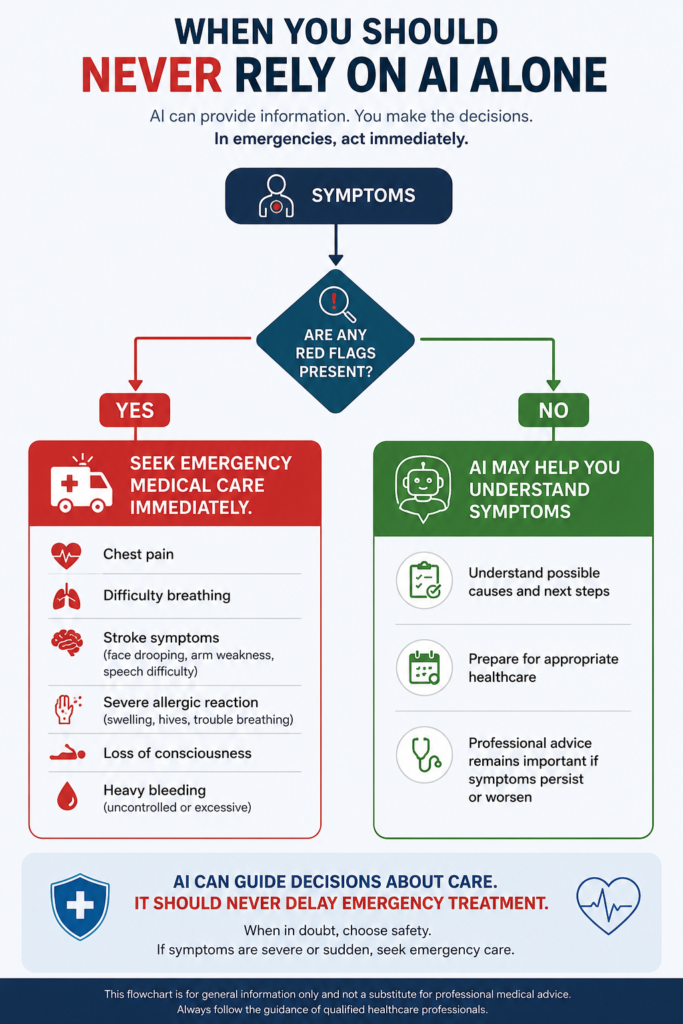
AI can support healthcare decisions. It should not replace professional medical assessment, particularly when symptoms are severe, persistent or rapidly worsening.
Visual Placeholder 4 – When You Should Never Rely on AI Alone
E
AI can guide decisions about care. It should never delay emergency treatment.
Why Human Behaviour Matters More Than Artificial Intelligence
Perhaps the most overlooked finding in recent research is that AI performance is only part of the story.
People often communicate their symptoms poorly.
Researchers have shown that the quality of information patients provide has a substantial influence on AI performance. Missing medications, inaccurate timelines, forgotten medical conditions or vague descriptions can all reduce the quality of recommendations. In other words, even a highly capable AI system cannot compensate for incomplete or inaccurate information.
This mirrors everyday clinical practice.
Doctors frequently revise their initial thinking after asking additional questions.
Experienced clinicians understand that diagnosis is rarely a single moment of insight. It is an iterative process of gathering evidence, testing hypotheses and excluding alternatives.
The lesson is surprisingly simple:
Better questions often matter more than faster answers.
Mental Health: AI’s Most Human Conversation?
One of the fastest-growing uses of conversational AI is mental wellbeing.
People increasingly ask AI about anxiety, stress, insomnia, burnout and low mood—often outside normal healthcare hours.
The attraction is understandable.
Unlike traditional services, AI is available instantly, does not appear rushed and allows users to discuss sensitive concerns without fear of embarrassment. For some individuals, particularly those hesitant to seek help, this can reduce the psychological barrier to beginning a conversation.
However, mental health experts consistently emphasise an important distinction.
Conversation is not therapy.
AI may help users organise their thoughts, explain common mental health conditions or encourage people to seek professional support. It is not a substitute for qualified mental health professionals, particularly where there is significant distress, self-harm risk or suicidal thinking.
The greatest opportunity may therefore lie in helping more people access appropriate care earlier rather than attempting to replace established mental health services.
The Next Healthcare Revolution Is About Trust
Healthcare has always depended on trust.
Patients disclose deeply personal information because they believe it will be handled responsibly and used to improve their care.
The same principle applies to artificial intelligence.
People are no longer asking only:
“Can AI answer my question?”
Increasingly, they are asking:
- Can I trust the information?
- Where did it come from?
- How is my health data used?
- Who is accountable if the advice is wrong?
These questions are likely to become defining issues for healthcare over the next decade.
Organisations that combine clinical expertise, transparent governance, robust privacy protections and responsible AI deployment are more likely to earn lasting public confidence than those competing solely on technological capability.
Visual Placeholder 5 – The Trusted AI Healthcare Framework
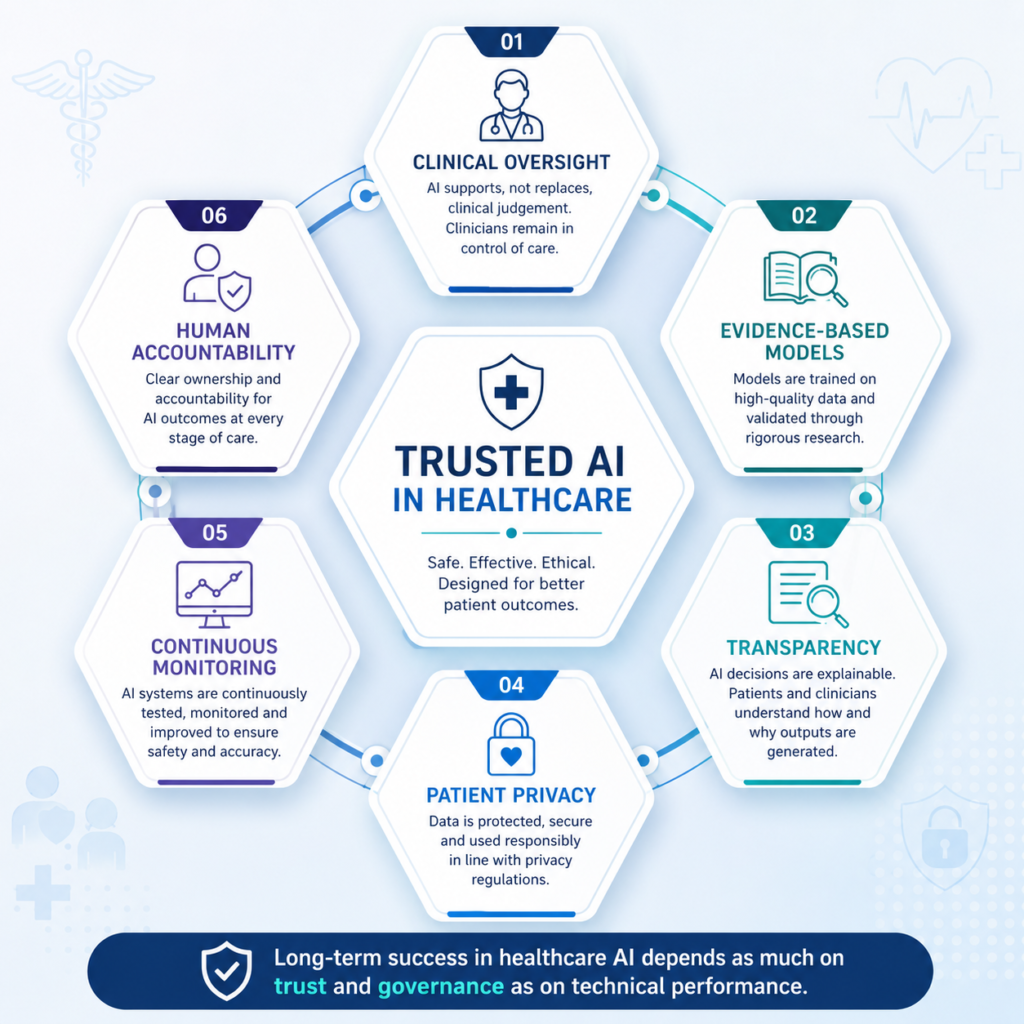
Long-term success in healthcare AI depends as much on trust and governance as on technical performance.
Executive Insight: AI Is Changing the First Conversation, Not the Final Decision
History suggests that transformative technologies rarely replace professionals overnight.
Instead, they reshape how professionals work.
Email did not eliminate lawyers.
Online banking did not eliminate financial advisers.
GPS did not eliminate pilots.
Artificial intelligence is unlikely to eliminate doctors.
It is far more likely to redefine the patient’s first conversation.
For millions of people, that first conversation is already happening with an AI assistant before they speak to a clinician.
The organisations that will lead this transformation are unlikely to be those with the most powerful algorithms alone.
They will be those that combine technological innovation with clinical governance, patient safety, transparency and human-centred design.
In healthcare, trust is becoming the ultimate competitive advantage.
Key Takeaways
- Millions of people are already using conversational AI to understand symptoms before seeking medical care.
- Research analysing more than 500,000 AI health conversations shows symptom assessment is one of the most common use cases, particularly during evenings and overnight.
- AI performs particularly well in health education, symptom organisation and preparing patients for consultations.
- Current evidence indicates AI should complement not replace clinical assessment, especially in emergencies and complex cases.
- Healthcare organisations are increasingly integrating AI into patient navigation and clinical workflows, but responsible governance, transparency and human oversight remain essential.
Final Thought
A decade from now, many people may struggle to remember what healthcare looked like before conversational AI.
The first question about a persistent cough, an unexplained rash or recurring chest discomfort may routinely begin with an AI assistant rather than a search engine.
That future is already emerging.
The real challenge is no longer whether AI can participate in healthcare.
It is whether healthcare systems, technology companies and clinicians can ensure that AI is deployed safely, ethically and transparently.
Artificial intelligence may transform how patients begin their healthcare journey.
But for the foreseeable future, the most important decisions will still depend on something no algorithm can fully replace:
the knowledge, experience and judgement of qualified healthcare professionals.