
As artificial intelligence reshapes industries at an unprecedented pace, not every country is equally prepared for the transformation. While some nations are positioning themselves to lead the AI revolution, others risk falling behind due to slower adoption, weaker digital infrastructure and limited investment in innovation. This analysis explores which economies are most vulnerable to AI disruption and why the decisions governments make today will determine their prosperity for decades to come.
Artificial Intelligence Is Creating Winners and Losers
Artificial intelligence is rapidly becoming one of the most influential technologies of the twenty-first century. From automating routine administrative tasks and optimising manufacturing to accelerating scientific research and transforming financial services, AI is fundamentally changing how economies operate. According to the International Monetary Fund (IMF), AI is expected to affect nearly 40% of jobs globally, with advanced economies likely to experience the greatest immediate disruption because a larger proportion of their workforce is employed in knowledge-intensive occupations. However, the economic consequences extend far beyond employment. AI is influencing productivity, investment, competitiveness, trade and long-term economic growth.
While much of the global conversation focuses on countries leading AI innovation, equal attention should be given to those at risk of falling behind. Nations that fail to invest in digital infrastructure, education, research and workforce transformation may find themselves increasingly unable to compete in an AI-driven global economy. The gap between AI leaders and AI followers could become one of the defining economic divides of the coming decades.
What Does the AI Economic Risk Score Measure?
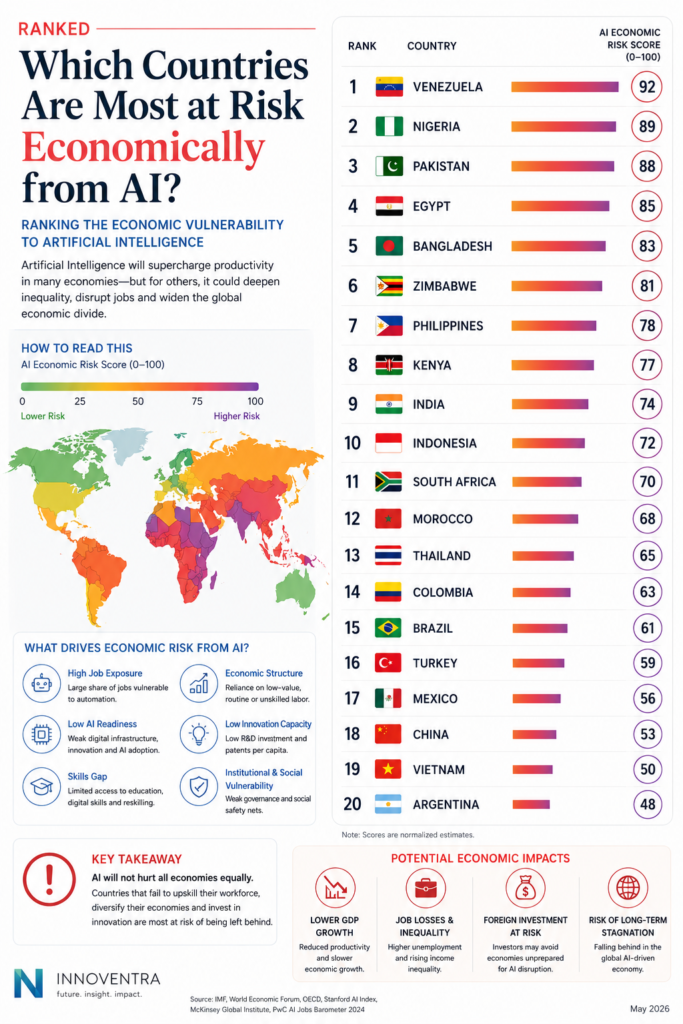
The ranking presented in the infographic is designed to assess economic vulnerability to AI, rather than technological advancement alone. It considers several interconnected factors that influence how successfully countries can adapt to rapid technological change.
These include:
- Exposure of existing jobs to automation.
- National AI readiness and digital infrastructure.
- Workforce skills and access to education.
- Investment in research, innovation and technology.
- Economic dependence on routine or low-value industries.
- Institutional resilience and the ability to support workers through economic transition.
Countries scoring higher face greater economic risks if they fail to accelerate AI adoption, improve workforce capabilities and modernise their economies.
Why Some Countries Face Greater Economic Risks
Many developing and emerging economies continue to depend heavily on labour-intensive industries, routine manufacturing, basic administrative services and low-skilled occupations. While these sectors have supported economic growth for decades, they are also among those most susceptible to automation.
Unlike advanced economies that often possess strong universities, mature technology sectors and substantial research investment, many lower-income countries face structural barriers including limited digital infrastructure, shortages of AI talent, lower research and development spending and constrained public investment.
These challenges do not mean such countries cannot benefit from AI. Rather, they indicate that without targeted policies and sustained investment, they may struggle to capture the productivity gains that AI offers while experiencing greater disruption to employment and economic competitiveness.
AI Will Not Replace Every Job—But It Will Change Most Jobs
One of the most common misconceptions surrounding AI is that it will simply replace human workers. Current evidence suggests a more nuanced reality. In many occupations, AI is augmenting rather than eliminating work.
Professionals in healthcare, finance, law, education, engineering and marketing increasingly use AI to analyse information, automate repetitive tasks and improve decision-making. Employees who learn to work alongside AI are often becoming more productive rather than redundant.
The greatest disruption is likely to occur in occupations characterised by repetitive, predictable and routine tasks. At the same time, demand is expected to grow for skills involving creativity, leadership, critical thinking, complex problem-solving, communication and ethical judgement—areas where human capabilities remain particularly valuable.
For individuals, the future of work is less about competing with AI and more about developing the skills needed to collaborate effectively with it.
The Economic Cost of Delayed AI Adoption
Countries that delay AI investment may experience consequences extending well beyond employment.
Businesses operating in AI-enabled economies are expected to produce goods and services more efficiently, innovate more rapidly and compete more effectively in international markets. Nations unable to match these productivity gains could experience slower GDP growth, reduced foreign investment and declining competitiveness in high-value industries.
Over time, this may contribute to widening income disparities both within and between countries. The AI revolution therefore represents not only a technological transformation but also a strategic economic challenge that will influence global competitiveness for decades.
Governments Must Act Before the Gap Widens
Preparing for the AI economy requires more than adopting new technology. It demands coordinated national strategies that combine education, infrastructure, innovation and responsible governance.
Governments should prioritise:
- Modernising education systems to include AI and digital literacy.
- Expanding lifelong learning and workforce reskilling programmes.
- Supporting research, innovation and technology entrepreneurship.
- Investing in high-speed digital infrastructure.
- Encouraging responsible AI adoption across both public and private sectors.
- Strengthening social protection for workers affected by technological transition.
Countries that begin these investments today are more likely to benefit from AI-driven productivity while reducing the social and economic disruption associated with automation.
Innoventra Insight: The New Global AI Divide
The emerging divide is unlikely to be between developed and developing countries alone. It will increasingly exist between AI-ready economies and AI-unprepared economies.
Success in the AI era will depend less on population size or natural resources and more on a nation’s ability to develop human capital, encourage innovation, adopt responsible AI and continuously adapt its workforce.
Artificial intelligence should therefore be viewed not merely as another technological advancement but as a strategic capability that will shape national prosperity throughout the coming decades.
The countries that invest in people, skills and innovation today are unlikely to simply survive the AI revolution—they will help define it. Those that hesitate risk facing slower growth, declining competitiveness and widening economic inequality in an increasingly intelligent global economy.
Key Takeaways
- AI is transforming economies, not just individual jobs.
- Countries with weaker digital infrastructure and lower AI readiness face greater long-term economic risks.
- Workforce reskilling and education will be among the most important investments of the next decade.
- AI adoption is becoming a key driver of national competitiveness.
- The greatest economic divide of the future may be between countries that prepare for AI and those that do not.