
Roblox has become one of the world’s most popular online gaming platforms, attracting hundreds of millions of users and millions of daily active children. It offers creativity, collaboration and educational opportunities through user-generated games and experiences. However, as screen time continues to increase globally, researchers, healthcare professionals and child development experts are raising important questions about how excessive gaming may affect children’s cognitive development, emotional wellbeing, behaviour and long-term health. While Roblox itself is not inherently harmful, growing evidence suggests that prolonged, unsupervised and excessive use of interactive digital platforms can influence multiple aspects of childhood development.
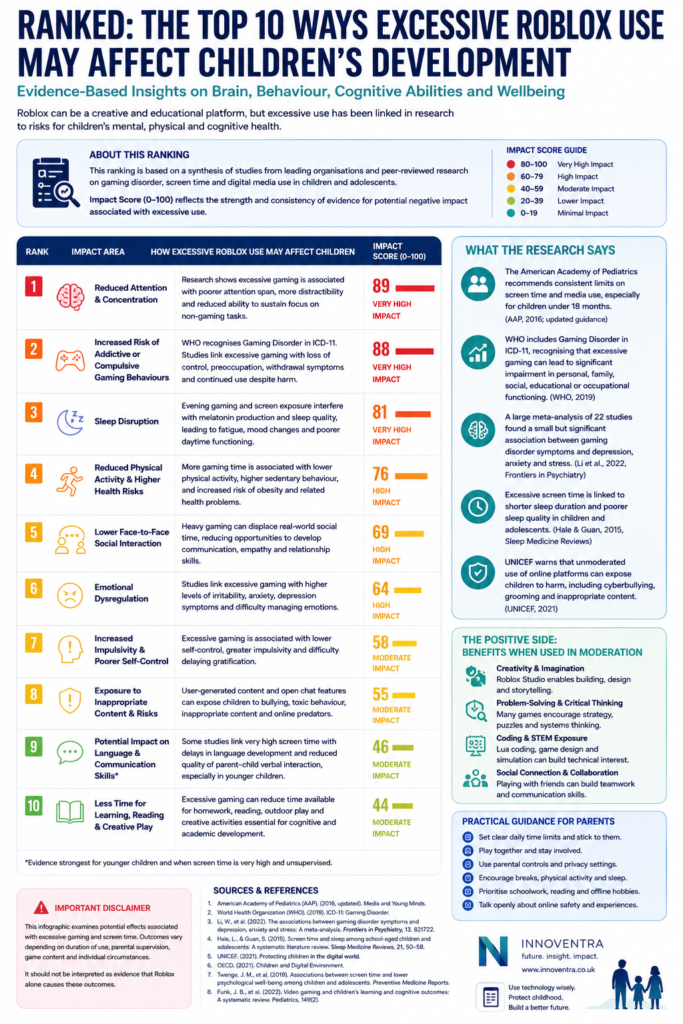
Why Roblox Has Become a Global Phenomenon
Roblox is far more than a traditional video game. It is an online ecosystem where children can play millions of user-created games, socialise with friends, build virtual experiences and even learn basic programming through Roblox Studio. Its creativity and accessibility have made it enormously successful among young people worldwide.
These benefits explain why educators increasingly recognise that platforms like Roblox can encourage creativity, teamwork, problem-solving and digital literacy when used appropriately. However, the very design features that make Roblox engaging including continuous rewards, personalised recommendations, social interaction, virtual achievements and user-generated content can also encourage children to spend extended periods online.
As with many forms of digital entertainment, the challenge lies not in the technology itself but in how, when and how much it is used.
What Does the Research Actually Say?
Current research does not conclude that Roblox alone damages children’s development. However, studies examining excessive gaming, prolonged recreational screen time and problematic gaming behaviours consistently identify several areas of concern.
The World Health Organization (WHO) formally recognised Gaming Disorder within the International Classification of Diseases (ICD-11), describing a pattern of gaming characterised by impaired control, increasing priority given to gaming over other activities and continuation despite negative consequences.
Similarly, the American Academy of Pediatrics (AAP) continues to recommend age-appropriate screen time guidance and encourages parents to prioritise high-quality digital experiences while maintaining healthy sleep, physical activity and family interaction. Research from UNICEF, the OECD, peer-reviewed journals and leading universities has also highlighted that the impact of digital technologies depends heavily on duration of use, supervision, content quality and the child’s broader environment.
The evidence therefore points towards moderation and responsible use, rather than suggesting that gaming should be avoided altogether.
How Excessive Roblox Use May Affect Children’s Cognitive Development
One of the most frequently studied areas concerns attention and executive functioning.
Interactive games are specifically designed to maintain player engagement through continuous rewards, rapid decision-making and frequent stimulation. While these features make games enjoyable, prolonged exposure may make it more difficult for some children to transition to slower-paced activities such as reading, homework or classroom learning.
Researchers have found associations between excessive recreational screen time and reduced attention span, increased distractibility and difficulty maintaining concentration in certain groups of children. These findings vary considerably between individuals, but they reinforce the importance of balancing gaming with offline learning, physical activity and creative play.
Importantly, cognitive development is influenced by many factors, including sleep quality, parenting, education and overall lifestyle. Roblox should therefore be considered as one element within a much broader developmental picture.
Sleep, Physical Activity and Emotional Wellbeing
Perhaps the strongest evidence concerns sleep.
Numerous studies have shown that excessive evening screen use can interfere with sleep quality by delaying bedtime and reducing melatonin production. Poor sleep has subsequently been linked with lower academic performance, reduced concentration, irritability and emotional regulation difficulties.
Heavy gaming may also reduce time available for physical activity, outdoor play and face-to-face social interaction. These experiences remain fundamental for healthy physical, emotional and social development throughout childhood.
Research has additionally identified associations between problematic gaming behaviours and increased symptoms of anxiety, depression and emotional dysregulation in some young people. While these findings do not demonstrate that gaming directly causes mental health conditions, they suggest that excessive use may contribute to existing vulnerabilities, particularly where children experience limited parental supervision or reduced offline social engagement.
Online Safety and Social Development
Unlike traditional offline games, Roblox combines gaming with social networking.
Children can communicate with other users, participate in multiplayer experiences and access content created by millions of developers worldwide. This openness creates valuable opportunities for collaboration and creativity but also introduces important safeguarding considerations.
Organisations including UNICEF and child protection experts have highlighted risks associated with user-generated content, inappropriate interactions, cyberbullying and online grooming across many digital platforms. Roblox has invested significantly in moderation systems, parental controls and safety technologies, yet no online platform can eliminate every risk.
Parents therefore remain the most important safeguard. Open communication, privacy settings, parental supervision and ongoing conversations about online safety are essential components of responsible digital parenting.
Innoventra Insight: Childhood Is Entering the Age of AI-Powered Digital Engagement
The next generation of gaming platforms will increasingly combine artificial intelligence with personalised recommendation systems, adaptive gameplay and intelligent virtual characters.
Innoventra believes this marks the beginning of what can be described as the Age of AI-Powered Digital Engagement.
Future gaming experiences are likely to become even more immersive, personalised and emotionally engaging. AI will adapt game difficulty, personalise rewards, recommend new experiences and create increasingly realistic interactions tailored to each individual player.These innovations offer exciting educational possibilities but also increase the importance of responsible design.
Developers, regulators, educators and parents must work together to ensure that technologies designed to maximise engagement do not unintentionally undermine children’s wellbeing, healthy development or family relationships.
The objective should not be to discourage digital innovation but to ensure that children’s long-term development remains at the centre of technological progress.
Helping Children Develop Healthy Digital Habits
Parents should view Roblox as one component of a balanced childhood rather than as either entirely beneficial or entirely harmful.
Practical strategies include:
- Establishing consistent daily screen time boundaries.
- Encouraging outdoor play, reading and creative hobbies.
- Keeping devices out of bedrooms before bedtime.
- Playing together and discussing online experiences.
- Using Roblox’s parental controls and privacy settings.
- Encouraging regular breaks during longer gaming sessions.
- Maintaining open conversations about online friendships and digital safety.
Healthy digital habits developed during childhood are likely to remain important throughout adulthood as AI and digital technologies become increasingly integrated into everyday life.
The Future of Childhood in an AI-Driven World
Artificial intelligence, gaming and digital platforms are transforming childhood faster than any previous generation has experienced.
The challenge facing society is not whether children should engage with technology they almost certainly will—but whether governments, technology companies, schools and families can work together to ensure that these technologies support healthy development rather than undermine it.
Success will depend upon balanced regulation, responsible platform design, improved digital literacy, stronger parental engagement and continued investment in independent research examining the long-term effects of interactive digital environments.
The future of childhood should be shaped by technology that enhances curiosity, creativity, learning and human connection not technology that competes with them.
Key Takeaways
- Roblox can support creativity, collaboration and digital skills when used in moderation.
- Current evidence links excessive gaming and prolonged recreational screen time, rather than Roblox specifically, with several potential developmental risks.
- Healthy sleep, physical activity and face-to-face interaction remain essential for children’s cognitive and emotional development.
- Parents play the most important role in establishing healthy digital habits and supervising online experiences.
- As AI makes gaming increasingly personalised and immersive, responsible platform design and informed parenting will become even more important.
Frequently Asked Questions
Is Roblox bad for children?
No. Roblox can provide educational, creative and social benefits. Research suggests that excessive or unsupervised use, rather than Roblox itself, may be associated with developmental and wellbeing risks.
How much Roblox is too much?
There is no universal limit. Experts recommend balancing gaming with sleep, schoolwork, exercise, family interaction and offline activities appropriate to the child’s age.
Can Roblox affect attention and learning?
Some research has found associations between excessive recreational gaming and reduced attention or concentration in certain children. Individual outcomes vary and depend on many factors, including sleep, supervision and overall lifestyle.
How can parents make Roblox safer?
Parents should enable parental controls, review privacy settings, encourage regular breaks, discuss online safety and remain actively involved in their children’s digital experiences.