
An evidence-based analysis of AI, human capability, innovation and the future of creative thinking.
Executive Summary
Artificial intelligence is transforming the global economy at a pace unmatched by previous technological revolutions. Large language models, autonomous agents, multimodal systems and intelligent automation are already reshaping healthcare, finance, manufacturing, education, scientific research and government.
Yet an increasingly important question is emerging among researchers, educators and business leaders.
Are we using AI to amplify human intelligence or gradually replacing the very capabilities that drive innovation?
The answer is considerably more nuanced than many headlines suggest.
Current evidence indicates that AI has enormous potential to improve productivity, accelerate scientific discovery and support better decision making. However, growing research also suggests that excessive dependence on AI-generated answers may weaken critical thinking, creativity, deep learning and independent problem solving if organisations fail to develop appropriate governance and learning practices.
The future therefore depends not on artificial intelligence itself but on how societies choose to integrate it into education, work and everyday life.
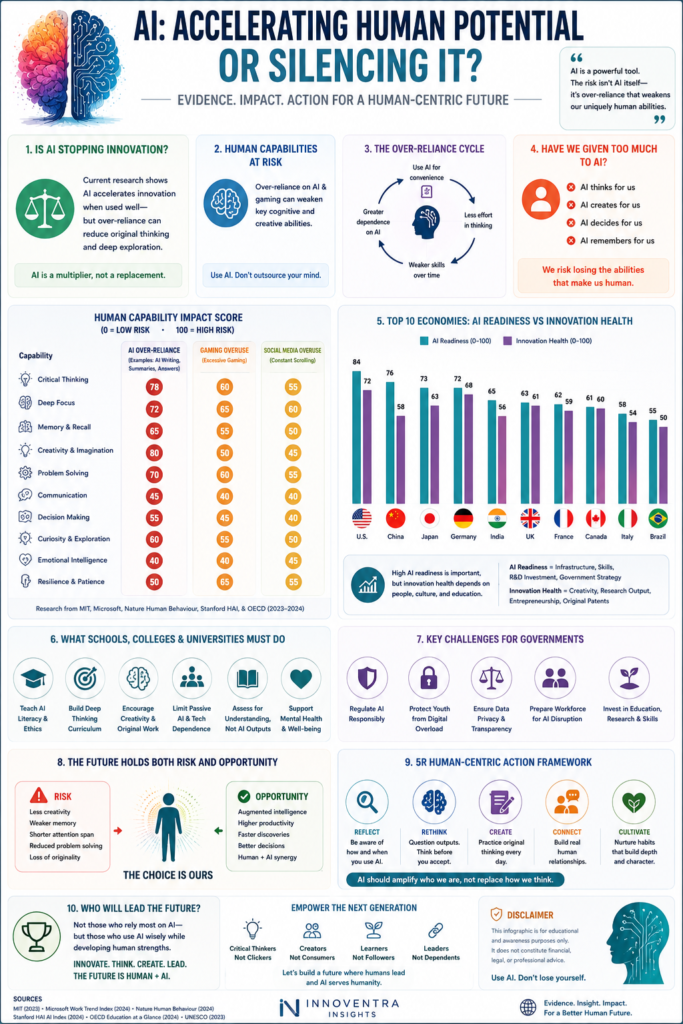
AI Is Not Replacing Innovation But It Could Change How Humans Innovate
Contrary to popular belief, there is little evidence that artificial intelligence is inherently reducing innovation.
In fact, recent advances have accelerated discoveries across numerous sectors.
Examples include:
- drug discovery
- protein engineering
- climate modelling
- semiconductor design
- engineering optimisation
- software development
- legal research
- advanced manufacturing
Researchers increasingly describe AI as a force multiplier rather than a replacement for human expertise.
However, productivity gains should not be confused with human capability development.
When people consistently outsource thinking rather than augment it, the long-term consequences become far more significant.
The Hidden Risk of AI Over-Reliance
Several emerging studies suggest that excessive reliance on AI tools may gradually reduce the amount of deep cognitive effort people invest in solving problems.
Rather than analysing information independently, users may increasingly:
- accept AI responses without verification
- generate reports without understanding them
- write code without learning programming principles
- summarise research without reading original evidence
- create presentations without developing strategic thinking
This phenomenon is increasingly referred to as cognitive offloading.
Used appropriately, cognitive offloading frees mental capacity for higher-value work.
Used excessively, it may weaken the very capabilities organisations need most.
Which Human Capabilities Face the Greatest Risk?
Our assessment identifies several capabilities that deserve particular attention.
Critical Thinking
The ability to evaluate evidence, challenge assumptions and identify flawed reasoning remains one of the most valuable skills in every profession.
AI can support analysis but should never replace independent judgement.
Creativity
Original ideas emerge through curiosity, experimentation and diverse experiences.
Generative AI excels at recombining existing knowledge but genuine breakthrough innovation still depends heavily upon human imagination.
Deep Focus
Continuous switching between AI prompts, social media and digital platforms reduces opportunities for sustained concentration.
Deep work remains essential for research, engineering, law, medicine and leadership.
Problem Solving
Organisations create value by solving complex problems.
Employees who rely entirely upon AI recommendations may gradually lose confidence in solving unfamiliar challenges independently.
Curiosity
Innovation begins with asking better questions.
If AI always provides immediate answers, fewer people may develop the habit of exploring problems in greater depth.
Communication
Human leadership requires empathy, negotiation, storytelling and emotional intelligence.
These capabilities remain difficult to automate successfully.
Why This Matters for Business Leaders
Artificial intelligence is rapidly becoming standard business infrastructure.
The competitive advantage no longer comes simply from adopting AI.
It comes from deploying AI while simultaneously strengthening human capability.
The most successful organisations increasingly invest in:
- AI governance
- workforce capability
- data quality
- critical thinking
- experimentation
- leadership development
- responsible AI policies
Businesses that treat AI purely as a cost reduction exercise may achieve short-term efficiency but risk reducing long-term innovation capacity.
Related Innoventra Insight
Here you should embed an internal link to your article:
The Future of AI Will Be Defined by Human Judgement, Not Artificial Intelligence
It perfectly reinforces the argument that competitive advantage comes from human governance rather than simply owning powerful AI models.
Implications for Schools, Colleges and Universities
Educational institutions face perhaps the greatest challenge.
Students now have instant access to AI capable of generating essays, programming solutions and research summaries within seconds.
Assessment models designed twenty years ago are becoming increasingly obsolete.
Future education should place greater emphasis on:
- critical reasoning
- debate
- original research
- project-based learning
- creativity
- ethics
- collaboration
- real-world problem solving
Rather than banning AI, institutions should teach students how to use AI responsibly while preserving independent thinking.
What Governments Should Prioritise
Governments seeking long-term competitiveness should focus on balancing technological adoption with human capability development.
Priority areas include:
- national AI literacy
- investment in education
- lifelong learning programmes
- workforce reskilling
- responsible AI regulation
- public trust
- digital wellbeing
- research funding
Economic leadership will increasingly depend upon combining advanced AI infrastructure with highly skilled people.
Innoventra Perspective
Our analysis suggests the debate should no longer focus on whether artificial intelligence is good or bad. That is the wrong question. The more important question is whether AI is being used to strengthen human capability or quietly replace it.
History demonstrates that every major technological revolution has rewarded societies that invested not only in machines but also in people.
Artificial intelligence should therefore be viewed as an accelerator of human potential not a substitute for curiosity, imagination, creativity or judgement.
The organisations, universities and governments that succeed during the next decade will almost certainly be those that develop both technological capability and human capability together.
In the age of AI, the greatest competitive advantage may not belong to those with the smartest algorithms.
It may belong to those who continue producing the smartest people.
References
Include a concise references section citing high-authority sources:
- Stanford AI Index Report 2026
- OECD – Artificial Intelligence and Future Skills
- UNESCO – Guidance for Generative AI in Education and Research
- World Economic Forum – Future of Jobs Report
- Microsoft Work Trend Index
- Nature Human Behaviour (research on cognitive offloading and AI)
- MIT Sloan Management Review
- McKinsey Global Institute – The Economic Potential of Generative AI
- OECD Education Policy Outlook