
Category: AI Strategy | AI Governance | Enterprise Transformation
Estimated reading time: 8–9 minutes
Artificial intelligence has entered a new phase of enterprise adoption. The strategic question facing organisations is no longer whether to adopt AI, but how to deploy it responsibly, securely and at scale.
The pace of adoption has been extraordinary. According to McKinsey’s 2025 State of AI survey, 78% of organisations now report using AI in at least one business function, compared with 72% in early 2024 and around 50% only a few years earlier, illustrating how rapidly AI has become embedded across business operations. At the same time, McKinsey found that organisations with CEO oversight of AI governance are significantly more likely to report meaningful financial returns from generative AI than those where governance remains fragmented.
Yet widespread adoption has exposed an equally significant governance gap.
While organisations continue investing billions in AI infrastructure, relatively few have established mature governance covering executive accountability, model risk, data quality, human oversight and regulatory compliance. Gartner has reported that organisations conducting regular AI governance assessments are substantially more likely to achieve high business value from generative AI initiatives, highlighting that governance has become a performance enabler rather than simply a compliance requirement.
This represents a fundamental shift.
Artificial intelligence should no longer be viewed as a technology programme managed exclusively by IT departments. It has become an enterprise capability affecting strategic decision-making, workforce productivity, customer experience, operational resilience, cybersecurity and corporate reputation.
For boards and executive teams, AI governance is rapidly becoming as important as financial governance, cybersecurity and enterprise risk management.
What is an AI governance framework?
The US National Institute of Standards and Technology AI Risk Management Framework—NIST AI RMF provides organisations with a voluntary structure for incorporating trustworthiness into the design, development, deployment and evaluation of AI systems.
The framework is organised around four connected functions:
- Govern — establish accountability, policies and organisational oversight;
- Map — understand the system’s purpose, context and potential impacts;
- Measure — assess, test and monitor AI risks;
- Manage — prioritise and respond to identified risks.
Readers seeking the complete technical framework can also access the official NIST AI RMF 1.0 publication.
The AI Governance Challenge in 2026
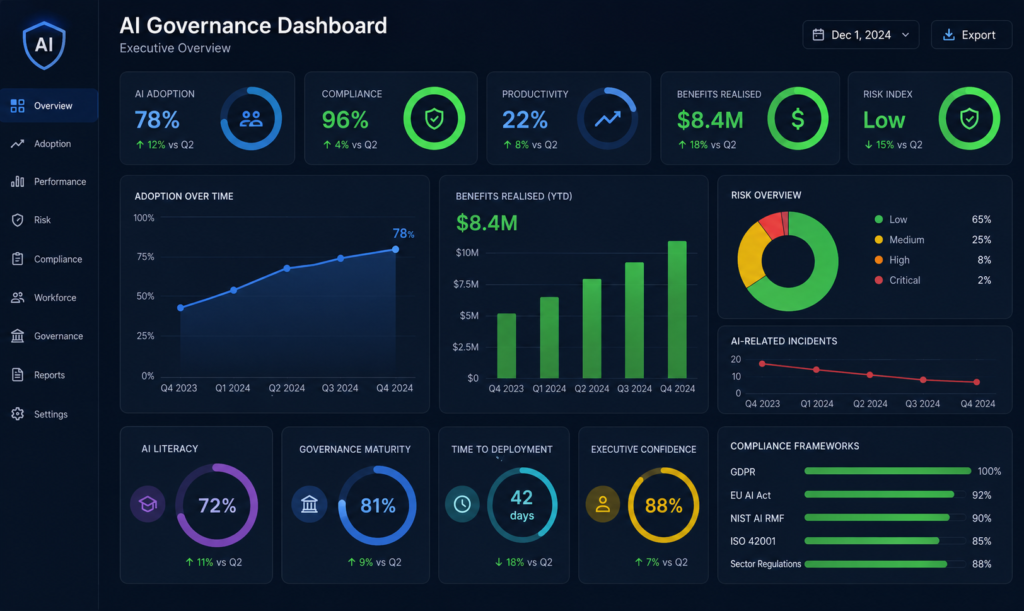
What happens when AI governance fails?
Generative and agentic systems introduce risks including prompt injection, insecure tool use, sensitive-data leakage, unreliable outputs and unintended actions.
The NIST Generative AI Profile supplements the broader AI Risk Management Framework by identifying risks that are particularly relevant to generative AI.
The profile helps organisations consider issues including:
- inaccurate or fabricated content;
- information security;
- data privacy;
- harmful bias;
- intellectual-property risks;
- human–AI interaction;
- value-chain and third-party dependencies.
Why AI Governance Has Become a Board-Level Priority
For much of the last decade, AI discussions focused almost exclusively on algorithms, data science and computing power.
That conversation has changed.
Today’s executive discussions increasingly focus on entirely different questions.
- Can we trust AI-generated decisions?
- Who is accountable when AI makes mistakes?
- How do we comply with emerging regulation?
- Which AI systems create unacceptable organisational risk?
- How do we prevent employees exposing confidential information through public AI tools?
- How can we measure whether AI is genuinely creating business value?
These are governance questions rather than technology questions.
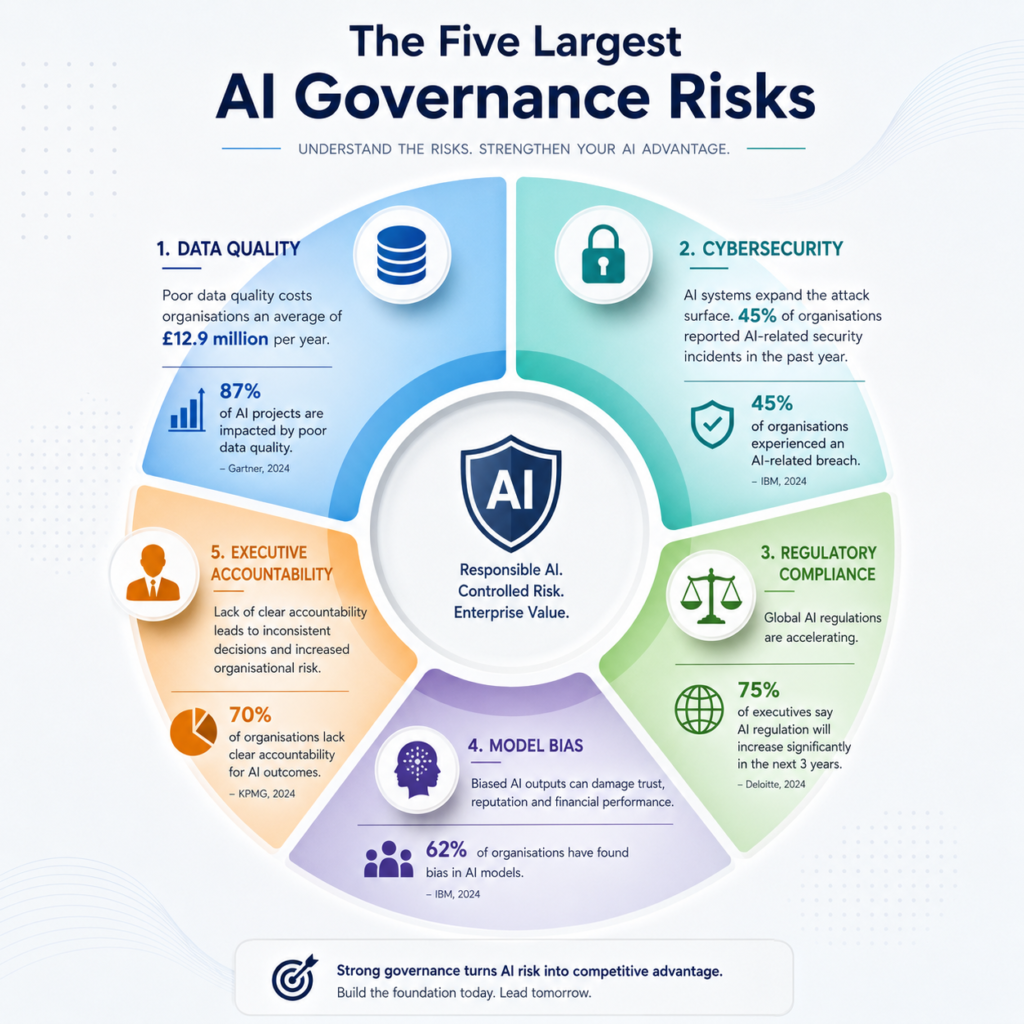
Research consistently shows that AI programmes fail far more often because of organisational challenges than technical limitations. Poor data quality, unclear ownership, fragmented decision-making, weak change management and insufficient executive oversight frequently undermine otherwise capable AI solutions.
The organisations generating the greatest value from AI are therefore not necessarily those deploying the largest number of models. They are the organisations embedding governance into every stage of the AI lifecycle.
AI Is No Longer an Innovation Project
Many organisations continue managing AI through innovation teams or isolated pilot programmes.
That approach becomes increasingly risky as AI expands into:
- financial decision-making
- recruitment
- healthcare
- fraud detection
- customer service
- cybersecurity
- legal services
- supply chain optimisation
Each deployment introduces questions surrounding accountability, fairness, transparency and regulatory compliance.
Without governance, organisations risk creating dozens—or even hundreds—of disconnected AI solutions operating with inconsistent standards.
This phenomenon, often described as “AI sprawl”, mirrors earlier challenges organisations experienced with shadow IT and uncontrolled cloud adoption.
The difference is that AI directly influences decisions affecting customers, employees and citizens.
Consequently, governance failures can have immediate financial, operational and reputational consequences.
The Cost of Poor AI Governance
Poor governance rarely causes problems immediately.
Instead, risks accumulate gradually.
Examples include:
Data Risks
AI models trained using inaccurate, incomplete or poorly governed data frequently generate unreliable outputs.
Poor data governance therefore creates poor AI governance.
Regulatory Risks
The EU Artificial Intelligence Act entered into force on 1 August 2024 and is being implemented through a phased timetable.
Provisions concerning prohibited AI practices and AI-literacy responsibilities began applying in February 2025. Governance rules and obligations for general-purpose AI models began applying in August 2025. Further provisions become applicable from 2 August 2026, although the exact requirements depend on the type of system, the organisation’s role and applicable transitional arrangements.
The European Commission also provides an official AI Act information and compliance portal, which should be treated as the principal source for implementation updates.
Organisations should seek specialist legal advice when determining how the Act applies to particular systems or business activities.
Reputational Risks
Several high-profile organisations have experienced public criticism following biased AI outputs, inaccurate recommendations or inappropriate use of copyrighted content.
Although technologies differ, the underlying governance failures are remarkably similar:
- inadequate oversight
- insufficient testing
- weak accountability
- poor quality assurance
Operational Risks
Employees are increasingly using generative AI without organisational approval.
This creates significant concerns regarding:
- confidential information
- intellectual property
- inaccurate outputs
- inconsistent decision-making
- cybersecurity
Industry analysts have warned that unmanaged “shadow AI” is becoming a growing enterprise risk as employees independently adopt publicly available AI tools for business tasks.
Which standards should shape an AI governance framework?
No single standard answers every organisational need. Mature governance draws from several complementary frameworks.
NIST AI Risk Management Framework
The NIST AI Risk Management Framework provides a flexible structure organised around Govern, Map, Measure and Manage.
It is particularly useful for integrating AI risk into wider enterprise-risk processes and evaluating potential impacts on individuals, organisations and society.
ISO/IEC 42001
ISO/IEC 42001:2023 is the international management-system standard for artificial intelligence.
It specifies requirements for establishing, implementing, maintaining and continually improving an AI management system. It can help organisations create structured policies, objectives, responsibilities and governance processes for the responsible development, provision or use of AI.
ISO also provides a more accessible explanation of what ISO/IEC 42001 means for organisations.
ISO/IEC 42005
ISO/IEC 42005 provides guidance on conducting AI system impact assessments.
Impact assessments can help organisations examine the likely consequences of an AI system for individuals, groups and wider society before deployment and during its operational lifecycle.
ISO/IEC 23894
ISO/IEC 23894:2023 provides guidance on managing risks related to artificial intelligence.
It can be used alongside wider enterprise-risk management arrangements and ISO/IEC 42001.
EU AI Act
The European Union’s official AI Act overview explains the legislation’s risk-based approach and phased implementation.
The Act distinguishes between prohibited practices, high-risk systems, AI systems subject to transparency requirements and other forms of AI. It also introduces obligations relating to general-purpose AI models.
OECD AI Principles
The OECD AI Principles provide an internationally recognised foundation for innovative and trustworthy AI.
They address:
- inclusive growth and wellbeing;
- human rights and democratic values;
- transparency and explainability;
- robustness, security and safety;
- accountability.
UK AI governance guidance
UK organisations should also consult the government’s AI regulation and governance resources and the Information Commissioner’s Office guidance on AI and data protection.
The ICO guidance is particularly relevant where AI systems process personal data, conduct profiling or support decisions affecting individuals.
Title: The Five Largest AI Governance Risks
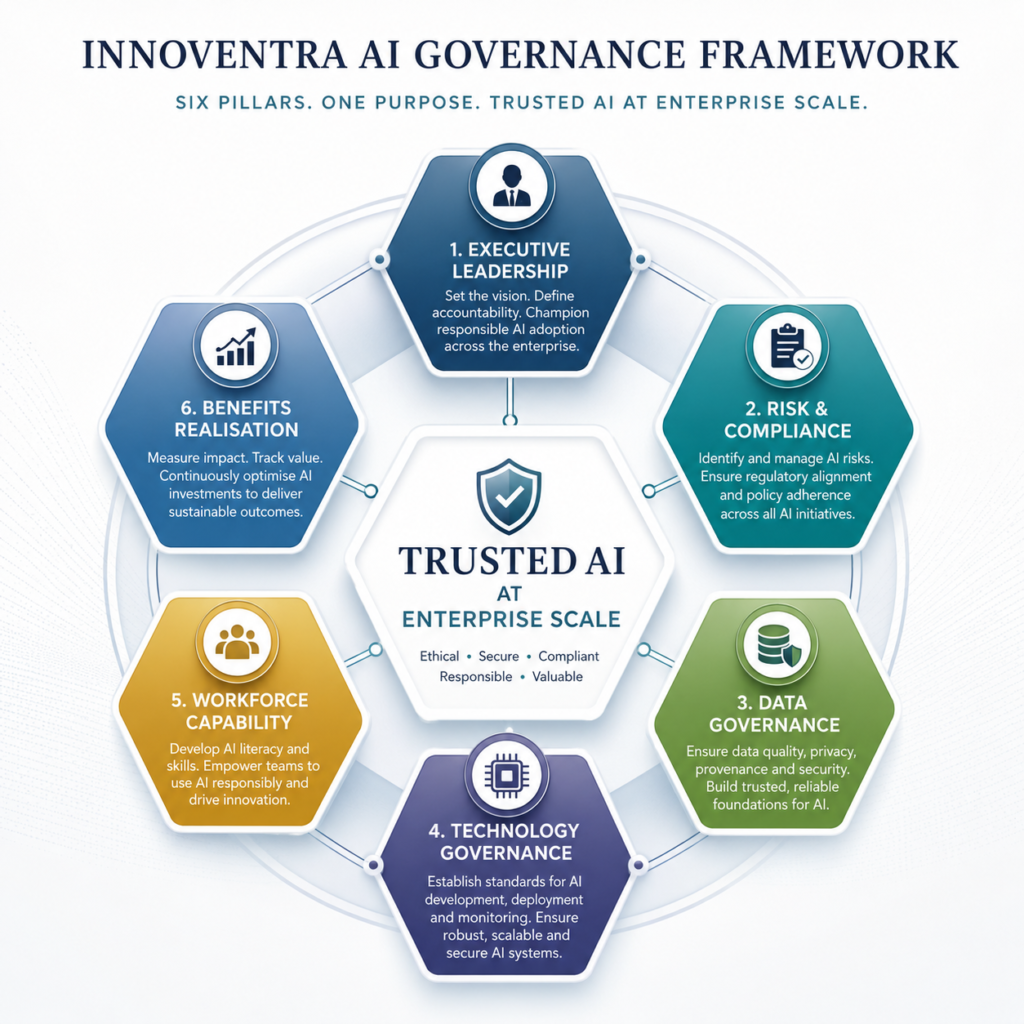
The Innoventra AI Governance Framework
Most governance frameworks focus heavily on technical controls.
Our analysis suggests that mature organisations treat AI governance as an organisational capability rather than an IT capability.
The Innoventra AI Governance Framework consists of six interconnected pillars.
Pillar 1 – Executive Leadership
Successful governance begins with visible executive sponsorship.
Board members should understand:
- organisational AI strategy
- risk appetite
- governance responsibilities
- investment priorities
- ethical principles
AI governance cannot be delegated entirely to technical teams.
Pillar 2 – Risk and Compliance
Every AI deployment should undergo proportionate risk assessment considering:
- business impact
- regulatory obligations
- security
- privacy
- explainability
- human oversight
Higher-risk applications require stronger governance.
Pillar 3 – Data Governance
Reliable AI requires reliable data.
Leading organisations establish:
- data ownership
- metadata standards
- access controls
- quality assurance
- lifecycle management
- auditability
AI maturity is therefore closely linked to organisational data maturity.
Pillar 4 – Technology Governance
Technology governance extends beyond selecting AI models.
It includes:
- model validation
- deployment controls
- version management
- monitoring
- resilience
- cybersecurity
- third-party assurance
Technical governance ensures AI remains safe throughout its operational lifecycle.
Pillar 5 – Workforce Capability
Technology alone cannot deliver responsible AI.
Employees require practical capability in:
- prompt engineering
- AI literacy
- responsible AI
- governance responsibilities
- information security
- critical thinking
Future competitive advantage will increasingly depend upon workforce capability rather than technology alone.
Pillar 6 – Benefits Realisation
Many organisations measure AI success using:
- number of pilots
- models developed
- tools purchased
These are activity measures.
Leading organisations instead evaluate:
- productivity improvements
- operational efficiency
- financial benefits
- customer outcomes
- employee adoption
- strategic value
Governance should therefore ensure every AI investment remains aligned with measurable organisational outcomes rather than technical activity.
How should AI be governed throughout its lifecycle?
ISO/IEC 42001 is especially relevant to lifecycle governance because it adopts a continual-improvement approach.
Governance should therefore cover:
- system design;
- data selection and preparation;
- development and configuration;
- testing and validation;
- approval;
- deployment;
- monitoring;
- material changes;
- incident management;
- retirement.
The strongest governance model is not a single annual assessment. It is continuous assurance proportionate to the system’s risk, autonomy and potential impact.
What capabilities do employees need?
The European Commission’s official AI Act guidance explains the legislation’s implementation and AI-literacy requirements.
Organisations should provide training that reflects employees’ roles, technical knowledge, the context in which AI is used and the potential impact on people affected by AI systems.
Training should not consist solely of a general e-learning module. It should equip employees to recognise unsafe outputs, protect confidential information, apply human judgement and escalate incidents.
How should organisations measure value?
The distinction between widespread adoption and mature value creation is explored in McKinsey’s State of AI 2025.
McKinsey’s research indicates that adoption alone does not demonstrate successful transformation. Organisations must redesign workflows, establish leadership oversight and connect AI initiatives to measurable business outcomes.
More recent analysis of trust in autonomous systems is available in McKinsey’s State of AI Trust in 2026: Shifting to the Agentic Era.