Executive Summary
Artificial intelligence has reached a pivotal moment for small and medium-sized enterprises. Until recently, advanced AI capabilities were largely confined to multinational corporations with extensive technology budgets, specialist data scientists and dedicated innovation teams. That landscape has changed dramatically.
Today, affordable cloud-based AI platforms, generative AI assistants, workflow automation tools and industry-specific AI applications have made enterprise-grade capabilities accessible to organisations employing fewer than twenty people. The competitive question has therefore shifted from “Can small businesses afford AI?” to “Can they afford not to use it?”
However, successful AI adoption is not simply about purchasing software. Evidence from international studies consistently demonstrates that organisations achieving the greatest returns first strengthen their data, processes, governance and workforce capabilities before scaling AI across the business.
This guide presents an evidence-led framework designed to help SME leaders determine whether they should adopt AI immediately, strengthen organisational foundations first or delay investment until greater readiness has been achieved.
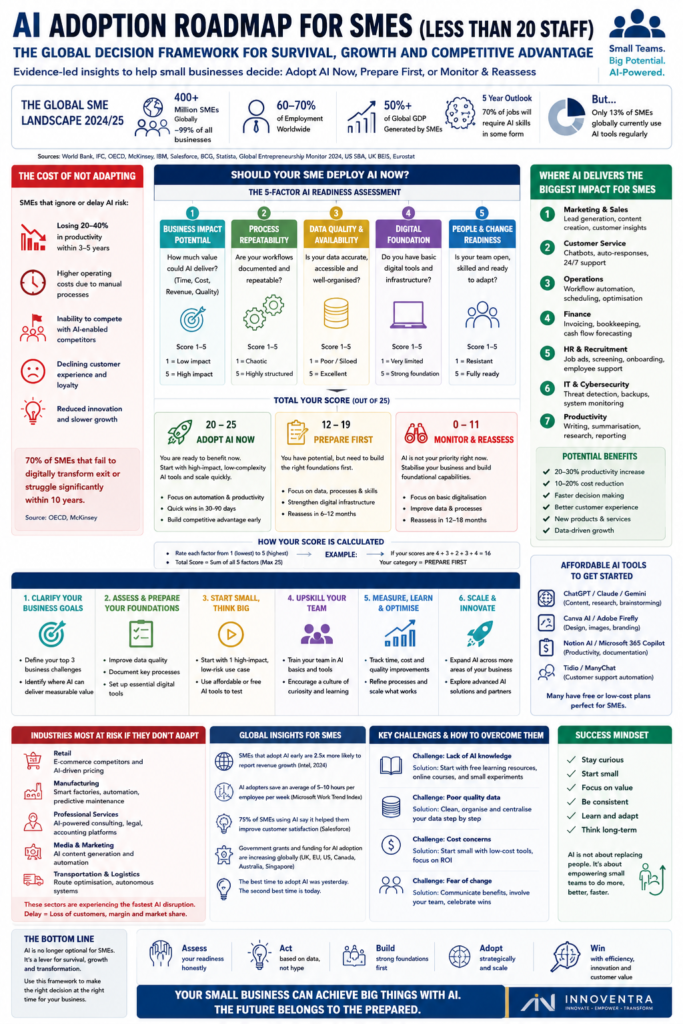
Innoventra’s evidence-based framework helps SME leaders determine when to adopt AI, how to prepare their organisations and where AI delivers the greatest commercial value.
Why This Matters
More than 90% of businesses globally are SMEs, collectively employing a substantial share of the world’s workforce while generating significant economic output. Across developed economies including the United Kingdom, European Union, United States, Canada, Australia and Japan, SMEs increasingly face competition from larger organisations deploying AI to improve productivity, customer service and operational efficiency.
Research from organisations including the OECD, World Bank, Microsoft, McKinsey, Stanford HAI, IBM and Salesforce consistently highlights several important trends:
- AI adoption is accelerating across nearly every industry.
- Businesses deploying AI strategically report measurable productivity improvements.
- Administrative tasks are increasingly being automated.
- Customer expectations for rapid digital service continue to increase.
- Digital capability is becoming an important competitive differentiator.
The implication is clear. AI is no longer an experimental technology. It is rapidly becoming an essential business capability.
AI Is Not About Replacing People
One of the most common misconceptions surrounding AI is that it exists primarily to replace employees.
Our assessment reaches a different conclusion.
The highest-performing organisations treat AI as an augmentation technology rather than a replacement technology. AI performs repetitive analysis, document generation, information retrieval and administrative tasks while employees focus on decision-making, customer relationships, creativity and strategic leadership.
This conclusion aligns closely with our earlier analysis in “The Future of AI Will Be Defined by Human Judgement, Not Artificial Intelligence.“ That article explains why sustainable competitive advantage increasingly depends upon human capability rather than technology alone. Linking to that article here strengthens both reader understanding and your internal SEO.
The Five Questions Every SME Should Answer Before Investing in AI
Rather than asking whether AI is useful, business leaders should ask five practical questions.
1. Will AI Solve a Real Business Problem?
AI should address measurable challenges such as reducing administrative effort, improving customer service, increasing sales conversion, enhancing reporting or strengthening operational efficiency.
Technology without a business objective rarely delivers meaningful return on investment.
2. Are Your Business Processes Clearly Defined?
Poorly documented processes create poor AI implementations.
Before automation begins, organisations should understand exactly how work currently flows through the business.
3. Is Your Business Data Reliable?
AI systems perform only as well as the information provided.
Businesses relying on inconsistent spreadsheets, duplicated records or fragmented customer information should first improve data quality before introducing more advanced AI solutions.
4. Is Your Workforce Ready?
Successful AI transformation depends heavily on organisational culture.
Leaders who encourage experimentation, continuous learning and responsible AI use consistently achieve stronger implementation outcomes than organisations relying solely on technology procurement.
5. Can Success Be Measured?
Every AI initiative should include measurable objectives.
Examples include:
- time saved
- customer satisfaction
- revenue growth
- response times
- operational cost reduction
- employee productivity
If success cannot be measured, AI investment becomes difficult to justify.
Where SMEs Are Seeing the Greatest Value
Evidence suggests the strongest returns currently occur in:
- Marketing and content creation
- Sales intelligence
- Customer support
- Finance and bookkeeping
- HR administration
- Operations management
- Proposal writing
- Research
- Internal knowledge management
- Business reporting
These applications typically require relatively modest investment while producing measurable operational improvements.
The Cost of Waiting
Not every business must deploy advanced AI immediately.
However, organisations delaying digital capability indefinitely face growing risks.
Potential consequences include:
- declining productivity
- higher operating costs
- slower customer response
- reduced competitiveness
- increasing recruitment challenges
- reduced innovation capacity
History demonstrates that technological transitions rarely occur overnight. Nevertheless, organisations preparing early generally experience smoother adoption than those forced into rapid reactive transformation.
Industries Facing the Fastest AI Disruption
Our research indicates particularly rapid change across:
- Professional Services
- Financial Services
- Healthcare
- Manufacturing
- Retail
- Logistics
- Education
- Marketing
- Software Development
- Customer Service
Many traditional administrative activities within these industries are already being partially automated.
The Innoventra Perspective
The evidence increasingly suggests that artificial intelligence represents a fundamental business capability rather than a temporary technology trend. However, our research also demonstrates that successful organisations rarely begin with AI itself. Instead, they begin with leadership. Businesses achieving the greatest long-term value establish clear objectives, improve organisational data, strengthen digital skills, build trusted governance frameworks and implement AI gradually where measurable commercial value exists. Artificial intelligence therefore becomes an accelerator of organisational capability rather than a substitute for strategic thinking. For SME leaders, the objective should not be to become an AI company. The objective should be to become a better business that uses AI intelligently.
References
Include a concise references section citing authoritative sources rather than making the article overly academic:
- OECD – SME and Entrepreneurship Outlook
- World Bank – Small and Medium Enterprise Finance
- International Finance Corporation (IFC) – MSME Country Indicators
- Stanford Human-Centered AI Institute – AI Index Report
- McKinsey – The State of AI
- Microsoft – Work Trend Index
- IBM – Global AI Adoption Index
- Salesforce – Small Business Trends Report
- World Economic Forum – Future of Jobs Report