
AI video generation is rapidly becoming less about producing an impressive five-second clip and more about solving a specific business problem.
A filmmaker needs visual control. A social-media creator needs speed. A training manager needs consistency. A small business needs complete videos without hiring an editor. A content team needs to turn written material into reusable visual assets.
Those users should not buy the same platform.
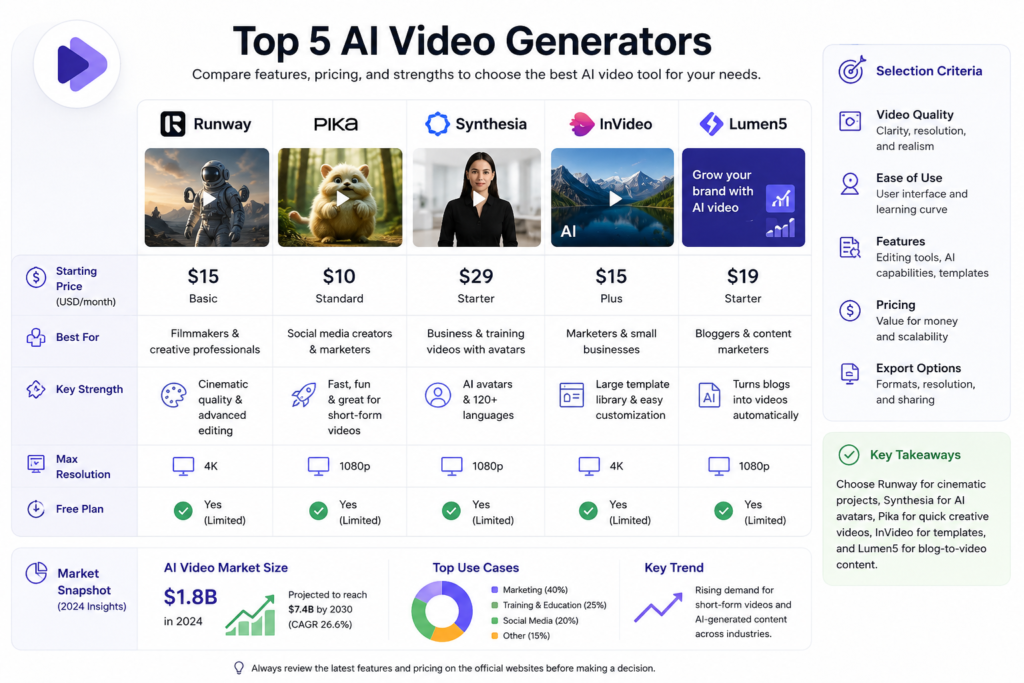
This comparison examines five leading tools Runway AI , Pika , Synthesia ,InVideo AI and Lumen5 against the criteria that matter most: output quality, controllability, production speed, ease of use, scalability and total cost.
The Decision in One Minute
| User | Best choice | Principal reason |
|---|---|---|
| Filmmakers and creative professionals | Runway | Strongest creative control and model choice |
| Social-media creators | Pika | Fast, distinctive short-form effects |
| Learning and development teams | Synthesia | Avatars, localisation and enterprise workflows |
| Small businesses and marketers | InVideo AI | Produces more complete videos from prompts |
| Publishers and content teams | Lumen5 | Efficiently converts articles into branded videos |
The central insight is simple: the best generator is determined by the type of video you repeatedly need not by which platform produces the most spectacular demonstration.
1. Runway: Best for Filmmakers and Creative Professionals
Runway is the strongest choice for directors, designers, advertising teams and serious visual storytellers who want to control how a scene looks and moves.
Its Gen-4.5 model supports text-to-video and image-to-video generation, with particular emphasis on prompt adherence, visual fidelity, camera choreography and sequenced action. Runway says the model can interpret detailed instructions covering composition, timing, movement and atmospheric change.
The real advantage, however, is not one model. Runway now provides access to its own models alongside alternatives including Kling, Veo and Seedance. This lets professionals test different generation engines within one production environment rather than maintaining several subscriptions.
Pricing begins at $12 per month when billed annually, providing 625 monthly credits. At current rates, that equates to approximately 52 seconds of Gen-4.5 output. The $28 Pro tier provides around 187 seconds, while the $76 Max plan provides approximately 791 seconds.
That calculation exposes an important weakness: AI filmmaking remains iteration-intensive. A creator may generate dozens of unsuccessful shots before obtaining ten usable seconds. The subscription price therefore understates the practical production cost.
Choose Runway when: individual shots, camera movement and visual originality matter more than generating a finished video immediately.
Avoid it when: you mainly need presenter videos, templated explainers or high-volume social posts. Runway gives you powerful raw material, but it still rewards users with editing judgement.
2. Pika: Best for Social-Media Creators
Pika is designed for a different kind of creativity: immediate, visually surprising and highly shareable.
Its tools include Pikaffects, which can melt, inflate, crush or transform objects; Pikaswaps for replacing objects inside existing footage; and additional scene, frame and transition controls.
This makes Pika especially well suited to TikTok, Instagram Reels, YouTube Shorts, memes, music promotions and product teasers. Social video often succeeds because it creates a moment of surprise in the first seconds. Pika’s effect-led design is built around that requirement.
The free plan provides 80 monthly credits. Some Turbo actions cost 10 credits, meaning a user may produce roughly eight basic generations before exhausting the allowance; more complex Pikatwists can consume 60 to 80 credits each. Paid plans unlock higher resolutions, faster generation, commercial usage and watermark-free downloads.
The trade-off is that an eye-catching effect is not the same as sustained storytelling. Pika is excellent at creating a memorable clip but less naturally suited to long, logically connected scenes, corporate explainers or detailed training content.
Choose Pika when: your success is measured through attention, sharing, novelty and rapid experimentation.
Avoid it when: every scene must remain visually consistent or communicate complex information accurately.
3. Synthesia: Best for Training and Internal Communications
Synthesia should not be assessed primarily as a cinematic generator. Its value lies in eliminating cameras, studios, presenters and repeated recording sessions from business communication.
Users can turn scripts into presenter-led videos using more than 240 stock avatars and voices covering over 160 languages. It also supports learning-management-system workflows and, at enterprise level, SCORM export, brand kits, collaboration, SSO and one-click translation into more than 80 languages.
This matters for organisations producing onboarding, compliance, software demonstrations, policy updates or multilingual training. Traditional video becomes expensive when content changes: the presenter, production team and translators may need to repeat the work. With an avatar-based system, teams can revise the script and regenerate the affected material.
The Starter plan costs $29 monthly, or approximately $18 a month when billed annually, and includes up to ten minutes of video. Creator costs $89 monthly, or around $64 annually billed, and supports up to 30 minutes per month plus team and API features. Enterprise pricing is customised.
Synthesia says more than 50,000 companies use the platform, while its pricing page cites a 4.7 rating from over 2,000 G2 reviews. These are company-presented figures, but they indicate substantial adoption beyond experimental use.
Its limitation is emotional range. Avatar delivery can be clear and consistent, but it may feel less authentic for leadership messages, sensitive announcements or storytelling that depends on genuine human performance.
Choose Synthesia when: accuracy, repeatability, localisation and governance are more valuable than cinematic imagination.
4. InVideo AI: Best for Small Businesses and Marketers
InVideo AI is best understood as a production orchestrator rather than a single video model.
A user can describe a desired video and allow the platform to assemble the script, footage, narration, music, subtitles and transitions. Its paid plans include access to more than 200 image, video, audio and music models, including Veo, Kling, Seedance and ElevenLabs, alongside stock libraries such as iStock and Storyblocks.
That breadth makes InVideo attractive to small companies that need advertisements, YouTube videos, product explainers and social campaigns but do not employ specialist editors.
Its strongest advantage is completion. Runway may produce a more cinematic shot, but InVideo is more focused on turning an instruction into something close to a publishable video.
The weakness is predictability. Automated systems may choose generic stock footage, over-explain the message or produce an uneven visual identity. Recent hands-on testing also found that more ambitious generations could take longer to render than simpler competing editors.
Pricing is now heavily credit-based and can vary according to the models and agents selected. InVideo explicitly warns that model and agent prices are subject to change, so buyers should assess the cost of their recurring workflow rather than relying on a headline subscription figure.
Choose InVideo AI when: you need complete marketing videos quickly and cannot assemble scripts, voiceovers, stock footage and edits separately.
5. Lumen5: Best for Publishers and Content Teams
Lumen5 solves a quieter but commercially important problem: converting existing knowledge into visual content.
Users can begin with an article, document, link or script and let the platform build a first cut using stock media, text overlays and branded layouts. Lumen5 positions the product specifically for people without professional video-production experience.
This makes it useful for publishers, consultancies, universities and business-to-business marketing teams with large archives of reports and articles. Instead of inventing a video from nothing, Lumen5 repackages an existing intellectual asset for LinkedIn, presentations, campaigns and social distribution.
Paid features can include branding removal, brand colours and fonts, translation and access to a media library exceeding 500 million images and clips.
Its limitation is originality. Template-led videos can look polished but familiar. Lumen5 is therefore stronger for explanation, summarisation and distribution than for cinematic storytelling.
Choose Lumen5 : your organisation already has valuable written content but lacks the time or skills to transform it into video.
Final Verdict: Match the Tool to the Bottleneck
The decisive question is not, “Which AI video generator is best?”
It is: what currently prevents you from producing effective video?
When the bottleneck is visual imagination, choose Runway. When it is social-media speed, choose Pika. When it is scalable training, choose Synthesia. When it is producing a complete marketing video, choose InVideo AI. When it is repurposing written expertise, choose Lumen5.
AI video platforms do not remove the need for human judgement. They relocate it. The competitive advantage increasingly comes not from pressing “generate”, but from selecting the right workflow, recognising weak output and knowing precisely what the audience needs to see next.