
Artificial intelligence is often described as a race between nations.
Governments announce multi-billion-dollar investment programmes. Technology companies unveil increasingly capable foundation models. Every few months another benchmark claims a new leader in reasoning, coding or multimodal performance.
The evidence certainly suggests AI innovation is accelerating. Stanford University’s AI Index Report 2025 found that private AI investment reached US$252.3 billion globally in 2024, while investment in generative AI alone increased to US$33.9 billion. The United States attracted US$109.1 billion in private AI investment more than China (US$9.3 billion) and the United Kingdom (US$4.5 billion) combined reinforcing its position as the world’s largest commercial AI ecosystem.
Viewed through investment alone, the conclusion appears straightforward.
The United States is winning.
Yet economic history suggests that conclusion may be incomplete.
Investment Has Never Been the Same as Economic Leadership
Every major technological revolution has produced two distinct phases.
The first rewards invention.
The second rewards diffusion.
The steam engine transformed Britain because it spread beyond engineering workshops into mining, transport and manufacturing. Electricity generated its greatest economic returns only after factories redesigned production around electrified assembly lines. Likewise, the internet created extraordinary corporate value not simply because browsers were invented, but because governments, businesses and households fundamentally changed how they communicated, traded and accessed information.
Economists increasingly describe this process as technology diffusion the widespread adoption of innovations across an economy until they become embedded in everyday production rather than isolated demonstrations of technical capability.
Artificial intelligence appears to be entering exactly this phase.
The strategic question therefore changes fundamentally.
It is no longer:
Which country builds the most capable AI model?
It becomes:
Which country can help millions of workers and businesses use AI productively?
The answers may not be the same.
The Productivity Gap Is Becoming the Real AI Race
Current evidence suggests that many organisations remain at an early stage of AI maturity despite rapid growth in adoption.
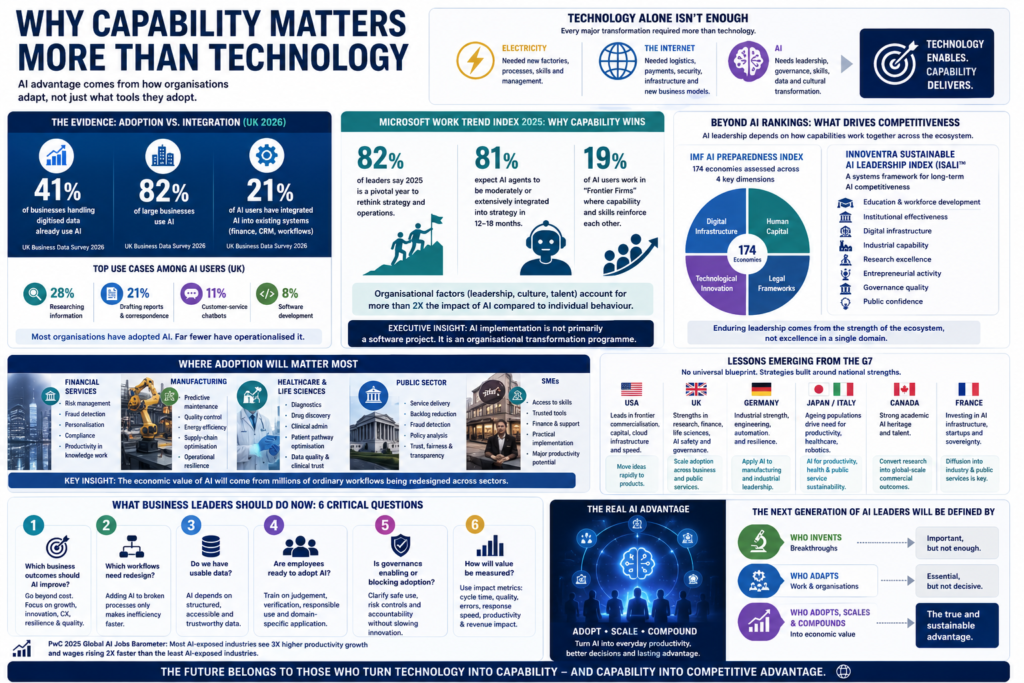
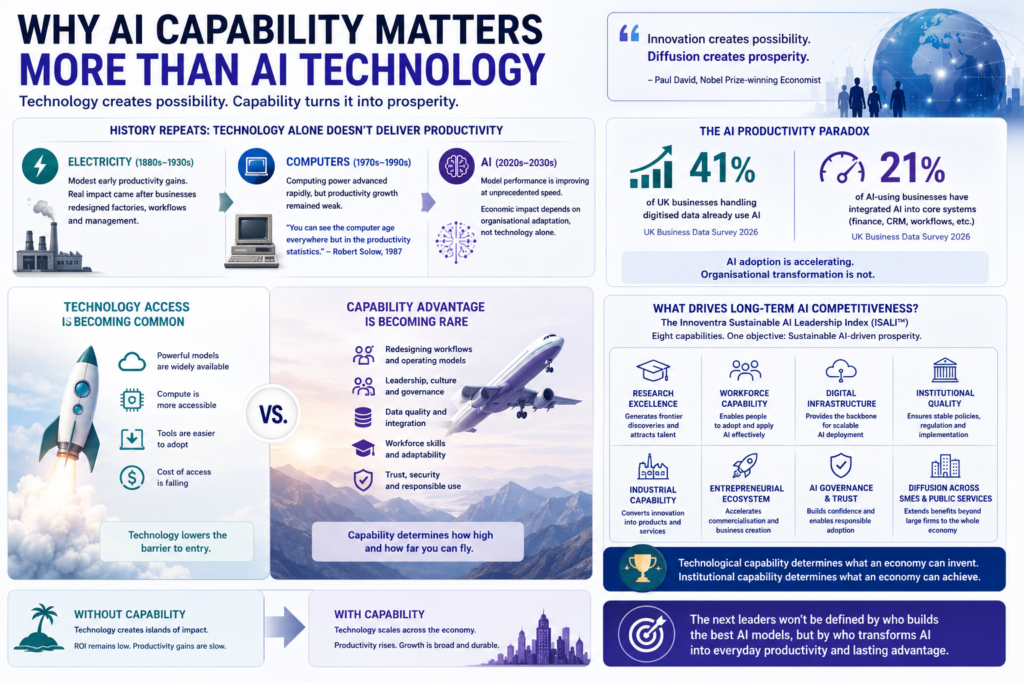
According to the UK Business Data Survey 2026, 41% of businesses handling digitised data now use AI, rising to 82% among large organisations. However, only 21% of AI-using organisations have integrated AI into their existing business systems, while the most common applications remain relatively basic, including research (28%) and drafting reports or correspondence (21%).
This distinction is economically significant.
Using AI to summarise documents may improve individual productivity.
Embedding AI into procurement, logistics, finance, customer service, supply chains and operational decision-making changes how businesses create value.
The first improves tasks.
The second transforms organisations.
That difference increasingly separates countries experimenting with AI from those building AI-enabled economies.
Why Are So Few Organisations Creating Measurable Value?
If AI models continue becoming more capable, why do relatively few organisations report significant commercial returns?
Research from multiple institutions points towards a remarkably consistent explanation.
McKinsey’s State of AI 2025 found that organisations reporting the greatest financial benefits from generative AI were significantly more likely to redesign workflows, restructure operating models and establish executive governance rather than simply deploying AI tools.
Similarly, Boston Consulting Group’s AI Radar 2025 reported that only 5% of organisations had achieved substantial value creation at scale despite widespread investment in AI technologies.
Viewed independently, these studies describe organisational behaviour.
Viewed together, they reveal something much larger.
The principal constraint on AI competitiveness is no longer algorithmic capability.
It is organisational capability.
This represents a profound shift in the economics of technological change.
During the previous decade, competitive advantage depended heavily on acquiring scarce technologies.
Today, access to frontier AI models has become increasingly commoditised.
The scarce resource is no longer technology.
It is management capability.
The New Economics of AI Competitiveness
Traditional measures of national AI strength including research publications, venture capital investment, patents and benchmark performance—remain important.
However, each primarily measures the capacity to invent.
They reveal far less about the capacity to diffuse innovation throughout an economy.
That distinction matters because productivity growth has slowed across many advanced economies for more than a decade despite rapid technological progress.
The OECD, IMF and World Bank have repeatedly argued that productivity gains depend not only on innovation itself but also on management quality, workforce skills, digital infrastructure, competition and institutional capability.
Artificial intelligence is unlikely to prove an exception.
Countries capable of combining frontier AI research with widespread SME adoption, modern digital infrastructure, trusted governance and continuous workforce reskilling are likely to capture disproportionately greater economic value than countries excelling in only one dimension.
The AI race, therefore, is becoming less about who builds the smartest machines.
It is becoming a competition over which economies can redesign themselves fastest.
An Innoventra Insight: From AI Capability to AI Capacity
One weakness in many international AI rankings is that they measure technological capability while paying relatively little attention to economic absorption.
To understand long-term competitiveness, Innoventra proposes distinguishing between two complementary concepts:
AI Capability – the ability to develop frontier models, attract investment, publish research and build advanced computing infrastructure.
AI Capacity – the ability of an economy to translate those technological advances into higher productivity, stronger public services, faster business adoption, workforce transformation and sustainable GDP growth.
History suggests capability creates breakthroughs.
Capacity determines prosperity.
The countries most likely to lead the AI economy over the next decade will therefore not necessarily be those inventing every breakthrough.
They will be those that enable millions of businesses not just a handful of technology companies to transform those breakthroughs into measurable economic output.
Why AI Capability Matters More Than AI Technology
One of the biggest misconceptions surrounding artificial intelligence is that technological leadership automatically produces economic leadership.
History suggests otherwise.
Over the past two centuries, economists have repeatedly observed that the countries inventing breakthrough technologies do not always capture the largest long-term economic benefits. The decisive factor is often not invention itself but diffusion the speed and scale at which innovations spread across businesses, public institutions and society.
This phenomenon has shaped every major industrial revolution.
Economic historian and Nobel Prize-winning economist Paul David argued that electricity generated relatively modest productivity gains during its early decades despite rapid investment in electrical infrastructure. Manufacturers initially replaced steam engines with electric motors but left factory layouts largely unchanged. Productivity accelerated only after businesses redesigned production around smaller electric machines, continuous workflows and new management practices.
A similar pattern emerged during the computer revolution. Despite extraordinary advances in computing power throughout the 1970s and 1980s, productivity growth remained unexpectedly weak across many advanced economies. Economist Robert Solow famously observed in 1987:
“You can see the computer age everywhere but in the productivity statistics.”
The productivity surge arrived years later not because computers became dramatically faster, but because organisations fundamentally redesigned supply chains, management systems and business processes around digital technologies.
Artificial intelligence increasingly displays the same characteristics.
Model performance continues to improve at unprecedented speed, yet measurable economic transformation depends far more slowly on organisational adaptation than technological capability.
This distinction may explain one of the defining paradoxes of the AI economy.
Investment in AI continues to accelerate.
Productivity growth does not.
The AI Productivity Paradox
Recent international research reveals an increasingly consistent pattern.
Businesses are adopting artificial intelligence much faster than they are transforming the way they operate.
McKinsey’s State of AI 2025 found that organisations reporting the strongest financial returns from generative AI were significantly more likely to redesign workflows, restructure operating models and establish executive governance than organisations simply deploying AI tools. Workflow redesign emerged as one of the strongest predictors of measurable EBIT impact.
Boston Consulting Group reached a remarkably similar conclusion.
Its AI Radar 2025 reported that only 5% of organisations have successfully created substantial value from AI at scale despite widespread investment and growing executive commitment. Most organisations remain trapped in pilot programmes or isolated productivity experiments rather than enterprise-wide transformation.
The UK Government’s Business Data Survey 2026 reinforces this pattern from a national perspective.
Although AI adoption continues to increase rapidly, only around one in five AI-using businesses has integrated AI into core operational systems such as finance, customer relationship management or workflow platforms. Most organisations continue using AI primarily for research, drafting correspondence and summarising information.
Viewed independently, these studies appear to measure different aspects of AI adoption.
Viewed collectively, they reveal something far more significant.
The principal constraint on AI competitiveness is no longer access to frontier models.
It is organisational capability.
The competitive advantage is shifting away from those who own the most sophisticated algorithms towards those who redesign work most effectively.
Are We Measuring AI Leadership Correctly?
Most international AI rankings evaluate countries using indicators such as research publications, patents, venture capital investment, semiconductor capability and computing infrastructure.
These remain essential measures of technological capability.
However, they largely measure a country’s ability to generate innovation rather than its ability to convert innovation into economy-wide productivity.
That distinction is increasingly important.
Consider two hypothetical economies.
The first develops one of the world’s leading frontier AI laboratories, attracting billions in venture capital and publishing world-class research.
The second produces fewer breakthrough models but successfully enables manufacturers, banks, hospitals, schools, public services and millions of SMEs to integrate AI into everyday operations.
Traditional AI rankings would almost certainly place the first economy higher.
Long-term productivity growth may favour the second.
This reflects one of the oldest principles in innovation economics.
Innovation creates possibility. Diffusion creates prosperity.
The IMF’s AI Preparedness Index, covering 174 economies, represents an important step towards measuring this broader challenge by incorporating digital infrastructure, human capital, technological innovation and legal frameworks.
However, even these measures capture only part of the picture.
Emerging evidence from McKinsey, Microsoft, BCG and the OECD increasingly suggests that long-term AI competitiveness also depends upon organisational leadership, management capability, workforce adaptability, SME adoption and public trust factors that remain difficult to quantify yet increasingly determine whether AI delivers measurable economic value.
Introducing the Innoventra Sustainable AI Leadership Index
Existing AI rankings provide valuable insights into technological progress.
Few attempt to measure whether countries possess the institutional capability to convert frontier AI into sustained national prosperity.
To address this gap, Innoventra proposes the Sustainable AI Leadership Index a conceptual framework that distinguishes between technological capability and economic absorption.
Rather than asking which country builds the most advanced AI systems, ISALI asks a different question:
Which countries are most capable of transforming AI into long-term productivity growth?
The framework evaluates eight mutually reinforcing dimensions:
| Capability | Why it matters |
|---|---|
| Research excellence | Generates frontier scientific discoveries and attracts global talent. |
| Workforce capability | Determines whether employees can adopt and apply AI effectively. |
| Digital infrastructure | Enables scalable deployment across the economy. |
| Institutional quality | Supports policy stability, regulation and implementation. |
| Industrial capability | Converts innovation into commercial products and services. |
| Entrepreneurial ecosystem | Accelerates commercialisation and business creation. |
| AI governance and trust | Encourages responsible adoption while reducing regulatory uncertainty. |
| Diffusion across SMEs and public services | Ensures productivity gains extend beyond large technology firms. |
The underlying principle is straightforward.
Technological capability determines what an economy can invent.
Institutional capability determines what an economy can achieve.
Countries performing well across all eight dimensions are likely to generate more resilient and sustainable AI-driven growth than economies excelling in only one or two.