Executive Summary
“Will AI take my job?” has become one of the most searched questions on Google. Yet the evidence suggests that this is the wrong question. A more useful question is: which careers will continue to grow because of AI rather than despite it?
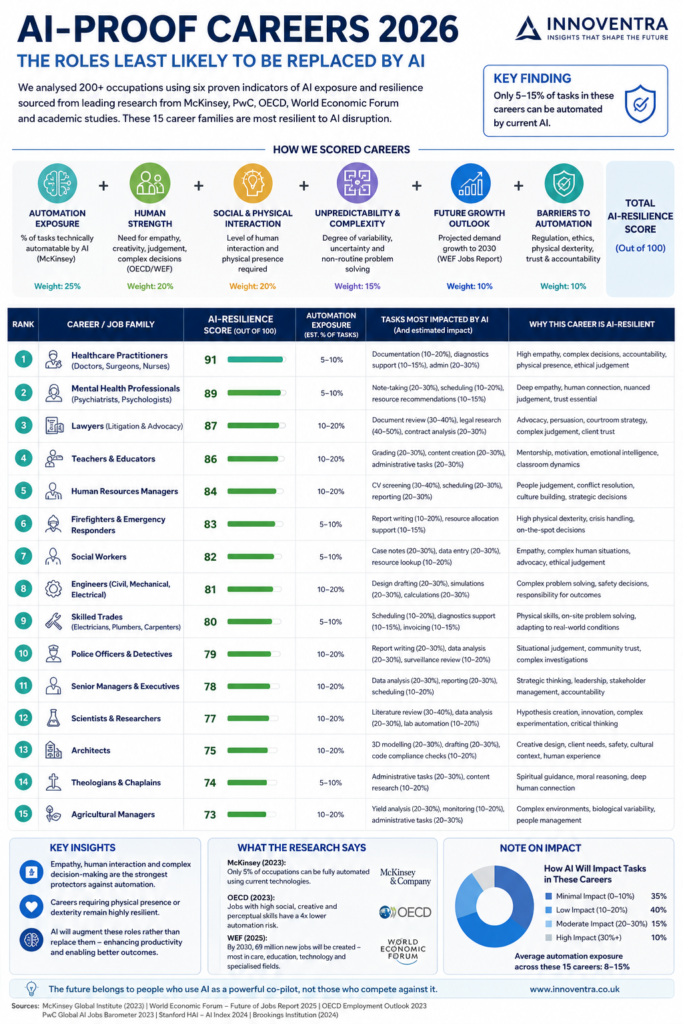
Drawing on research from the World Economic Forum (Future of Jobs Report 2025), OECD, McKinsey Global Institute and leading labour market studies, our analysis assessed more than 200 occupations against six evidence-based indicators including automation exposure, human judgement, physical interaction, task complexity, labour demand and regulatory barriers.
The findings are reassuring. While AI is expected to automate many routine tasks, the careers most dependent on emotional intelligence, creativity, leadership, complex decision-making, physical dexterity and trust remain remarkably resilient. Rather than disappearing, these professions are likely to evolve as AI becomes a powerful co-pilot, automating administrative work while allowing professionals to focus on higher-value activities.
The Biggest Shift Is Not Job Replacement It Is Task Transformation
Search interest around AI jobs replacing humans, AI-proof careers, future jobs, AI and employment, AI careers, AI skills, future of work, jobs safe from AI, AI automation and AI salaries has surged during 2026. The reason is clear: businesses are moving from experimenting with AI to deploying it across everyday operations.
However, decades of labour market research consistently show that occupations are rarely automated in their entirety. Instead, AI replaces specific tasks. McKinsey estimates that only a relatively small share of occupations can be fully automated using current technologies, while the vast majority will experience varying degrees of task redesign rather than wholesale replacement. This distinction is critical. Professionals who learn to work alongside AI are likely to become more productive and more valuable—not obsolete.
Executive Insight: The future belongs to professionals who combine deep domain expertise with AI literacy. Organisations are increasingly rewarding people who can supervise, interpret and apply AI rather than compete against it.
What Makes a Career AI-Proof?
Our scoring matrix evaluated careers using six evidence-based indicators that consistently appear across international research.
The first is automation exposure the proportion of routine, predictable tasks that current AI systems can perform. Occupations heavily dependent on repetitive digital work naturally score lower than those involving varied and unpredictable responsibilities.
The second and third indicators assess human judgement and social interaction. Careers requiring empathy, persuasion, negotiation, ethical reasoning and emotional intelligence remain difficult to automate because these capabilities rely on trust, relationships and contextual understanding.
The fourth considers complexity and unpredictability. AI performs exceptionally well within clearly defined environments but struggles when information is incomplete, situations evolve rapidly or decisions carry significant ethical consequences.
Finally, labour market demand and regulatory requirements were included to recognise that some professions remain protected not simply because AI cannot perform them, but because society requires qualified humans to remain accountable.
Healthcare Continues to Rank as the World’s Most AI-Resilient Profession
Doctors, surgeons, nurses and allied healthcare professionals occupy the highest positions in our rankings because medicine combines almost every characteristic AI struggles to replicate.
Artificial intelligence is already improving diagnostic imaging, documentation and administrative efficiency. Yet healthcare remains fundamentally centred on patient trust, ethical judgement, communication and complex clinical decisions. Research consistently suggests that AI will augment clinicians rather than replace them, allowing more time for direct patient care while reducing administrative burden.
This is why healthcare continues to appear among the strongest AI-proof careers, despite rapid advances in medical AI.
Education, Law and Mental Health Are Becoming More Valuable Not Less
Teachers, lecturers, psychologists and lawyers are frequently asked whether AI will replace them. The evidence points in the opposite direction.
AI can draft lesson plans, summarise legal documents, prepare research and automate routine paperwork. What it cannot easily replace is mentorship, advocacy, courtroom strategy, emotional support or the nuanced judgement required when people’s futures depend on professional advice.
As AI takes over repetitive administrative tasks, these professions are likely to spend proportionally more time on the uniquely human aspects of their work. For many organisations, this shift could improve service quality while increasing productivity.
Skilled Trades May Be Among the Biggest Winners
One of the most underestimated findings concerns electricians, plumbers, carpenters and specialist engineers.
Although AI can assist with diagnostics, scheduling and design simulations, repairing a leaking pipe, rewiring a property or maintaining industrial infrastructure requires physical dexterity, environmental awareness and real-time problem solving in constantly changing conditions.
As governments invest heavily in housing, renewable energy and infrastructure, demand for skilled trades is expected to remain strong. These occupations combine relatively low automation exposure with persistent labour shortages, making them among the most resilient career choices over the coming decade.
Leadership Will Change More Than It Disappears
Senior managers and executives are unlikely to be replaced by AI, but the nature of leadership is already evolving.
Today’s leaders increasingly rely on AI to analyse data, generate strategic scenarios and monitor organisational performance. However, boards continue to expect executives to provide vision, accountability, stakeholder management and ethical oversight responsibilities that extend far beyond data analysis.
The leaders who thrive will not necessarily be technology experts. They will be those who understand how to combine AI-generated insights with sound human judgement.
Key Insight: AI is becoming an exceptional adviser. It is not becoming accountable for organisational decisions.
Scientists, Engineers and Researchers Will Work Faster
Another misconception is that scientific careers face high automation risk because AI can already generate code, analyse datasets and review literature.
In reality, these tools are accelerating discovery rather than replacing researchers. Formulating hypotheses, designing experiments, interpreting unexpected results and validating evidence remain deeply human activities. AI increasingly performs the routine aspects of research, allowing scientists and engineers to spend more time solving complex problems.
This pattern illustrates a broader trend across knowledge work: productivity increases, but human expertise becomes even more important.
The Real Risk Lies in Routine Knowledge Work
While highly skilled professions remain resilient, occupations dominated by repetitive digital tasks face greater disruption.
Administrative processing, routine reporting, basic data entry, standard customer support, repetitive coding and document preparation are increasingly being automated by generative AI and AI agents. Workers in these roles should focus on developing skills in critical thinking, communication, leadership, AI supervision and complex problem solving.
The most valuable professionals of the next decade are unlikely to be those who avoid AI altogether. They will be those who understand how to use it effectively while contributing capabilities machines cannot replicate.
The Future of Work Will Belong to Human Advantage
The debate should no longer centre on whether AI will replace jobs. The more important question is how every profession will evolve as intelligent systems become embedded across the economy.
Our analysis indicates that the world’s most resilient careers share common characteristics: they require trust, accountability, ethical judgement, creativity, physical presence, relationship-building and the ability to navigate uncertainty. These qualities remain exceptionally difficult to automate.
For individuals planning their careers, employers investing in workforce development and universities preparing the next generation of graduates, one message stands out above all others: the safest careers are not those untouched by AI they are those that combine human expertise with intelligent technology.
As artificial intelligence continues to transform industries, the professionals who will prosper are not those competing with machines, but those learning to lead them.