
Why the Labour Market Is Changing Faster Than Most People Realise
Executive Insight
Artificial intelligence is not simply replacing jobs. It is redefining which human capabilities organisations are willing to pay for. Throughout history, technology has repeatedly reduced the value of one form of labour while increasing the value of another. AI is accelerating that process at an unprecedented pace, shifting economic value away from routine expertise towards judgement, creativity, accountability and strategic decision-making.
Part 1 — The Great Labour Market Shift Has Already Begun
Something unusual is happening in the global labour market.
Companies are investing record amounts in artificial intelligence. Technology spending continues to accelerate, enterprise AI adoption has reached historic highs, and executives increasingly describe AI as a strategic priority rather than an experimental technology. Yet, at the same time, graduate recruitment has slowed across several knowledge-intensive industries, entry-level professional vacancies have become noticeably more competitive, and employers are asking existing workforces to deliver higher productivity without equivalent growth in headcount.
At first glance these developments appear unrelated.
They are not.
They are early indicators of one of the largest reallocations of economic value since the emergence of the internet.
The defining question is therefore no longer whether AI will replace jobs. It is why organisations are changing what they are prepared to pay humans to do.
Recent evidence suggests this transformation is already well underway. The Stanford AI Index 2026 reports that 88% of organisations now use AI in at least one business function, illustrating how rapidly artificial intelligence has become embedded across the global economy. Frontier AI systems continue to improve in reasoning, coding and multimodal capabilities, while enterprise deployment has accelerated across sectors ranging from financial services and healthcare to manufacturing and professional services.
Technology adoption, however, tells only part of the story.
Labour markets are beginning to reflect a much deeper economic transition.
Market Insight
Every technological revolution changes how work is performed. Artificial intelligence is changing how work is valued. That distinction is likely to determine the careers of millions of workers over the next decade.
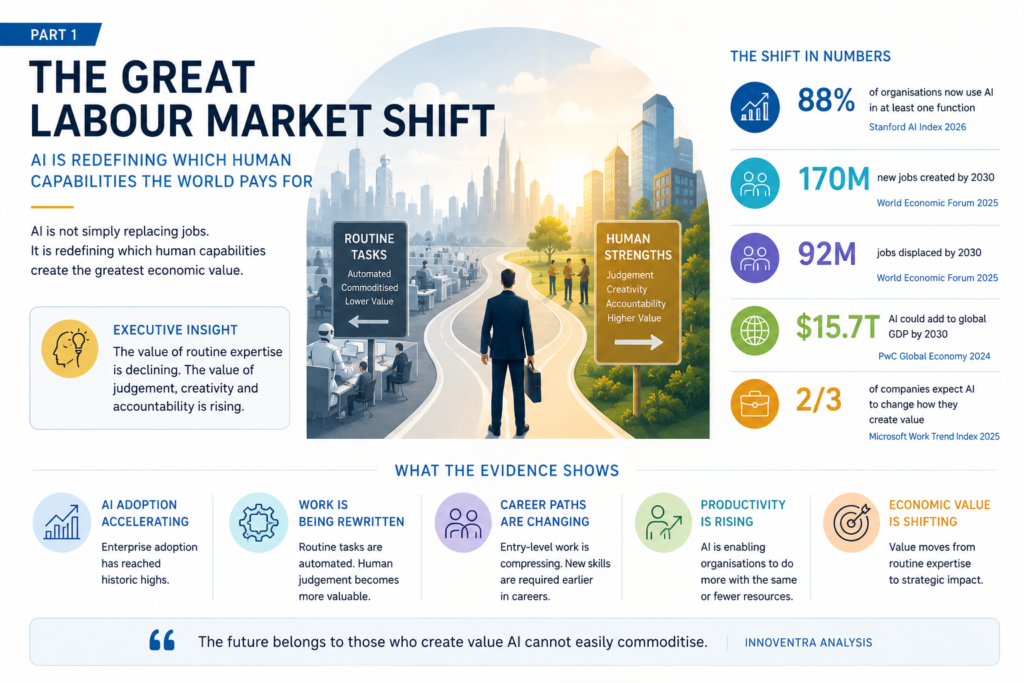
AI Is Not Replacing Occupations First. It Is Replacing Routine Economic Value.
For decades, organisations employed millions of people to perform activities that computers struggled to complete.
Reading contracts.
Preparing reports.
Writing first drafts.
Analysing spreadsheets.
Searching documents.
Summarising meetings.
Responding to standard customer enquiries.
Producing software code.
These activities generated enormous economic value because they required human cognition.
Large language models have fundamentally changed that equation.
Artificial intelligence can now perform many of these tasks within seconds, often at negligible marginal cost. Consequently, the market value of routine cognitive work is beginning to decline, even when the occupation itself remains.
This distinction explains why many predictions about “AI replacing jobs” fail to capture what is actually happening.
Most professions will not disappear overnight.
Instead, the routine component of those professions is becoming progressively cheaper, while the remaining human activities become increasingly valuable.
This represents one of the most important findings emerging from recent labour-market research.
Innoventra Analysis
The strongest evidence from Stanford HAI, PwC, Microsoft, OECD, Goldman Sachs and the World Economic Forum points towards a common conclusion. AI is not replacing occupations first. It is reducing the economic value of routine expertise within occupations. As that value declines, organisations redesign jobs around the capabilities that remain difficult to automate: judgement, accountability, trust, creativity and interdisciplinary problem-solving.
Why Previous Industrial Revolutions Offer an Important Lesson
History suggests that labour markets rarely change because technology simply performs existing work faster.
They change because technology alters where economic value is created.
Steam engines reduced the value of human and animal muscle while dramatically increasing demand for engineers, factory supervisors and industrial managers.
Electricity transformed manufacturing, but the greatest productivity gains occurred only after factories were redesigned around new production methods rather than simply replacing steam engines with electric motors.
The internet did not eliminate retail.
It fundamentally changed how customers discovered, compared and purchased products, rewarding organisations capable of redesigning entire business models rather than simply launching websites.
Artificial intelligence appears to be following the same historical pattern.
The technology itself matters.
But organisational adaptation matters considerably more.
This conclusion is reinforced by PwC’s 2026 Global AI Jobs Barometer, which analysed more than one billion job advertisements across multiple countries. Rather than finding widespread occupational collapse, the research identified a labour market increasingly divided between roles where AI amplifies expert judgement and roles where AI rapidly commoditises routine work. Workers possessing AI-related capabilities are also experiencing significantly stronger wage growth than comparable workers without those skills, indicating that the market is already rewarding AI-enabled expertise rather than AI avoidance.
Perhaps the most surprising finding is that AI exposure does not necessarily predict employment decline.
In many industries, organisations adopting AI are becoming more productive, more profitable and simultaneously more selective about the capabilities they recruit.
The labour market is therefore not simply shrinking.
It is becoming more demanding.
Executive Insight
The greatest career risk is increasingly not losing your current job. It is discovering that the next generation of jobs demands capabilities that yesterday’s career pathways no longer develop.
The Real Story Is Not Job Loss. It Is Career Compression.
Much public discussion continues to focus on the number of jobs AI might replace.
The emerging evidence suggests a more profound transformation.
Artificial intelligence is beginning to compress traditional career ladders.
For decades, graduates entered organisations by performing routine analytical work under supervision. Junior lawyers reviewed documents. Junior accountants reconciled accounts. Junior consultants prepared presentations. Junior software engineers wrote relatively straightforward code before progressing towards systems architecture and product design.
These routine activities served an essential purpose.
They developed judgement.
Today, many of those same activities are increasingly performed by AI.
The question facing employers is therefore becoming increasingly uncomfortable.
How do organisations develop future experts if many of the tasks that historically created expertise are disappearing?
That question not the number of jobs AI replaces—may prove to be one of the defining workforce challenges of the coming decade.
Part 2 — Which Professions Are Entering Structural Decline?
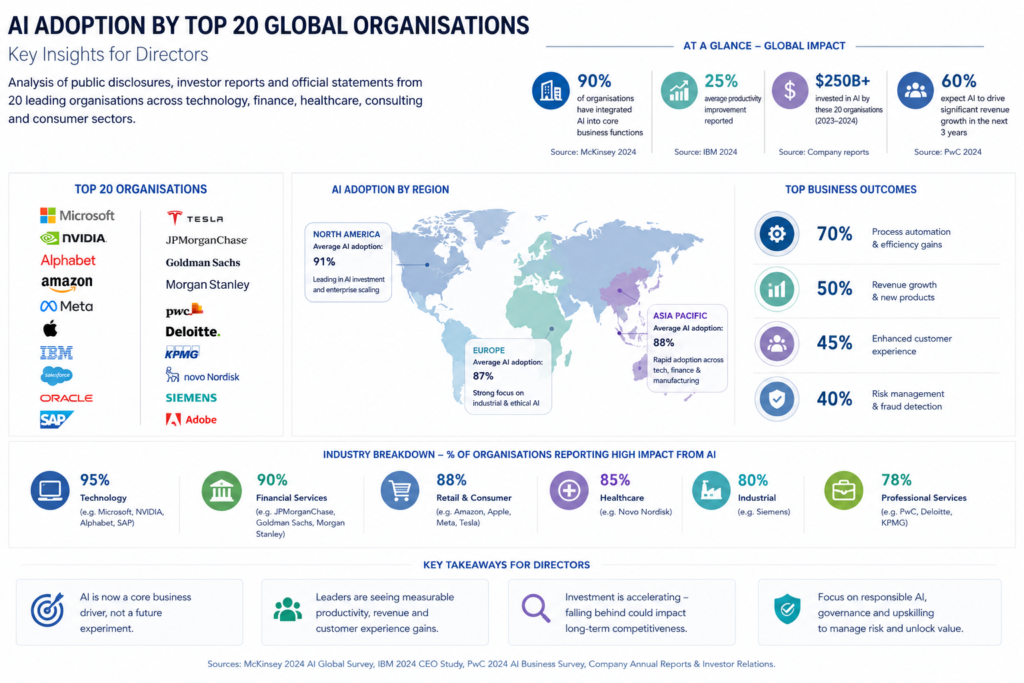
For decades, economists believed automation would primarily replace repetitive physical labour. Artificial intelligence has overturned that assumption. Today’s disruption is increasingly concentrated in occupations built around language, information processing and routine decision-making rather than manual work. This is one of the defining characteristics of the AI revolution: it targets cognitive routine, not simply physical routine.
Recent labour-market evidence reinforces this shift. The OECD has consistently found that occupations involving routine cognitive tasks are among the most exposed to generative AI, while the International Labour Organization concludes that clerical and administrative occupations are particularly vulnerable because AI complements or substitutes many of their core activities rather than merely assisting them. These findings represent a fundamental departure from previous automation waves, which primarily affected manufacturing and production roles.
Executive Insight
The first wave of automation reduced the value of physical repetition. The AI revolution is reducing the value of cognitive repetition. Organisations are not simply automating work—they are redefining what constitutes economically valuable human expertise.
The Occupations Facing the Greatest Structural Pressure
Contrary to popular belief, occupations disappear slowly. Their economic foundations disappear much faster.
Throughout history, professions have rarely become obsolete overnight. Instead, technology gradually erodes the value of the activities that once justified employing large numbers of people. The occupation often survives, but with fewer workers, different responsibilities and higher expectations.
That pattern is becoming increasingly visible across knowledge-intensive industries.
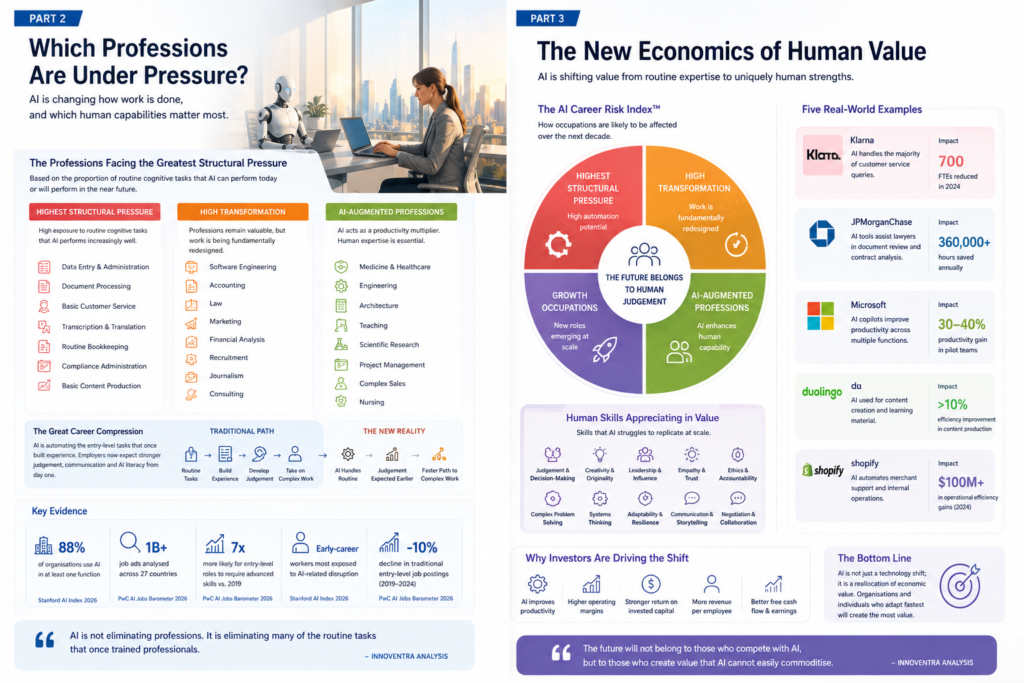
Administrative assistants, data-entry specialists, transcription professionals, document processors, basic customer-support agents, routine bookkeeping staff and first-line compliance administrators all perform work centred on organising, validating, summarising or transferring information. These are precisely the capabilities in which modern large language models have advanced most rapidly.
This does not imply these professions will disappear completely. Rather, organisations are likely to require significantly fewer people to complete the same volume of work. AI enables a single employee to perform tasks that previously required several colleagues, fundamentally changing workforce economics.
Microsoft’s 2025 Work Trend Index illustrates this shift. The research found that many organisations expect AI agents to become an integral part of daily operations within the next 12–18 months, while leaders increasingly describe AI as a mechanism for expanding organisational capacity rather than merely reducing costs. The implication is clear: future administrative work will exist, but its scale and composition are changing rapidly.
Innoventra Analysis
Occupations rarely disappear because technology becomes capable. They contract because the economics of employing people changes. When one worker supported by AI can produce the output that previously required three, organisations inevitably redesign the workforce.
Why White-Collar Work Is More Exposed Than Many Expected
For years, the prevailing assumption was that professional occupations would remain comparatively insulated from automation.
The evidence increasingly suggests otherwise.
Generative AI performs particularly well on tasks involving reading, writing, summarisation, translation, coding, research and structured reasoning—the very activities underpinning millions of white-collar careers. Unlike previous automation technologies, AI does not require physical interaction with the environment to create value. It creates value by processing information.
This explains why financial services, consulting, law, marketing, journalism, software development and public administration are all experiencing significant organisational redesign despite employing highly educated workforces.
The irony is striking.
Higher education traditionally increased career security because knowledge itself was scarce.
Artificial intelligence is making access to knowledge abundant.
Consequently, competitive advantage is shifting away from possessing information and towards interpreting information effectively.
That distinction is likely to redefine professional careers throughout the next decade.
Market Insight
Knowledge is becoming increasingly abundant. Judgement remains scarce. As information becomes cheaper to produce, organisations increasingly reward those capable of interpreting it, challenging it and applying it responsibly.
Software Engineering Is Being Reinvented Not Replaced
Few professions illustrate AI disruption more clearly than software engineering.
Public discussion often oscillates between two extremes: either AI will replace programmers entirely or software engineers have nothing to fear. Neither conclusion reflects the available evidence.
AI coding assistants have substantially increased productivity for routine programming tasks, including code generation, testing, documentation and debugging. At the same time, enterprise demand for experienced software architects, cybersecurity specialists, systems engineers and AI infrastructure professionals remains exceptionally strong.
The explanation lies in the changing economics of software development.
Routine coding is becoming increasingly commoditised.
Systems thinking is becoming increasingly valuable.
Modern software projects require architectural decisions, integration across complex technology ecosystems, cybersecurity oversight, regulatory compliance, product strategy and accountability for technical outcomes. These responsibilities extend well beyond writing code.
In other words, AI is reducing the value of typing code while increasing the value of understanding why that code exists.
This represents a profound shift in career development.
Junior developers previously gained experience through repetitive programming tasks. AI now performs many of those activities, forcing organisations to rethink how future engineering talent develops.
Technology Insight
Software engineering is not becoming obsolete. Routine coding is becoming inexpensive. The premium is migrating towards architecture, security, systems integration and engineering judgement.
The Professions Most Likely to Experience Fundamental Redesign
The strongest evidence suggests that many respected professions are entering a period of structural redesign rather than structural disappearance.
Accountants increasingly rely on AI for reconciliation, document analysis and routine tax preparation.
Lawyers use AI to review contracts, summarise case law and draft standard legal documents.
Financial analysts employ AI to process market data, generate scenarios and automate reporting.
Marketing professionals use AI to produce first drafts of campaigns, advertising copy and customer segmentation.
Recruiters increasingly automate CV screening, candidate outreach and interview scheduling.
In each case, AI performs activities that were once delegated to junior professionals.
The profession survives.
The routine work contracts.
The economic value shifts towards client relationships, strategic judgement, regulatory interpretation, negotiation and accountability.
This explains why many organisations are simultaneously investing heavily in AI while continuing to recruit experienced professionals.
The expertise remains valuable.
The pathway to acquiring that expertise is changing.
Executive Insight
The defining workforce challenge is no longer whether professions survive. It is whether organisations can develop future experts when many of the routine activities that historically created expertise are disappearing.
The Great Career Compression
Perhaps the most underreported consequence of artificial intelligence is its impact on career progression.
Historically, expertise developed gradually.
Graduates entered organisations by performing repetitive analytical work. They reviewed documents, prepared presentations, reconciled accounts, analysed data, drafted reports and supported senior colleagues. These activities generated relatively modest commercial value, but they created something far more important: professional judgement.
Artificial intelligence is rapidly changing this model.
Recent labour-market research shows employers increasingly expect junior employees to arrive with stronger communication skills, AI literacy, business understanding and independent judgement from the outset. Entry-level positions are becoming less focused on routine execution and more focused on supervising, validating and extending AI-generated work.
This creates a paradox.
AI increases productivity among experienced professionals while simultaneously reducing many of the traditional opportunities through which future professionals acquired experience.
For employers, the challenge becomes strategic.
How do organisations build tomorrow’s experts if yesterday’s apprenticeship model no longer exists?
For governments and universities, the question is equally profound.
How should education evolve when routine knowledge work is no longer the primary gateway into professional careers?
These questions remain largely unresolved, yet they may shape labour markets more profoundly than the technology itself.
Innoventra Analysis
Artificial intelligence is compressing professional careers. The routine work that once developed expertise is disappearing faster than new models of capability development are emerging. Organisations that redesign learning, mentoring and workforce development early are likely to enjoy a significant long-term competitive advantage.
Part 3 — The New Economics of Human Value
For more than two centuries, every industrial revolution has followed a remarkably consistent pattern.
New technologies rarely eliminate the need for human work. Instead, they change which forms of human work create the greatest economic value.
The steam engine reduced the commercial value of physical strength while dramatically increasing demand for engineers, managers and industrial planners.
Electricity transformed manufacturing, yet productivity accelerated only after organisations redesigned factories rather than merely replacing steam engines with electric motors.
The internet reduced the value of geographic proximity while increasing the value of digital platforms, logistics and data.
Artificial intelligence is following the same economic pattern.
The difference is that AI is targeting something previous technologies could not: routine expertise.
Executive Insight
Artificial intelligence is not creating a shortage of work. It is creating a shortage of economically valuable human work. Those are fundamentally different challenges.
Why Investors Are Accelerating Workforce Transformation
Much of the public debate focuses on technology.
The stronger economic force may be capital.
Every publicly listed company is ultimately evaluated on its ability to create more value from the resources it controls.
Investors reward organisations that improve:
- productivity,
- operating margins,
- return on invested capital,
- revenue per employee,
- free cash flow,
- earnings growth.
Artificial intelligence has the potential to improve every one of these measures.
Consequently, AI is no longer simply an innovation programme.
It has become a capital allocation strategy.
This explains why nearly every major technology company is investing billions of dollars in AI infrastructure despite considerable short-term costs.
Executives are not investing because AI is fashionable.
They are investing because financial markets increasingly expect productivity gains.
Microsoft, Alphabet, Amazon and Meta have all significantly increased AI-related capital expenditure while presenting AI as central to long-term growth strategies. Investors have generally evaluated these investments through the lens of future productivity and competitive positioning rather than immediate workforce reductions.
The implication extends well beyond technology companies.
Boards across financial services, healthcare, manufacturing, retail and professional services increasingly face similar questions.
If AI allows one employee to produce substantially greater output, should organisations continue operating with existing structures?
History suggests the answer is usually no.
Market Insight
AI disruption is not driven solely by technological capability. It is reinforced by capital markets that reward organisations capable of converting technology into higher productivity and stronger financial performance.
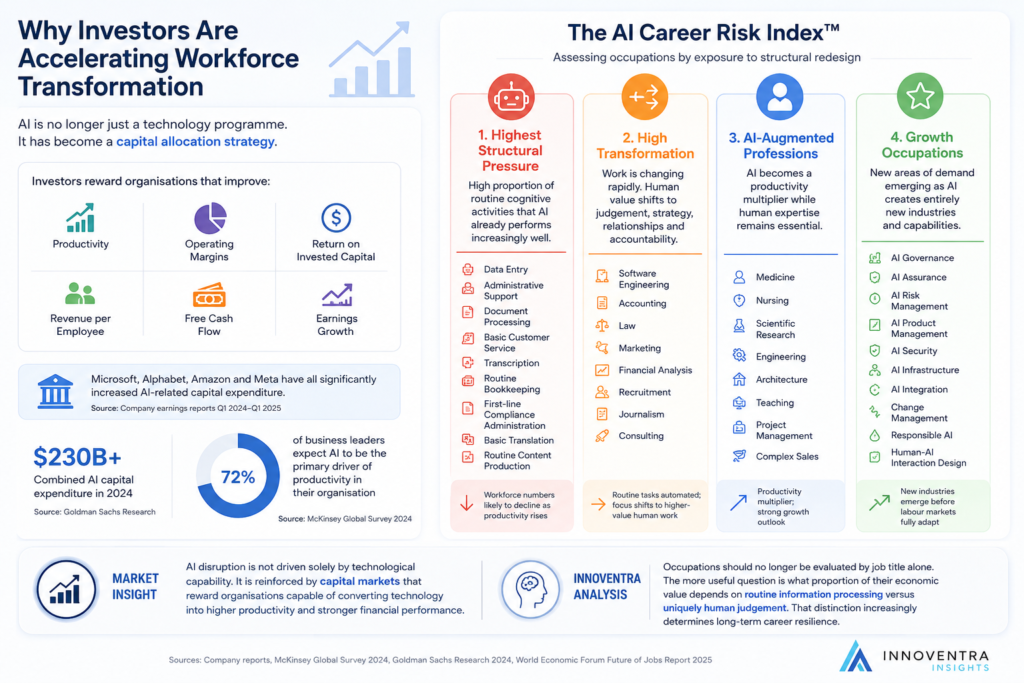
The AI Career Risk Index
Rather than asking whether occupations are “safe” or “unsafe”, executives should assess how exposed different forms of work are to structural redesign.
Highest Structural Pressure
These occupations contain a high proportion of routine cognitive activities that AI already performs increasingly well.
- Data Entry
- Administrative Support
- Document Processing
- Basic Customer Service
- Transcription
- Routine Bookkeeping
- First-line Compliance Administration
- Basic Translation
- Routine Content Production
The evidence suggests these occupations are unlikely to disappear entirely.
However, workforce numbers may decline as AI significantly increases individual productivity.
High Transformation
These professions continue creating substantial value but the nature of work is changing rapidly.
- Software Engineering
- Accounting
- Law
- Marketing
- Financial Analysis
- Recruitment
- Journalism
- Consulting
Routine activities increasingly become automated.
Human value shifts towards judgement, client relationships, strategic interpretation and accountability.
AI-Augmented Professions
These occupations are expected to benefit significantly from AI while remaining highly dependent upon human expertise.
- Medicine
- Nursing
- Scientific Research
- Engineering
- Architecture
- Teaching
- Project Management
- Complex Sales
AI becomes a productivity multiplier rather than a replacement.
Growth Occupations
Entirely new areas of demand continue emerging.
- AI Governance
- AI Assurance
- AI Risk Management
- AI Product Management
- AI Security
- AI Infrastructure
- AI Integration
- Change Management
- Responsible AI
- Human-AI Interaction Design
History suggests technological revolutions create entirely new industries before labour markets fully understand them.
Artificial intelligence already appears to be following this trajectory.
Innoventra Analysis
Occupations should no longer be evaluated by job title alone. The more useful question is what proportion of their economic value depends upon routine information processing versus uniquely human judgement. That distinction increasingly determines long-term career resilience.
The Human Skills Appreciating in Value
Throughout history, scarcity has determined economic value.
As artificial intelligence makes information increasingly abundant, a different category of capability becomes scarce.
Judgement.
Trust.
Leadership.
Negotiation.
Creativity.
Ethical reasoning.
Systems thinking.
These capabilities become valuable precisely because AI struggles to replicate them reliably across complex organisational environments.
The World Economic Forum consistently identifies analytical thinking, resilience, leadership, technological literacy and creative problem-solving among the fastest-growing capabilities demanded by employers.
Notice something striking.
Most of these are not technical skills.
They are decision-making skills.
That observation fundamentally changes how individuals should think about career development.
Learning AI matters.
Learning how to make better decisions with AI matters considerably more.
Executive Insight
The long-term premium will not belong to workers who simply know how to use AI. It will belong to those capable of exercising better judgement because they use AI intelligently.
Five Lessons Every Executive, Employee and Student Should Take Away
The research reviewed throughout this article points towards five consistent conclusions.
First, AI is redesigning occupations before eliminating them.
Second, routine cognitive expertise is becoming progressively less valuable while strategic judgement becomes increasingly valuable.
Third, organisations that redesign work rather than simply automate tasks consistently capture greater productivity gains.
Fourth, the greatest workforce disruption may occur among early-career professionals whose traditional pathways into expertise are changing rapidly.
Finally, the most resilient organisations and individuals will be those that treat AI not as a substitute for human capability, but as a force multiplier for uniquely human strengths.
These conclusions emerge consistently across research from Stanford HAI, PwC, the World Economic Forum, OECD, Microsoft, McKinsey and other leading institutions despite differences in methodology and geography.
Executive Reflection
Every generation experiences a technological shift that fundamentally changes where economic value is created.
Steam power rewarded industrial capability.
Electricity rewarded operational redesign.
The internet rewarded digital business models.
Artificial intelligence is rewarding organisations capable of combining machine intelligence with human judgement.
This distinction matters because many people continue asking the wrong question.
The question is no longer:
“Will AI replace my job?”
The evidence suggests a far more important question.
“Which parts of my work create value that artificial intelligence cannot easily commoditise?”
For workers, the answer will shape career resilience.
For organisations, it will shape competitive advantage.
For governments, it will shape education, productivity and economic growth.
History suggests technological revolutions rarely reward those who adopt technology first.
They reward those who redesign themselves most effectively around it.
Artificial intelligence appears unlikely to be any different.
Final Executive Insight
The future of work will not be determined by artificial intelligence alone. It will be determined by how quickly organisations, education systems and individuals redefine human value in an economy where routine expertise is no longer scarce. Those who understand that shift earliest are unlikely to compete with AI. They will use AI to compete more effectively with everyone else.