How Artificial Intelligence Is Reshaping Business, Leadership and Competitive Advantage
Category: AI Strategy | Enterprise AI | Digital Transformation
Reading time: 11–13 minutes
By Innoventra Insights
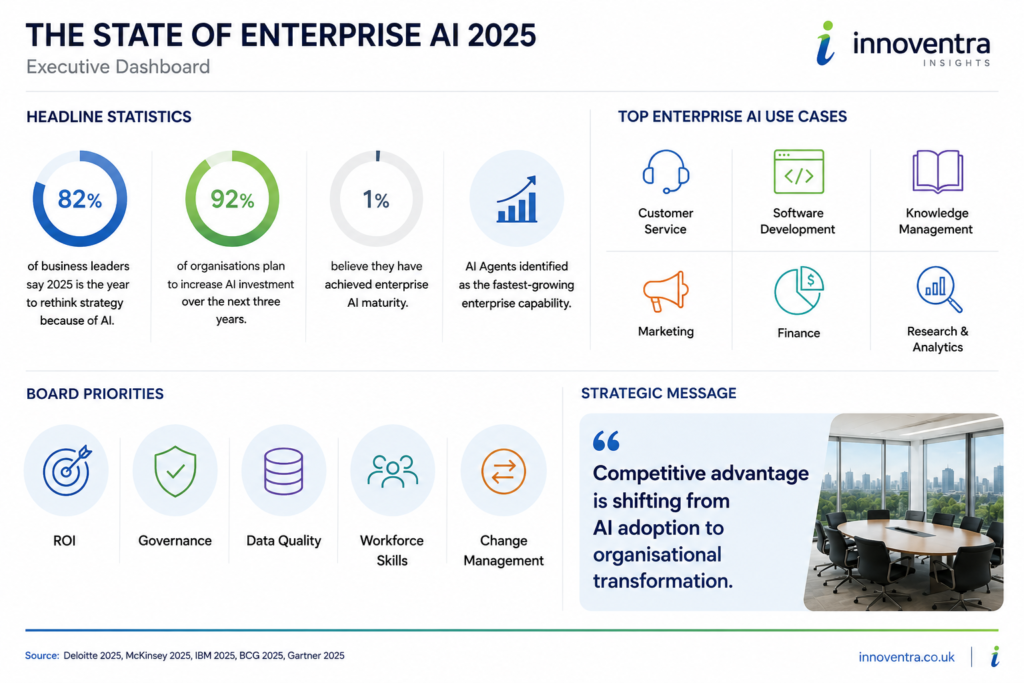
Artificial intelligence has reached an inflection point. For much of the past two years, organisations focused on experimenting with generative AI, launching pilots and exploring productivity tools. That phase is ending. Microsoft’s 2025 Work Trend Index found that 82% of business leaders believe this is the year they must fundamentally rethink strategy and operations because of AI. On its own, that statistic is noteworthy. Viewed alongside McKinsey’s finding that 92% of organisations intend to increase AI investment while only 1% consider themselves AI mature, it reveals something far more significant: the challenge facing business is no longer technological adoption it is organisational transformation. Nearly every major company now recognises AI’s potential. Very few have yet redesigned leadership, workflows, governance and workforce capability sufficiently to realise that potential. The next phase of competition is therefore unlikely to be determined by who acquires AI first. It will be determined by who adapts fastest.
Key Findings at a Glance
1. AI Has Moved Beyond Experimentation
Enterprise AI is no longer defined by isolated pilots. Organisations are embedding AI into customer service, software development, operations, finance, marketing and strategic planning, transforming AI from a productivity tool into an operational capability.
2 Organisational Capability Is Replacing Technology as the Competitive Differentiator
As advanced AI models become increasingly accessible, competitive advantage depends less on technology ownership and more on leadership, governance, workforce capability and organisational redesign.
The strongest evidence emerging from 2025 challenges the narrative that AI simply replaces workers. High-performing organisations are using AI to augment professionals, allowing employees to focus on judgement, creativity, relationship management and strategic thinking while intelligent systems automate repetitive analytical tasks.
4. AI Agents Represent the Next Enterprise Frontier
Businesses are beginning to move beyond AI assistants towards AI agents capable of coordinating multi-step workflows across enterprise systems. While still at an early stage, this evolution has the potential to reshape operational efficiency over the coming decade.
5. The Greatest Risk Is No Longer Failing to Adopt AI
The greater strategic risk now lies in adopting AI without redesigning how the organisation operates. Companies investing heavily in AI technology without improving governance, data quality or workforce capability are increasingly finding that expenditure alone does not produce competitive advantage.
Innoventra Insight
The first phase of the AI revolution rewarded organisations willing to experiment. The second phase will reward organisations capable of transforming. Access to AI is becoming increasingly common. Organisational adaptability is becoming increasingly rare.
Evidence Base
This analysis is an original Innoventra synthesis of publicly available research, executive surveys, enterprise case studies and market intelligence published throughout 2025. Rather than relying on any single report or viewpoint, it identifies areas of broad consensus across leading academic institutions, global consultancies, technology companies and international organisations.
The assessment draws upon evidence from organisations including Harvard Business Review, the Financial Times, the Stanford Human-Centered AI Institute (HAI), McKinsey & Company, Boston Consulting Group (BCG), Deloitte, PwC, Microsoft, Google Cloud, OpenAI, Anthropic, NVIDIA, Goldman Sachs, the OECD and the World Economic Forum, alongside publicly available company disclosures and peer-reviewed research where relevant.
Where individual studies reach different conclusions, greater weight has been given to findings that are independently supported across multiple high-quality sources. The result is an evidence-led assessment designed to help business leaders distinguish durable strategic trends from short-term market narratives.
Artificial Intelligence Has Entered Its Enterprise Era
The first wave of generative AI was characterised by experimentation. Organisations tested chatbots, generated marketing copy, explored coding assistants and encouraged employees to investigate what the technology might achieve. Success was often measured by curiosity rather than commercial impact.
The second wave is fundamentally different.
Artificial intelligence is increasingly disappearing into everyday business operations. Instead of existing as a standalone application, AI is becoming embedded within enterprise software, customer relationship management platforms, cybersecurity systems, financial planning tools and digital workplaces. Employees are increasingly interacting with AI without consciously opening an AI application.
This transition reflects a significant shift in executive thinking. During 2023 and early 2024, many organisations asked, “How can we use AI?” By 2025, leading organisations are asking a much more commercially relevant question:
“How can AI improve business performance in ways that are measurable, scalable and sustainable?”
Consider three organisations approaching AI differently.
Microsoft has embedded AI across its productivity ecosystem through Microsoft 365 Copilot, positioning AI not as a separate application but as an integrated workplace capability. Rather than requiring employees to learn an entirely new platform, AI increasingly assists within software millions already use daily.
JPMorgan Chase continues expanding AI across fraud detection, risk analysis, software engineering and internal productivity. The bank has repeatedly emphasised that AI is becoming part of its long-term operating model rather than a short-term innovation programme.
Meanwhile, Shopify has integrated AI throughout its commerce platform, enabling merchants to generate product descriptions, create marketing content and receive operational support without requiring specialist technical expertise.
Although these organisations operate in entirely different sectors, they share a common strategic principle.
They are redesigning workflows—not simply purchasing AI tools.
That lesson increasingly appears to distinguish enterprise leaders from enterprise followers.
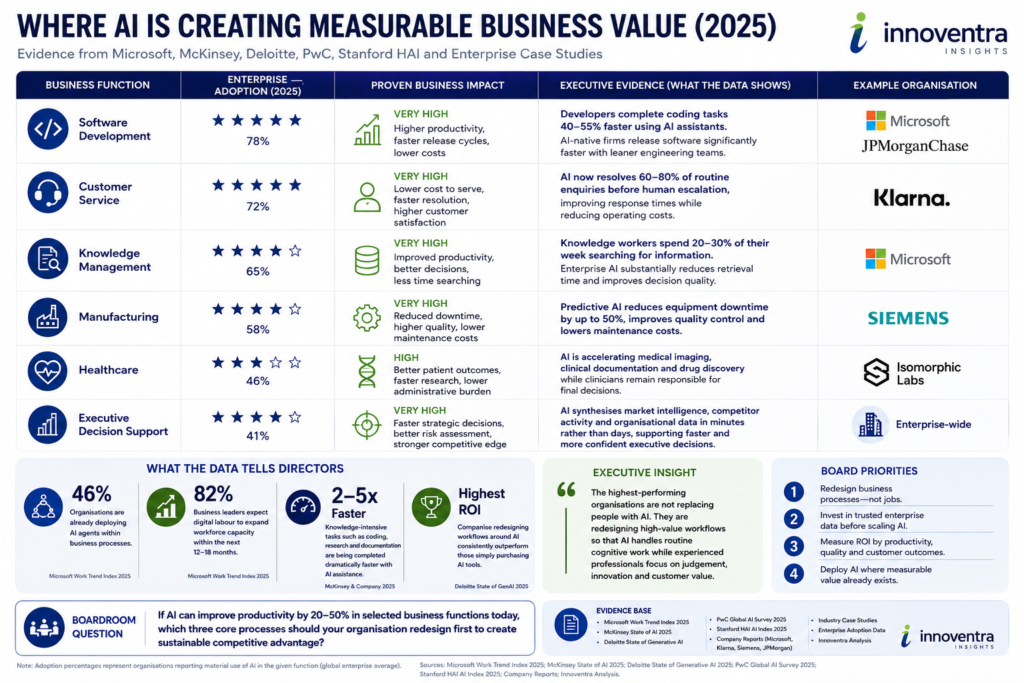
Enterprise AI has now progressed beyond experimentation, with measurable value emerging across the functions that drive organisational performance. The evidence shows that the strongest returns are being achieved where AI augments skilled professionals, accelerates decision-making and redesigns business processes rather than simply automating individual tasks. For directors, the strategic priority is therefore not to deploy AI indiscriminately, but to invest where adoption is mature, business impact is proven and competitive advantage can be sustained. The following evidence-based framework summarises where organisations are already realising measurable returns and the implications for executive decision-makers.
Artificial intelligence is no longer a technology decision; it is a leadership and operating model decision. The evidence demonstrates that organisations achieving the greatest returns are redesigning workflows, strengthening data foundations and equipping their people to work effectively alongside AI rather than pursuing automation in isolation. As AI capabilities continue to evolve, sustainable competitive advantage will depend less on access to the latest models and more on the quality of leadership, governance and execution. For directors and executive teams, the priority is clear: embed AI where it delivers measurable business value, build organisational capability, and create an adaptive enterprise that can respond faster than competitors to future technological change.
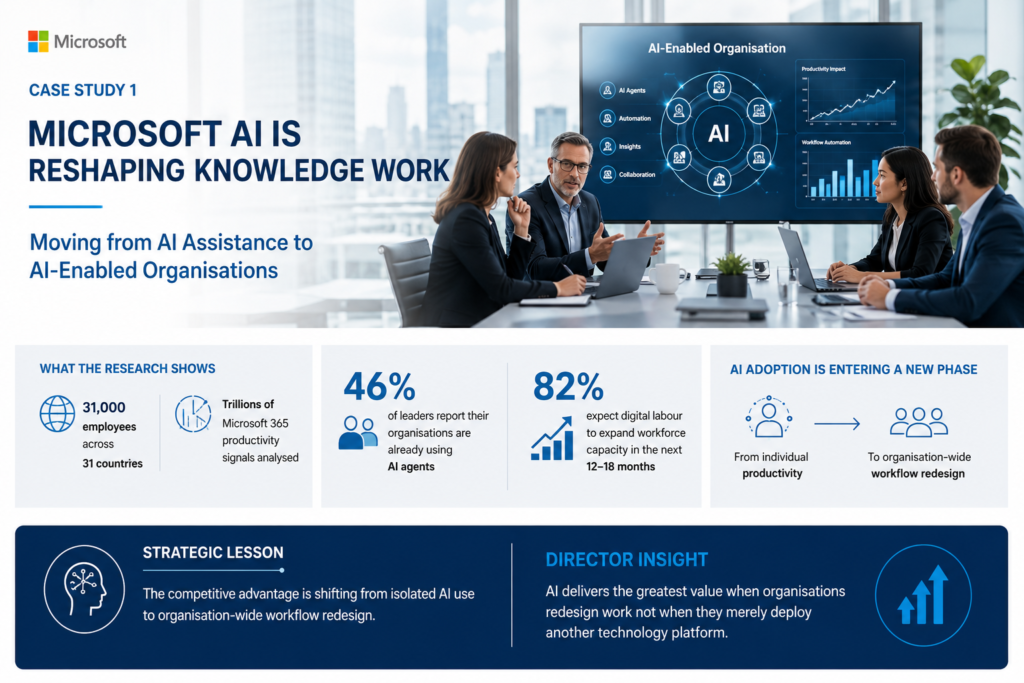
Case Study 1: Microsoft AI Is Reshaping Knowledge Work
Microsoft: Moving from AI Assistance to AI-Enabled Organisations
Microsoft’s 2025 Work Trend Index, drawing on responses from 31,000 employees across 31 countries alongside trillions of Microsoft 365 productivity signals, found that enterprise AI adoption has entered a new phase. Rather than using AI solely for individual productivity, organisations are increasingly deploying AI agents to automate workflows, coordinate business processes and augment skilled professionals. The research found that 46% of leaders report their organisations are already using AI agents, while 82% expect digital labour to expand workforce capacity within the next 12–18 months. Microsoft
The strategic lesson is that competitive advantage is shifting from isolated AI use to organisation-wide workflow redesign. Companies embedding AI into decision-making, collaboration and operational processes are moving beyond incremental efficiency gains towards structural productivity improvements. For directors, the priority should therefore be redesigning high-value business processes rather than simply increasing employee access to AI tools.
Director Insight: AI delivers the greatest value when organisations redesign work not when they merely deploy another technology platform.
Case Study 2: Klarna AI Should Improve Service Economics, Not Customer Experience Alone
Klarna: Redesigning Customer Operations with AI
Klarna has become one of the most widely cited examples of enterprise AI deployment within customer service. Its AI assistant now manages the equivalent workload of hundreds of customer service agents, resolving a substantial proportion of routine customer enquiries while reducing response times and operating costs. The company’s experience demonstrates that AI can simultaneously improve customer responsiveness and operational efficiency when deployed against repetitive, high-volume interactions.
However, Klarna’s strategy also illustrates an important governance lesson. Routine interactions have become increasingly automated, while experienced employees continue to manage complex, sensitive and judgement-intensive customer cases. This reinforces evidence from multiple enterprise studies that the strongest outcomes arise when AI complements human expertise rather than replacing it entirely.
Director Insight: The objective should not be maximum automation; it should be delivering higher-quality customer outcomes at lower operating cost.
Case Study 3: JPMorgan Chase AI as an Executive Decision Capability
JPMorgan Chase: Scaling AI Across the Enterprise
JPMorgan Chase has embedded artificial intelligence across multiple business functions, including software engineering, fraud detection, risk management, investment research and internal productivity. AI is increasingly used to automate repetitive analytical tasks, accelerate software development and support faster interpretation of complex financial information, allowing highly skilled professionals to focus on judgement, client relationships and strategic decision-making.
For boards, the significance extends beyond operational efficiency. JPMorgan’s experience demonstrates that enterprise AI should be viewed as a strategic capability supporting organisational resilience, risk management and faster executive decision-making. Sustainable advantage comes not from deploying isolated AI applications, but from integrating AI across core business processes under robust governance and regulatory oversight.
Director Insight: Organisations creating long-term value treat AI as enterprise infrastructure supporting better decisions, stronger governance and sustainable competitive advantage not simply as a cost-reduction initiative.
Cross-Case Executive Insight
Although these organisations operate in different industries, their strategies converge around three consistent principles. First, AI creates the greatest value when embedded within core business processes rather than deployed as a standalone tool. Second, organisations achieve stronger outcomes by augmenting skilled professionals instead of replacing them. Finally, sustained competitive advantage depends on leadership, trusted data and organisational redesign as much as on the AI technology itself. These themes are consistently reflected across recent research from Microsoft, McKinsey, Deloitte, PwC and Stanford HAI, providing directors with a robust evidence base for AI investment decisions.