
1. Palantir Technologies: The AI Operating System for Modern Defence
Palantir sits at the centre of the defence AI debate because its value is not in building tanks, aircraft or missiles. Its value lies in helping militaries make sense of vast, fragmented and time-sensitive information. In modern conflict, that may be as decisive as firepower.
The company’s Maven Smart System has become especially significant. In 2026, Reuters reported that the Pentagon had moved to adopt Palantir’s Maven AI system as a core U.S. military command-and-control platform, giving it programme-of-record status and long-term funding relevance. Maven is designed to analyse data from satellites, drones, radar and sensors to support threat identification and operational decision-making.
For executives, Palantir’s strategic importance is clear: it is not merely selling software; it is embedding itself into the decision layer of allied defence systems. NATO also awarded Palantir a contract in 2025 to adopt Maven Smart System NATO for AI-enabled battlefield operations, reinforcing its role in alliance-level interoperability.
The risk is equally important. As Palantir becomes more deeply integrated into military operations, questions around accountability, transparency, ethics and dependency will intensify. Defence buyers may want AI speed, but democratic governments will also need explainability and control.
Executive insight: Palantir is best understood as the AI command layer of modern defence. Its advantage is not hardware scale, but its ability to turn disconnected data into operational decisions.
2. Anduril Industries: The AI-Native Defence Manufacturer
Anduril represents a different model of defence innovation. It combines software, sensors, autonomous systems and manufacturing into a vertically integrated defence technology company. Its central proposition is simple: future militaries will need autonomous systems that can be produced, upgraded and deployed faster than traditional procurement cycles allow.
Its Lattice platform is the company’s core AI-enabled operating system, designed to connect sensors, autonomous platforms and human operators. In June 2026, Anduril said the U.S. Air Force selected its Lattice for Mission Autonomy software stack for the next phase of the Collaborative Combat Aircraft programme.
The company also announced a production contract to deliver an initial set of FQ-44 semi-autonomous fighter aircraft for continued testing under the U.S. Air Force Collaborative Combat Aircraft programme.
This matters because Anduril is moving beyond defence technology demonstrations into production-scale military programmes. That transition is critical. Many defence startups can build impressive prototypes; far fewer can become trusted suppliers of operational military capability.
Executive insight: Anduril’s advantage is that it does not treat AI as an add-on. It designs defence systems around autonomy from the beginning.
3. Shield AI: Building the Autonomous Pilot
Shield AI has one of the clearest propositions in defence AI: build an AI pilot capable of operating aircraft with limited or no communications, including in GPS-denied environments. That is strategically important because future conflicts are likely to involve electronic warfare, communications disruption and contested airspace.
Its Hivemind software is designed to enable autonomous aircraft operations. In June 2026, Shield AI announced a U.S. Air Force production contract focused on collaborative combat autonomy, allowing multiple autonomous aircraft to operate together under human supervision.
This places Shield AI directly inside one of the most important shifts in air power: the move from single expensive crewed platforms towards human-supervised fleets of autonomous or semi-autonomous aircraft.
The company’s importance is not only technological but operational. If autonomous aircraft can reduce pilot risk, increase mission scale and operate in environments where communications are degraded, they could fundamentally change air combat economics.
Executive insight: Shield AI is not just building drones. It is building autonomy that could become the software brain inside many different aircraft.
4. Helsing: Europe’s Sovereign Defence AI Challenger
Helsing is strategically important because it sits at the intersection of defence AI and European sovereignty. For Europe, the issue is not only whether AI can improve military capability. It is whether Europe can develop sovereign AI systems without relying entirely on U.S. technology providers.
In June 2026, reports said Germany was preparing a €580 million contract for Helsing to build CFSN combat-cloud software linking future fighters, drones, satellites and sensors.
Helsing has also partnered with HENSOLDT on the CA-1 Europa autonomous combat aircraft, where Helsing’s Centaur AI agent is expected to support autonomous mission execution and secure information processing.
The company’s partnership with EURENCO to deliver sovereign European warheads for the HX-2 AI-defined strike drone further shows how Helsing is moving from software into broader AI-defined military capability.
Executive insight: Helsing’s competitive advantage is not only AI capability. It is geopolitical positioning. It gives European governments a route to defence AI that aligns with sovereignty, alliance needs and domestic industrial strategy.
5. Lockheed Martin: AI at Defence Scale
Lockheed Martin remains essential because defence AI will not be won by startups alone. The future of military technology will also depend on companies that can integrate AI into aircraft, missiles, space systems, naval systems and command architectures already used by allied militaries.
Lockheed’s advantage is scale, trust and integration. It has deep relationships with governments, decades of procurement experience and an installed base across some of the world’s most important defence platforms. The company says it is embedding AI and machine learning across its business and product lines, while emphasising ethical and trustworthy AI development.
Recent market activity also shows why primes remain powerful. The Financial Times reported in July 2026 that Lockheed Martin was leading the race to acquire Ultra Maritime, a naval technology group specialising in anti-submarine warfare, in a deal valued at about $3.5 billion.
For directors, the lesson is important: AI-native firms may move faster, but primes such as Lockheed remain central because they can take AI into certified, mission-critical, large-scale defence programmes.
Executive insight: Lockheed Martin may not look like an AI startup, but it has something many startups lack: the ability to embed AI into platforms already trusted by militaries around the world.
Executive Comparison: Which AI Defence Companies Are Best Positioned?
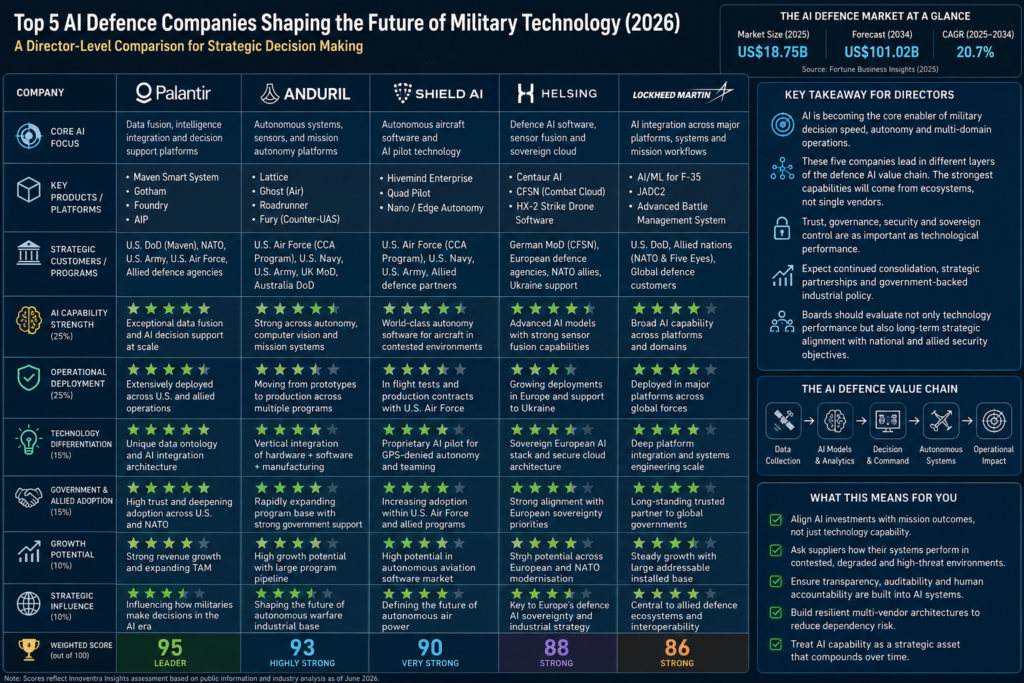
The five companies in this analysis are not competing in exactly the same category. That is what makes the AI defence market strategically important. Palantir is strongest in battlefield data and decision systems. Anduril is building autonomous platforms at speed. Shield AI is focused on autonomy software for aircraft. Helsing is becoming Europe’s sovereign AI defence champion. Lockheed Martin is integrating AI into large-scale military platforms already used by allied governments.
For defence leaders, the more useful question is not simply which company is “best”. The better question is: which company is best positioned for the specific military capability governments now need?
AI Defence Leadership Matrix
| Company | Core AI Role | Strategic Strength | Main Buyer Appeal | Key Risk |
|---|---|---|---|---|
| Palantir | Battlefield data fusion and command decision systems | Deep integration into U.S. and NATO defence workflows | Faster intelligence analysis and operational decision support | Ethical scrutiny, dependency and explainability |
| Anduril | Autonomous defence platforms and mission autonomy | Combines software, hardware and rapid manufacturing | Faster deployment of autonomous systems | Scaling production and maintaining trust as systems become more lethal |
| Shield AI | Autonomous aircraft software | AI pilot for GPS-denied and communications-contested environments | Reduced pilot risk and scalable air autonomy | Narrower focus than larger defence primes |
| Helsing | European sovereign defence AI | Strong fit with European strategic autonomy | Domestic AI capability for NATO and European governments | Must prove scale against U.S. competitors |
| Lockheed Martin | AI integration into major defence platforms | Procurement trust, platform scale and global reach | Ability to embed AI into certified military systems | Slower innovation cycle than AI-native firms |
The comparison shows why the AI defence sector is not likely to produce a single winner. Instead, the market is fragmenting into layers. One layer provides battlefield intelligence and decision systems. Another builds autonomous platforms. Another supplies mission autonomy software. Another integrates AI into existing military assets. The most powerful defence ecosystems will likely combine several of these layers rather than rely on one supplier.
The next decade of defence competition will not be defined by one AI company replacing traditional defence contractors. It will be defined by how well governments combine AI-native firms with established industrial scale.
Strategic Ranking by Capability
Best for battlefield decision intelligence: Palantir
Palantir currently has the strongest position in AI-enabled defence decision systems. Its Maven Smart System has been designated as a core U.S. military command-and-control platform, giving it long-term programme relevance inside the Pentagon. Maven is designed to analyse data from satellites, drones, radar and sensors to help identify threats and support operational decision-making.
This gives Palantir a powerful advantage. Defence organisations are struggling with fragmented data, legacy systems and rising operational complexity. Palantir’s proposition is not simply better analytics; it is a system that helps convert dispersed intelligence into usable military decisions.
Best for autonomous defence hardware: Anduril
Anduril is the strongest AI-native company in autonomous defence hardware. In June 2026, the U.S. Air Force awarded production contracts to General Atomics and Anduril to manufacture the first fleet of semi-autonomous Collaborative Combat Aircraft, with Anduril producing the FQ-44. The broader programme aims to field around 1,000 collaborative combat aircraft to support crewed fighters through human-machine teaming.
This is strategically significant because it moves Anduril beyond the startup narrative. The company is no longer only demonstrating autonomy; it is entering production pathways for major U.S. military capability.
Best for autonomous aircraft software: Shield AI
Shield AI is strongest where autonomy becomes mission software. The U.S. Air Force awarded Shield AI a production contract in June 2026 to implement Hivemind mission autonomy software for the Collaborative Combat Aircraft programme. The work focuses on enabling multiple autonomous aircraft to operate together under human supervision, reducing operator workload and allowing coordinated operations at scale.
This gives Shield AI a clear role in the future of air warfare. As militaries move towards human-supervised autonomous fleets, the software controlling behaviour, coordination and mission execution may become as important as the aircraft itself.
Best for European defence sovereignty: Helsing
Helsing is the most strategically important European AI defence company in this ranking. Germany is reportedly preparing a €580 million contract for Helsing to build CFSN combat-cloud software linking future fighters, drones, satellites and sensors.
This matters because Europe faces a dual challenge: it must modernise military capability while reducing excessive dependence on external technology suppliers. Helsing’s position is therefore not just commercial. It is political, industrial and strategic.
Best for AI at global defence scale: Lockheed Martin
Lockheed Martin remains essential because the AI defence market cannot scale through startups alone. The company says it is applying AI and machine learning to accelerate operational speed, increase agility and reduce sustainment costs across defence platforms.
Lockheed’s greatest advantage is not that it moves fastest. It is that it already sits inside the defence architecture of the U.S. and its allies. If AI is to be embedded into aircraft, missile defence, naval systems, space systems and command networks at scale, companies such as Lockheed will remain central.
What This Means for Defence Buyers
The strongest defence organisations will not treat AI procurement as a software purchase. They will treat it as a capability architecture decision.
That means asking more demanding questions:
Does the system improve decision speed without removing human accountability?
Can it operate in contested environments where GPS, communications and cloud connectivity may be degraded?
Can it integrate with existing platforms rather than creating another isolated data layer?
Can it be updated faster than traditional defence procurement cycles?
Does it strengthen national or allied sovereignty, or create new dependency risks?
These questions matter because AI in defence is not simply about automation. It is about trust, resilience, interoperability and strategic control.
Market Implication
The AI defence market is likely to reward companies that can do three things simultaneously: deliver operational performance, integrate into government procurement systems and maintain public trust. That is a difficult combination.
Palantir and Lockheed Martin benefit from deep institutional integration. Anduril and Shield AI benefit from speed, autonomy and software-native design. Helsing benefits from Europe’s growing urgency around sovereign defence capability.
The result is a market where size alone no longer determines influence. In AI defence, a smaller company with critical software can shape the effectiveness of much larger military systems.
Director-Level Takeaway
For business and policy leaders, the biggest lesson is that defence technology is moving from a platform-centred model to a system-centred model. The most valuable companies will not simply build better equipment. They will help militaries sense, decide, coordinate and act faster across air, land, sea, space and cyber domains.
That is why AI defence is becoming one of the most important technology markets of the next decade.
Market Outlook: Why Defence AI Is Becoming a Board-Level Issue
The rise of AI defence companies is not happening in isolation. It is being accelerated by three forces: rising global military expenditure, lessons from recent conflicts and the growing strategic importance of autonomous systems.
SIPRI reported that global military expenditure reached $2.887 trillion in 2025, the highest level it has recorded, with spending rising for the eleventh consecutive year. Europe increased military expenditure by 14%, while Asia and Oceania increased spending by 8.1%. This matters because defence AI is not growing inside a stagnant market. It is expanding within one of the most heavily funded security environments in decades.
The AI-specific opportunity is also growing rapidly. Fortune Business Insights estimates the global artificial intelligence in military market was worth $18.75 billion in 2025 and could grow from $22.41 billion in 2026 to $101.02 billion by 2034, implying a compound annual growth rate of 20.7%.
Those numbers should be treated as forecasts, not certainties. However, the direction of travel is clear. Defence AI is moving from experimental pilots into operational procurement. Governments are no longer asking whether AI belongs in defence. They are asking how quickly it can be deployed, how safely it can be governed and how deeply it can be integrated into existing forces.
Why Recent Conflicts Have Changed the Defence Technology Market
Recent wars have made one lesson unavoidable: cheap, networked and autonomous systems can challenge expensive legacy platforms. Drones, electronic warfare, open-source intelligence, satellite data and real-time targeting have changed how militaries think about scale.
The U.S. Department of Defense’s Replicator initiative reflects this shift. It was launched in 2023 to accelerate the fielding of autonomous and attritable systems, with the aim of moving faster than traditional defence procurement models. A 2026 Belfer Center assessment described Replicator as a pathfinder initiative intended to rapidly scale needed capabilities and force institutional change inside the Pentagon.
The implication for defence companies is significant. Future winners will not only be those with superior engineering. They will be those able to combine autonomy, software updates, manufacturing speed and battlefield learning loops.
In defence AI, the advantage is shifting from “build the most expensive platform” to “build systems that can learn, adapt and scale faster than the adversary can respond.”
Procurement Is Becoming a Technology Strategy Problem
For governments, buying AI defence technology is very different from buying traditional hardware. A fighter aircraft, submarine or missile system can be evaluated through physical performance, reliability and lifecycle cost. AI systems require additional scrutiny.
Decision-makers must consider:
whether the AI system can operate with limited connectivity;
whether it can be audited and governed;
whether it remains reliable under adversarial attack;
whether it integrates with classified and legacy systems;
whether the supplier creates strategic dependency;
and whether the model can be updated without undermining certification, safety or command accountability.
NATO’s revised AI strategy is important in this context. It reinforces responsible AI principles for defence, including lawfulness, responsibility and accountability, explainability and traceability, reliability, governability and bias mitigation.
This means the defence AI market will not reward speed alone. It will reward trusted speed: the ability to innovate quickly while meeting the governance expectations of democratic governments and military alliances.
Investor Implication: Defence AI Is Becoming a Strategic Asset Class
For investors, defence AI is becoming more attractive because it sits at the intersection of national security urgency and software economics. Traditional defence companies often benefit from long contracts, high barriers to entry and government-backed demand. AI-native defence firms add a different growth profile: faster software iteration, modular products and the potential to scale across multiple platforms.
That is why companies such as Palantir, Anduril, Shield AI and Helsing attract attention beyond the defence sector. They represent a wider shift in how national security capability may be built.
However, investors should also be careful. Defence AI is not the same as consumer AI. Sales cycles can be long. Government adoption depends on security clearance, compliance, trust, export controls, political acceptability and operational proof. Companies may win headlines long before they achieve profitable production at scale.
The strongest investment cases are likely to come from firms that can prove three things:
first, their technology is operationally useful rather than merely impressive;
second, their systems can integrate into government and allied defence architectures;
third, their products can scale from prototype to procurement programme.
Strategic Risks: The Questions Leaders Cannot Ignore
The rapid adoption of AI in defence also creates strategic risks. These risks should not be treated as reasons to halt adoption, but they must shape responsible deployment.
One risk is over-automation. Militaries may become tempted to compress decision cycles so aggressively that human judgement becomes symbolic rather than meaningful. That would create legal, ethical and operational dangers.
A second risk is dependency. If a country becomes reliant on a small number of proprietary AI platforms, it may gain short-term capability but lose strategic flexibility.
A third risk is adversarial manipulation. AI systems can be attacked through data poisoning, spoofing, cyber intrusion and deceptive battlefield signals.
A fourth risk is escalation. Autonomous systems may increase the speed and volume of military interactions, reducing the time available for political or human intervention during crises.
For directors and policymakers, the issue is therefore not whether AI should be used in defence. It is how to build systems that preserve human accountability, democratic legitimacy and operational resilience.
What the Top Five Reveal About the Future of Defence
The five companies in this article reveal five different versions of the defence AI future.
Palantir shows that data integration and decision support are becoming central to military power.
Anduril shows that defence hardware is becoming software-defined and autonomy-first.
Shield AI shows that aircraft may increasingly be controlled by AI pilots supervised by human commanders.
Helsing shows that Europe wants sovereign defence AI capability, not permanent dependency on external suppliers.
Lockheed Martin shows that traditional primes will remain essential because AI must be integrated into complex, certified and globally deployed defence platforms.
Together, they suggest that the future defence market will not be divided between startups and incumbents. It will be shaped by ecosystems. AI-native companies will provide speed, autonomy and software innovation. Traditional primes will provide scale, certification, platform integration and procurement credibility.
The winners will be those that can combine both.
Final Executive Takeaway
AI is not simply another defence technology. It is becoming the organising layer of modern military capability.
The most important defence companies of the next decade will be those that help governments make faster decisions, coordinate autonomous systems, strengthen resilience and integrate intelligence across domains. The market will reward companies that combine operational performance with trust, governance and scale.
For defence leaders, the lesson is clear: AI strategy can no longer sit at the edge of procurement. It belongs at the centre of force design, industrial strategy and national security planning.