
As artificial intelligence becomes increasingly accessible, the organisations that lead the next decade will be those that redesign leadership, operations and decision-making not simply those that deploy more AI.
Estimated reading time: 30 minutes
Executive Summary
Artificial intelligence has entered a new phase of enterprise adoption. Over the past two years, businesses have invested heavily in generative AI, governments have announced ambitious national AI strategies, and technology providers have accelerated the release of increasingly capable foundation models. Yet despite this rapid progress, many organisations continue to struggle to convert AI investment into measurable improvements in productivity, innovation and competitive advantage.
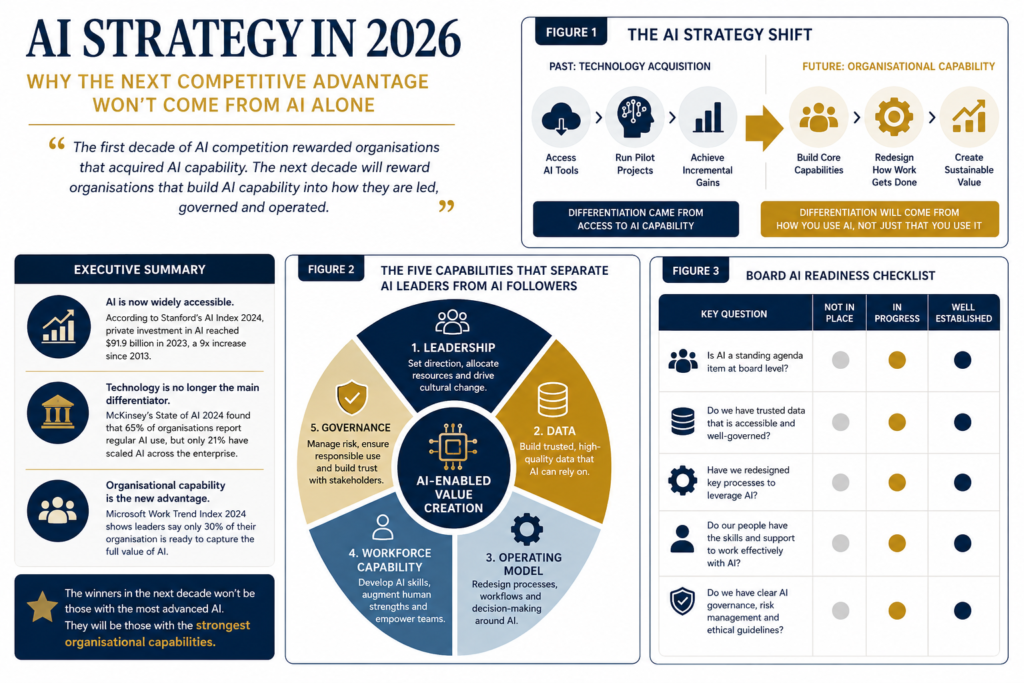
This article argues that the next phase of AI competition will not be won through technology acquisition alone. As access to advanced AI becomes increasingly widespread, competitive advantage is shifting towards organisational capability: the quality of leadership, trusted data, workforce skills, governance and the ability to redesign business processes around intelligent systems.
History suggests this pattern is not unique to AI. From electricity and enterprise software to the internet and cloud computing, transformative technologies have consistently delivered their greatest economic value only after organisations changed how they operated. Artificial intelligence appears to be reinforcing that lesson rather than rewriting it.
For directors, policymakers and business leaders, the implication is clear. The defining strategic question is no longer “How quickly can we adopt AI?” but “How effectively can we build an organisation that thrives because of AI?”
AI Strategy Has Entered a New Phase
Artificial intelligence has become one of the defining strategic priorities of the global economy. Organisations across almost every industry are experimenting with generative AI, intelligent automation and AI-assisted decision-making, while governments are investing billions in research, digital infrastructure and advanced computing capability.
Much of the public discussion has focused on increasingly powerful AI models. Each new product launch has fuelled predictions that technological capability alone will determine future winners and losers.
That assumption deserves closer examination.
For much of the past decade, access to advanced AI represented a meaningful competitive advantage. Only a relatively small number of organisations possessed the computing infrastructure, specialist expertise and financial resources required to develop sophisticated AI systems.
Today, the landscape looks very different.
Large language models are available through cloud platforms. Enterprise AI assistants are integrated into widely used productivity software. Open-source models continue to expand access to advanced capabilities. Organisations that once faced significant technical barriers can now deploy AI without building foundation models themselves.
This democratisation of AI is changing the basis of competition.
When competitors can purchase broadly comparable AI capabilities, technology itself becomes less capable of sustaining long-term advantage. Competitive differentiation increasingly depends on something much harder to replicate: the organisation’s ability to integrate AI into leadership, operations, culture and decision-making.
This marks an important transition in enterprise AI.
The first phase rewarded organisations that experimented with AI.
The next phase is likely to reward organisations that redesign themselves around it.
Executive Perspective
The question confronting today’s boards is no longer whether artificial intelligence will influence competitive advantage.
It already does.
The more important question is where that advantage actually comes from.
Many organisations continue to evaluate AI through a technology lens, comparing models, software vendors and implementation costs. Those decisions remain important, but they are becoming less strategically distinctive as AI capabilities become more widely available.
The organisations creating the greatest long-term value are increasingly asking different questions.
- How should decision-making change?
- Which business processes should be redesigned rather than automated?
- How should leaders govern AI responsibly?
- What new skills will employees require?
- How should organisational performance be measured in an AI-enabled enterprise?
These questions extend far beyond technology.
They concern organisational capability.
The AI Strategy Paradox
One of the defining characteristics of the AI economy is a paradox that receives surprisingly little attention.
Artificial intelligence has become simultaneously more powerful and more accessible.
Normally, greater technological capability creates greater competitive advantage for organisations possessing it.
AI appears to be following a different trajectory.
As advanced models become increasingly accessible through cloud services, enterprise software and open ecosystems, exclusive access to AI is becoming less significant than the organisational capability required to use it effectively.
This helps explain why organisations investing similar amounts in AI frequently achieve dramatically different outcomes.
Some businesses report measurable improvements in productivity, customer experience and operational efficiency.
Others remain trapped in a cycle of pilots, demonstrations and isolated proof-of-concepts with limited enterprise impact.
The difference rarely lies in the algorithm alone.
It lies in leadership, organisational design, governance, workforce capability and the willingness to rethink established ways of working.
In other words, artificial intelligence is becoming less of a technology challenge and more of a management challenge.
That distinction has profound implications.
Throughout history, transformative technologies have tended to reward organisations capable of adapting faster than their competitors. AI appears to be accelerating the same pattern.
Innoventra Analysis
The first decade of AI competition rewarded organisations that acquired AI capability. The next decade is likely to reward organisations that build AI capability into how they are led, governed and operated.
If this analysis proves correct, one of the most important strategic assets of the AI economy will not be artificial intelligence itself.
It will be organisational capability.
Why Technology Alone Never Creates Lasting Competitive Advantage
The assumption that revolutionary technology automatically creates competitive advantage has repeatedly been challenged by economic history. While breakthrough innovations often generate intense excitement and significant investment, organisations rarely realise their full value immediately. The greatest gains typically emerge only after leaders rethink how work is organised, decisions are made and value is created.
Artificial intelligence appears to be following this well-established pattern.
Understanding this history matters because it changes the question executives should ask. Rather than focusing solely on how quickly AI can be deployed, boards should ask what organisational changes are required for AI to create lasting value.
The Lesson from Electricity
The Industrial Revolution provides one of the clearest examples.
When electricity began replacing steam power in factories during the late nineteenth century, many manufacturers expected immediate productivity gains. Instead, early improvements were often modest. Businesses simply replaced steam engines with electric motors while leaving factory layouts, management structures and production processes largely unchanged.
The technology had changed.
The organisation had not.
Only later did manufacturers recognise that electricity fundamentally altered how factories could operate. Machines no longer needed to be connected to a single central driveshaft. Production lines could be redesigned around efficiency rather than mechanical constraints. Factory layouts became more flexible, downtime reduced and productivity accelerated.
The breakthrough came not because electricity became more powerful, but because organisations redesigned themselves around its capabilities.
Artificial intelligence presents a remarkably similar challenge.
Deploying AI into outdated operating models may improve efficiency at the margins. Redesigning decision-making, workflows and customer experiences around AI has the potential to transform organisational performance.
Technology Rewards Organisational Adaptation
Economic research has consistently demonstrated that technology alone rarely explains differences in organisational performance.
Studies of previous technological revolutions have shown that businesses achieve the greatest returns when investment in technology is accompanied by complementary investments in leadership, workforce capability, organisational redesign and management practices. Technology provides the capability. Organisations determine whether that capability is converted into measurable value.
This helps explain why two organisations using similar AI platforms can experience dramatically different outcomes.
One organisation may automate isolated administrative tasks and report modest productivity improvements.
Another may redesign entire customer journeys, shorten product development cycles, improve executive decision-making and create new revenue opportunities using broadly similar AI technology.
The competitive advantage lies not in the software itself but in the organisation’s ability to integrate it strategically.
This distinction is becoming increasingly important as AI becomes embedded within mainstream enterprise software rather than existing as a standalone capability.
The Shift from Experimentation to Transformation
The first wave of enterprise AI was characterised by experimentation.
Organisations tested chatbots, summarisation tools, coding assistants and document generation. Many achieved worthwhile efficiency improvements, while others demonstrated AI’s technical potential through proof-of-concept projects.
Those experiments were valuable because they helped organisations understand what AI could do.
The next phase requires a different mindset.
Rather than asking:
“Where can we use AI?”
leaders increasingly need to ask:
“How should AI change the way our organisation creates value?”
This represents the difference between technology adoption and organisational transformation.
Adoption introduces new tools.
Transformation redesigns the organisation around new capabilities.
History suggests that organisations succeeding in the second phase are the ones that achieve sustainable competitive advantage.
AI Is Becoming a Leadership Challenge
For many organisations, artificial intelligence is still viewed primarily as a technology programme.
Responsibility often sits within digital, innovation or information technology teams.
That approach made sense when AI adoption was limited to specialist projects.
It is becoming increasingly inadequate.
AI now influences customer service, product development, software engineering, finance, procurement, human resources, marketing, compliance and strategic planning. Decisions about AI increasingly affect workforce capability, governance, risk management and long-term competitiveness.
These are not technology questions.
They are leadership questions.
Boards therefore need to move beyond approving AI investment and begin evaluating whether the organisation itself is evolving quickly enough to benefit from that investment.
Organisations that continue treating AI as another software implementation risk overlooking the organisational changes required to realise its full potential.
Innoventra Analysis
Every major technological revolution has rewarded organisations that adapted faster than competitors rather than those that simply adopted new technology first. Artificial intelligence appears to be reinforcing this historical pattern. As AI becomes easier to acquire, the ability to redesign organisations around intelligent systems is becoming a more durable source of competitive advantage than technology ownership itself.
This perspective helps explain why the next phase of AI competition is unlikely to be determined by access to algorithms alone.
It will increasingly be determined by organisational capability.
Executive Insight
The strategic question facing boards is no longer:
“Do we have an AI strategy?”
It is becoming:
“Is our organisation capable of executing an AI strategy better than our competitors?”
Those are fundamentally different questions.
The first focuses on technology.
The second focuses on leadership, governance, people and execution.
History suggests that the second question is far more likely to determine long-term success.The Five Organisational Capabilities That Separate AI Leaders from AI Followers
As artificial intelligence becomes more accessible, the organisations creating the greatest value are not necessarily those deploying the most advanced models. They are the organisations that have developed the capabilities required to integrate AI into how they operate.
Across enterprise research, government studies and business case studies, five themes consistently emerge. Together, they explain why some organisations convert AI investment into measurable competitive advantage while others remain trapped in experimentation.
1. Leadership: The Competitive Advantage That Cannot Be Purchased
The quality of executive leadership increasingly determines whether AI becomes a strategic capability or another technology initiative.
Many organisations still delegate AI to technology departments. While specialist expertise remains essential, enterprise AI increasingly influences every major business function, including customer experience, product development, finance, risk management, operations and workforce planning.
This means AI has become a board-level issue.
The organisations creating sustainable value are not asking, “Which AI tool should we deploy?” They are asking, “How should AI change the way we compete?”
This distinction changes investment priorities. Rather than measuring the number of AI projects completed, leading organisations focus on measurable business outcomes such as faster innovation, higher productivity, improved customer satisfaction and better strategic decision-making.
Executive Insight
Technology may initiate transformation.
Leadership determines whether transformation succeeds.
2. Trusted Data: The Foundation of Reliable AI
Artificial intelligence can process information at extraordinary speed, but it cannot distinguish between high-quality organisational data and poor-quality organisational data without appropriate governance.
Many organisations discover this only after launching AI initiatives.
Duplicate records, fragmented systems, inconsistent definitions and weak information governance quickly undermine confidence in AI-assisted decisions. The technology performs exactly as designed—it exposes weaknesses that already existed.
This is why many successful AI programmes begin with improving data quality rather than deploying additional AI applications.
The strategic implication is straightforward.
The value of AI increasingly depends on the quality of organisational information.
For many organisations, data governance has become a competitive capability rather than a compliance exercise.
Case Example
Global financial institutions have invested heavily in data governance because AI-supported fraud detection, credit assessment and regulatory compliance depend upon trusted information rather than algorithms alone.
Executive Insight
Poor data rarely becomes good AI.
3. Operating Model: Redesigning Work Rather Than Automating Tasks
Perhaps the greatest misconception surrounding AI is that automation itself creates transformation.
History suggests otherwise.
Electricity did not transform factories because steam engines were replaced by electric motors.
Factories became more productive because leaders redesigned production around entirely new possibilities.
Artificial intelligence presents organisations with the same choice.
One organisation uses AI to write reports more quickly.
Another redesigns how customer services operate, how products are developed, how executives receive management information and how decisions are made.
Both organisations have adopted AI.
Only one has transformed.
The difference lies in the operating model.
AI creates its greatest value when organisations redesign workflows around human-machine collaboration instead of inserting AI into outdated processes.
Executive Perspective
Executives should ask:
“Which business processes would we design differently if AI already existed when the organisation was founded?”
That question often reveals opportunities invisible to incremental improvement programmes.
4. Workforce Capability: AI Is Increasing the Value of Human Judgement
Predictions about AI frequently focus on automation.
Less attention is given to augmentation.
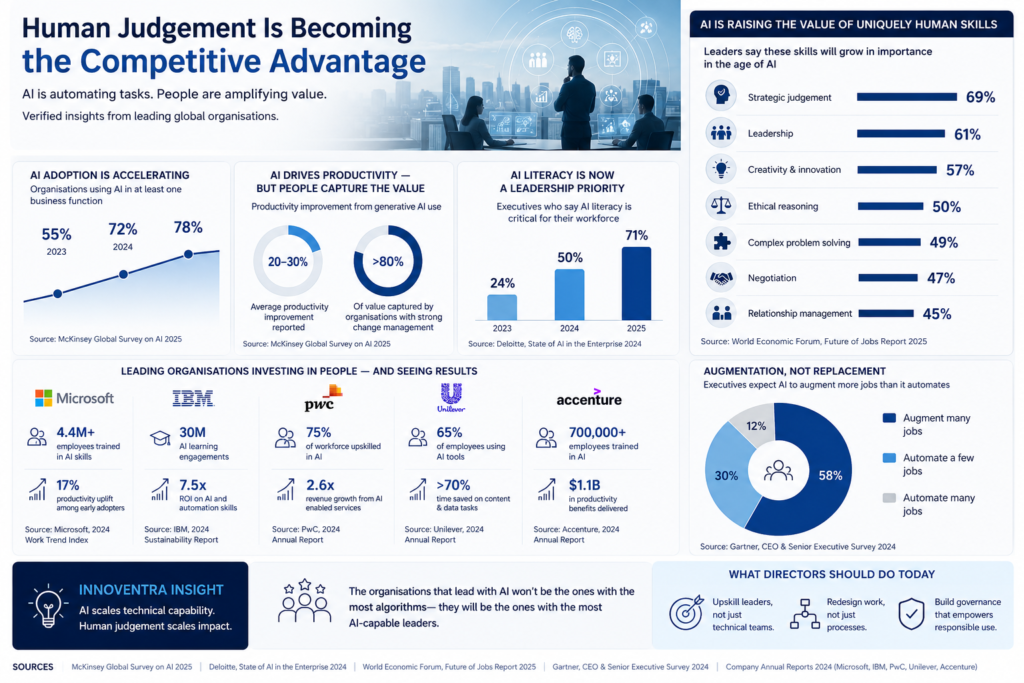
As AI assumes more routine analytical, administrative and content-generation tasks, uniquely human capabilities become increasingly valuable.
These include:
- strategic judgement
- leadership
- creativity
- negotiation
- relationship management
- ethical reasoning
- complex problem solving
This does not reduce the importance of technical skills.
Rather, it changes the balance between technical capability and organisational capability.
The most successful organisations are unlikely to employ only more AI specialists.
They will develop managers who understand how to redesign teams, workflows and decision-making around AI.
This represents a significant shift in workforce strategy.
Future competitiveness depends as much upon AI-literate leadership as technical expertise.
Innoventra Analysis
The organisations most likely to outperform competitors may not be those employing the largest AI teams. They are more likely to be those developing the largest proportion of AI-capable leaders.
5. Governance: Trust Is Becoming a Competitive Asset
As AI becomes embedded in business operations, governance moves from a regulatory obligation to a strategic differentiator.
Customers increasingly expect organisations to use AI responsibly.
Employees need confidence that AI supports rather than undermines their work.
Investors seek assurance that organisations understand AI-related risks.
Regulators expect appropriate oversight, accountability and transparency.
Trust therefore becomes commercially valuable.
Organisations that establish clear governance frameworks are more likely to deploy AI confidently, scale innovation responsibly and maintain stakeholder confidence.
Conversely, weak governance slows adoption, increases operational risk and can undermine public trust even where AI capability is technically advanced.
The strategic lesson is becoming increasingly clear.
Responsible AI is not simply about reducing risk.
It is about enabling sustainable innovation.
Executive Insight
In the coming decade, organisations may compete on trust as much as technology.
Bringing the Evidence Together
Viewed individually, leadership, data quality, operating models, workforce capability and governance appear to be separate organisational priorities.
Viewed collectively, they reveal something more significant.
They represent the organisational capabilities that determine whether artificial intelligence becomes a productivity multiplier or an expensive experiment.
This explains why organisations investing similar amounts in AI frequently experience very different outcomes.
The technology is increasingly comparable.
The organisations are not.
Innoventra Perspective
Artificial intelligence is becoming a capability multiplier rather than a competitive advantage in its own right. It amplifies existing organisational strengths while exposing weaknesses that were previously hidden by manual processes, fragmented decision-making and slower business cycles.
That may prove to be one of the defining management lessons of the AI economy.