
Estimated reading time: 10 minutes
Category: AI Strategy | Future of Work | Business Transformation
Executive Summary
Artificial intelligence is changing work at a pace few technologies have matched. Yet despite billions of pounds of investment and almost daily headlines about automation, one fundamental question remains unresolved: does AI create lasting competitive advantage by replacing people or by making people more capable?
Current evidence points firmly towards the latter.
Research from the International Labour Organization (ILO), OECD, McKinsey, Microsoft, Stanford University and leading AI companies consistently shows that generative AI is transforming individual tasks far more rapidly than entire occupations. While some routine activities are becoming increasingly automated, organisations achieving the strongest productivity gains are redesigning work around collaboration between people and AI rather than pursuing workforce replacement alone.
This distinction matters. Labour costs can be reduced quickly, but organisational capability is far harder to rebuild. Companies that remove critical expertise, weaken graduate recruitment or fail to develop AI-enabled skills may improve short-term financial performance while eroding the knowledge, leadership and adaptability that underpin long-term growth.
For directors and senior leaders, AI should therefore be viewed not simply as a technology investment but as an organisational redesign programme. The most successful organisations over the next decade are unlikely to be those deploying the most AI. They will be those combining AI with stronger leadership, better governance and continuous workforce development.
Executive Insight
AI is not replacing competitive advantage. It is changing where competitive advantage comes from.
Why Every Board Is Talking About AI and Jobs
Artificial intelligence has moved beyond experimentation. It is now one of the largest strategic investment priorities for global business.
According to IDC, worldwide spending on AI technologies is expected to exceed US$630 billion by 2028, driven by rapid adoption across customer service, software development, finance, operations and knowledge work. At the same time, Stanford University’s AI Index Report shows enterprise adoption of generative AI has accelerated dramatically since the public release of large language models, making AI one of the fastest-adopted business technologies on record.
Yet while investment has surged, executive confidence remains mixed.
McKinsey’s latest State of AI research found that although AI adoption continues to increase, only a minority of organisations report material financial benefits across the enterprise. Those achieving the greatest returns are significantly more likely to redesign workflows, invest in employee capability and establish governance structures rather than simply deploy AI tools.
This is an important finding.
Many organisations still evaluate AI primarily through a cost-reduction lens:
- Can we automate more work?
- Can we reduce headcount?
- Can we improve margins?
These are legitimate commercial questions, but they are incomplete.
The more strategic question is whether AI strengthens or weakens the organisation’s ability to compete over the next decade.
History suggests that technological leadership rarely comes from adopting new technology alone. It comes from redesigning organisations to capture its value more effectively than competitors.
Electricity transformed manufacturing only after factories were redesigned around it. Cloud computing delivered value only after organisations modernised their operating models. Artificial intelligence appears to be following the same pattern.
Technology creates opportunity.
Management determines whether that opportunity becomes competitive advantage.
Executive Insight
The primary challenge facing boards is no longer deciding whether to invest in AI. It is deciding how to redesign the organisation to maximise its value.
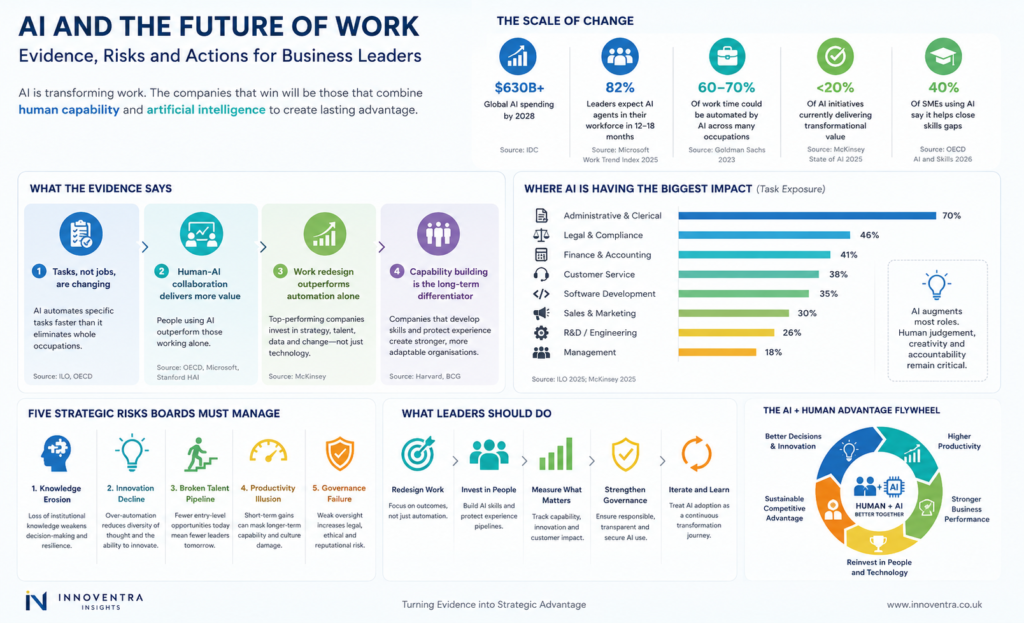
Figure 1. The AI Workforce Transformation Framework: Evidence, Risks and Strategic Priorities.
Evidence from leading international research consistently suggests that organisations achieve greater long-term value when AI is used to augment human capability, redesign work and strengthen organisational resilience rather than focusing solely on workforce reduction.
Will AI Replace Jobs? What the Evidence Actually Says
Few business topics generate more debate than whether artificial intelligence will replace human workers. Headlines frequently predict widespread job losses, while technology leaders often describe AI as creating entirely new forms of employment.
The evidence suggests reality lies somewhere between these two extremes.
The International Labour Organization (ILO) concluded that generative AI primarily automates tasks rather than occupations. Administrative, clerical and highly structured knowledge work face the greatest exposure, yet most jobs contain a mixture of automatable and non-automatable activities. As a result, AI is more likely to reshape how people work than eliminate entire professions.
The OECD reaches a similar conclusion. Its research indicates that organisations gain the greatest value where AI complements human judgement rather than replacing it. Employees supported by AI consistently outperform either humans or AI operating independently, particularly in complex environments requiring critical thinking, communication and contextual decision-making.
Evidence from industry reinforces this view.
Microsoft’s 2025 Work Trend Index, based on data from 31,000 employees across 31 countries, found that 82% of business leaders expect AI agents to become part of their workforce within the next 12 to 18 months. Importantly, the report does not describe a workforce without people. Instead, it anticipates organisations where employees increasingly manage, supervise and collaborate with AI systems rather than performing every task themselves.
This shift represents a profound change in the nature of work.
Historically, organisations invested in software to help employees complete tasks more efficiently.
Increasingly, organisations are investing in AI capable of completing parts of those tasks independently, leaving employees to focus on judgement, creativity, customer relationships and strategic decision-making.
The implication for directors is significant.
Success will depend less on the number of AI systems deployed and more on how effectively organisations redesign roles, develop workforce capability and integrate AI into existing business processes.
Companies asking “Which jobs can AI replace?” may therefore be asking the wrong strategic question.
The more valuable question is:
“Which combination of human expertise and artificial intelligence creates the greatest competitive advantage?”
Executive Insight
The evidence increasingly suggests AI changes the composition of jobs far faster than it eliminates jobs altogether.
Key Take Away
Three conclusions emerge consistently across current research.
First, AI should be viewed as a capability multiplier rather than simply a labour-saving technology.
Second, productivity improvements depend as much on organisational redesign, leadership and workforce capability as on the technology itself.
Third, organisations that treat AI as a strategic transformation programme not merely another IT investment are more likely to achieve sustainable competitive advantage.
These findings provide the foundation for the next question facing every board:
If AI is not simply replacing workers, where do the real strategic risks lie?
The Five Workforce Risks Most Boards Underestimate
The public debate about artificial intelligence has become dominated by one question:
How many jobs will AI replace?
Evidence suggests this is the wrong question.
Research published over the past two years by the OECD, International Labour Organization, Stanford University, Microsoft and McKinsey points towards a different conclusion. The organisations most likely to outperform are not necessarily those removing the greatest number of employees. They are those redesigning work while protecting the capabilities competitors cannot easily replicate.
For directors, the greatest risks therefore lie not in automation itself, but in the unintended consequences of poor implementation.
Risk 1 Organisations Are Losing Capability Faster Than They Realise
Most corporate knowledge never appears in a policy document.
It exists in thousands of informal decisions made every day.
Experienced employees know why a customer behaves differently from the data, why an exception exists in a process, or why a previous transformation failed. This tacit knowledge is rarely captured in manuals and cannot simply be transferred into a large language model.
Management research has long identified tacit knowledge as one of the most durable sources of competitive advantage because it is difficult for competitors to imitate. Artificial intelligence can analyse documented information at extraordinary speed, but it cannot automatically recreate years of organisational experience.
This distinction becomes important during restructuring.
Reducing headcount may improve operating margins within a financial year, yet the loss of institutional knowledge often remains invisible until organisations face unfamiliar problems, regulatory change or major transformation programmes. By then, rebuilding expertise can take years.
Board implication
Every workforce reduction should be accompanied by a capability assessment, not simply a financial assessment.
Executive Insight
AI can process knowledge. It cannot fully replace organisational wisdom.
Risk 2 Productivity Is Not the Same as Competitive Advantage
One of the most common assumptions in boardrooms is that higher productivity inevitably creates stronger businesses.
History suggests otherwise.
Kodak remained highly efficient at producing photographic film. Nokia manufactured mobile phones at extraordinary scale. Blockbuster continuously improved store operations.
None failed because they lacked operational efficiency.
They failed because they became less capable of adapting than emerging competitors.
Generative AI creates a similar risk.
An organisation can automate reporting, customer service, coding or administration while simultaneously reducing experimentation, weakening cross-functional collaboration and narrowing strategic thinking.
Research from Microsoft’s Work Trend Index suggests AI increasingly shifts employee time away from repetitive administration towards higher-value work. However, whether organisations actually use that additional capacity for innovation or simply further cost reduction remains a leadership decision.
The technology creates opportunity.
Management determines its outcome.
Executive Insight
Efficiency is a financial metric. Capability is a strategic asset.
Risk 3 The Graduate Pipeline Is Quietly Breaking
Perhaps the least discussed consequence of AI is its effect on workforce development.
Every experienced professional begins as a graduate, apprentice or junior employee.
These early roles have traditionally provided the practical experience through which organisations develop future leaders.
Generative AI increasingly performs many of those routine tasks.
Some organisations have therefore reduced graduate recruitment or slowed junior hiring.
AWS Chief Executive Matt Garman has argued that replacing junior employees with AI would be strategically short-sighted because organisations would eventually face shortages of experienced professionals. Similar concerns have been raised by researchers studying AI’s impact on career progression and organisational learning.
The risk is not immediate.
It is cumulative.
Companies reducing entry-level opportunities today may discover five years from now that they lack experienced managers, specialists and technical leaders.
This is no longer simply a human resources issue.
It is a board-level capability issue.
Executive Insight
AI can accelerate work, but it cannot accelerate experience.
Risk 4 AI Performance Depends More on Management Than Technology
One of the strongest findings emerging across enterprise AI research is that technology alone rarely determines success.
McKinsey consistently reports that organisations generating measurable returns from AI invest heavily in leadership, governance, operating model redesign and workforce capability alongside technology deployment.
Similarly, Microsoft’s global research shows organisations increasingly adopting AI agents while simultaneously redefining managerial roles.
This challenges one of the biggest misconceptions surrounding AI implementation.
Many companies ask:
“Which software should we buy?”
Leading organisations instead ask:
“How should work change?”
The difference is profound.
Technology implementation is an IT project.
Work redesign is a business transformation programme.
Boards confusing the two risk spending millions without achieving sustainable productivity gains.
Executive Insight
AI implementation is relatively straightforward. Organisational redesign is where competitive advantage is created.
Risk 5 Boards May Be Measuring the Wrong Return on Investment
Most AI business cases focus on three indicators:
- lower costs
- faster processes
- headcount reduction
These metrics matter.
But they are incomplete.
The more important question is whether AI increases the organisation’s long-term capacity to innovate, attract talent, improve customer experience and adapt to disruption.
Those outcomes are significantly harder to measure, yet history suggests they are ultimately what separates enduring market leaders from companies that merely improve quarterly margins.
Artificial intelligence should therefore be evaluated in the same way as any other strategic investment.
Not only by what it saves.
But by what it enables.
Executive Insight
The strongest AI investments create capability before they create efficiency.