Reading time: 8 minutes
Executive Summary
A quiet transformation is taking place in healthcare.
Instead of opening a search engine or calling their GP, millions of people are now asking artificial intelligence questions such as:
- Why do I have chest pain?
- Could this rash be serious?
- Should I go to A&E or wait until tomorrow?
- Do these symptoms suggest anxiety or something more serious?
For many, AI has become the first point of contact not because it replaces doctors, but because it is available instantly, 24 hours a day.
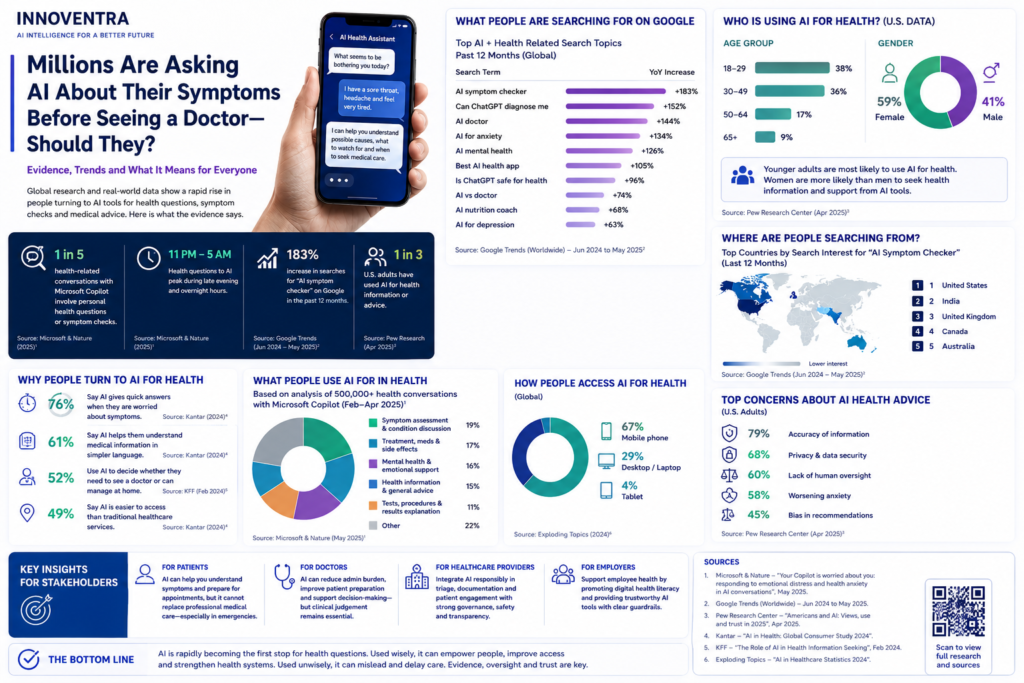
Recent research analysing more than 500,000 health-related conversations with Microsoft Copilot found that almost one in five conversations involved personal symptom assessment or condition discussion. It also found that health questions increase during evenings and overnight, when access to traditional healthcare is often more limited.
This shift presents significant opportunities but also important risks.
The future of healthcare is unlikely to be AI or doctors.
It will be AI supporting doctors, and patients using AI more intelligently.
Why Are People Turning to AI First?
Healthcare has always had one fundamental challenge: access.
Patients often face long waiting times, limited appointment availability and uncertainty about whether symptoms require urgent care.
AI changes that equation.
Unlike traditional search engines, conversational AI allows people to describe symptoms naturally:
“I’ve had a headache for three days, feel nauseous and have blurred vision.”
Instead of presenting dozens of websites, AI can ask follow-up questions, explain possible causes and encourage appropriate next steps.
Recent polling also shows growing public adoption. Many people say they use AI because it provides quick answers, helps them understand medical terminology and offers guidance before or after speaking with a clinician. Younger adults and those facing barriers to healthcare access are particularly likely to use AI tools.
The Questions People Are Asking
Recent search patterns show increasing interest in topics including:
- AI symptom checker
- Can ChatGPT diagnose me?
- AI doctor
- AI for anxiety
- AI mental health
- Best AI health apps
- Is ChatGPT safe for health?
- AI healthcare
- AI NHS
- AI medical advice
Although these searches appear different, they reflect a common goal:
People want reassurance before deciding whether professional medical care is needed.
AI Is Already Entering Mainstream Healthcare
This behavioural shift is being mirrored by healthcare providers.
NHS England recently announced the rollout of AI-powered triage within the NHS App to help direct patients to the most appropriate service whether that is a GP, pharmacy, emergency department or self-care. Early trials reduced telephone queues while allowing clinicians to focus more time on patients.
The NHS is also expanding the use of AI-assisted clinical documentation, helping reduce administrative workloads so clinicians can spend more time with patients.
This signals an important change.
Healthcare systems are not simply allowing patients to use AI they are beginning to integrate AI into routine care.
What AI Does Well
Generative AI offers several genuine advantages.
Faster access
People no longer need to wait until surgery opening hours to seek basic health information.
Better explanations
Medical terminology can be difficult to understand.
AI often explains complex conditions in plain language.
Preparing for appointments
Many patients now use AI to organise symptoms before seeing a healthcare professional.
This can improve communication during consultations.
Health education
AI can explain:
- medications
- diagnostic tests
- treatment options
- recovery expectations
making patients better informed.
Where AI Can Go Wrong
Despite its strengths, AI has important limitations.
Unlike doctors, AI:
- cannot perform physical examinations;
- cannot interpret body language or non-verbal cues;
- does not know your complete medical history unless you provide it;
- cannot take legal responsibility for medical decisions.
Studies comparing AI with established triage systems suggest AI can identify many emergency situations effectively, but it may also over-triage or produce recommendations that require careful interpretation. Researchers conclude that AI should currently be viewed as an adjunct to existing healthcare pathways rather than a replacement.
Even where AI performs well, expert judgement remains essential.
The Mental Health Opportunity
One of the fastest-growing areas of AI use is mental health.
People increasingly ask AI about:
- stress
- anxiety
- depression
- sleep
- burnout
AI offers something many people value:
Immediate conversation.
For someone struggling late at night, this accessibility can be meaningful.
However, experts continue to stress that conversational AI should complement not replace qualified mental health professionals, particularly where there is significant distress or risk.
Trust Is Becoming the New Healthcare Challenge
Healthcare depends on trust.
People are asking not only:
Is the answer correct?
but also:
Can I trust the system providing it?
Research suggests that conversational AI can be perceived as easier to engage with than traditional search engines, but trust depends on transparency, explanation and understanding the limits of AI-generated information.
Privacy is equally important.
Health information is among the most sensitive personal data people share online. Organisations developing AI health tools therefore need robust security, transparent data practices and clear accountability.
What This Means for Different Stakeholders
For Patients
Use AI to understand symptoms, prepare questions and improve health literacy.
Do not use it as a substitute for emergency care or professional diagnosis.
For Doctors
AI has the potential to reduce administrative burden, improve patient preparation and support clinical decision-making.
Its role is to augment professional judgement, not replace it.
For Healthcare Organisations
The challenge is not whether AI should be adopted, but how to deploy it responsibly—with governance, transparency and patient safety at the centre.
For Employers
As AI becomes more common in healthcare, organisations should help employees understand both its benefits and its limitations, particularly for wellbeing and mental health support.
Executive Insight
Healthcare is entering a new era.
The first conversation about a health concern may increasingly happen with an AI assistant.
The final decision, however, should still involve qualified healthcare professionals whenever symptoms are serious, persistent or uncertain.
The organisations that earn public trust will not necessarily be those with the most advanced AI.
They will be those that combine technological innovation with clinical expertise, transparency and patient-centred care.
Key Takeaways
- AI is becoming a first stop for health information because it offers immediate, conversational support.
- Symptom checking and condition discussions are among the most common health uses of conversational AI.
- Healthcare providers, including the NHS, are beginning to integrate AI into triage and clinical workflows.
- AI can improve health literacy, appointment preparation and access to information, but it cannot replace clinical examination or professional judgement.
- Responsible AI in healthcare requires accuracy, transparency, privacy protection and human oversight.
Final Thought
The question is no longer whether people will use AI for health advice.
They already are.
The more important question is whether healthcare systems, technology companies and policymakers can ensure that AI remains safe, evidence-based and centred on the needs of patients.
If they succeed, AI could become one of the most important tools for improving access to healthcare in the coming decade not by replacing doctors, but by helping patients reach the right care, at the right time, with better information.