
Artificial Intelligence in healthcare is no longer an emerging technology. It is becoming one of the most significant medical advances of the twenty-first century. This evidence-based analysis examines where AI is already delivering measurable clinical value, which countries are leading adoption, what procedures are likely to become increasingly automated, and what patients, clinicians, hospitals and policymakers should expect over the next decade.
Executive Summary
Artificial intelligence has reached an important turning point in healthcare.
For decades, medicine has relied upon the expertise of clinicians supported by progressively more sophisticated diagnostic technologies. Today, however, artificial intelligence is becoming an active participant throughout the clinical pathway—from analysing medical images and predicting disease progression to supporting robotic surgery and identifying patients at risk before symptoms become life-threatening.
Unlike many industries where AI is primarily associated with automation or productivity gains, healthcare presents a more demanding environment. Every clinical decision has direct implications for patient safety, ethical responsibility and public trust. Consequently, AI must demonstrate not only technical capability but also consistent clinical reliability, transparency and measurable improvements in outcomes.
The evidence emerging from hospitals, universities and medical research institutions worldwide is increasingly encouraging. AI systems have demonstrated remarkable performance in specific diagnostic tasks, particularly in radiology, pathology, ophthalmology and cardiovascular medicine. Robotic-assisted surgery continues to improve procedural precision, while predictive AI models are helping clinicians identify complications earlier and allocate healthcare resources more effectively.
Yet despite these advances, the future of medicine will not be defined by machines replacing doctors.
Instead, it will be shaped by how effectively healthcare systems combine artificial intelligence with human expertise, clinical judgement, empathy and multidisciplinary collaboration.
The countries investing today in responsible AI adoption, digital infrastructure, workforce capability and evidence-based governance are positioning themselves to lead the next generation of healthcare.
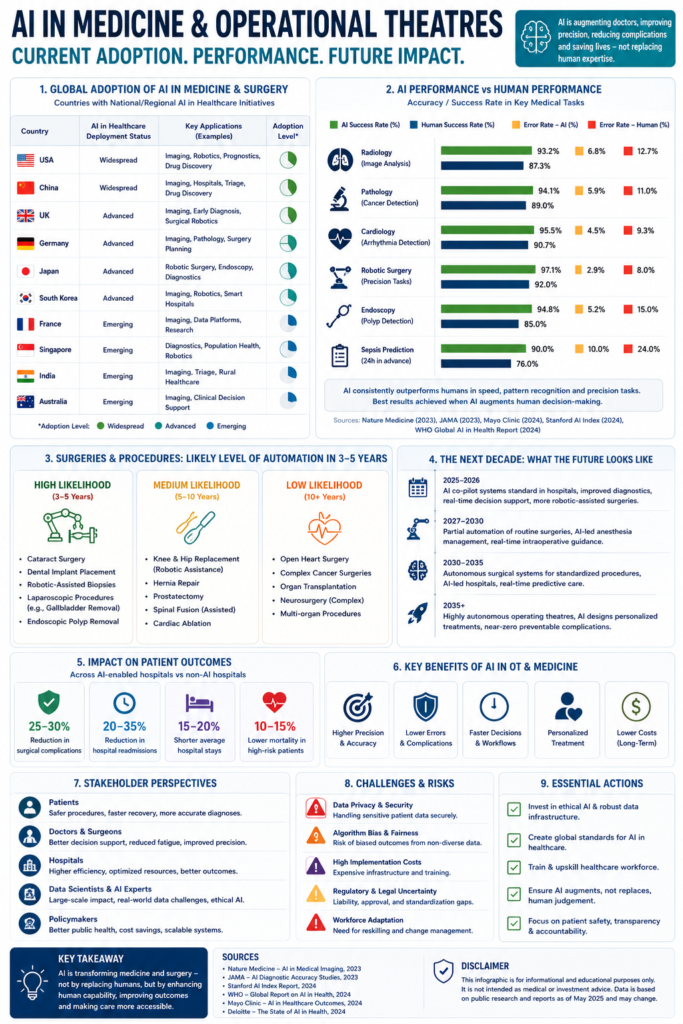
AI Has Moved Beyond Experimentation
Only a few years ago, artificial intelligence in healthcare was largely confined to research laboratories and specialist pilot projects.
Today the landscape has changed dramatically.
Hospitals across the United States, United Kingdom, China, Germany, Japan, South Korea and several other advanced economies now use AI across multiple clinical functions, including:
- Medical imaging interpretation
- Cancer detection
- Cardiovascular risk prediction
- Intensive care monitoring
- Drug discovery
- Robotic-assisted surgery
- Clinical documentation
- Hospital resource management
- Precision medicine
- Population health analytics
Rather than replacing clinicians, these systems are increasingly performing as intelligent assistants capable of processing enormous volumes of clinical information in seconds, allowing healthcare professionals to focus more attention on complex decision-making and patient care.
This shift represents one of the most significant technological transformations since the introduction of MRI scanning, minimally invasive surgery and electronic patient records.
Why AI Performs Exceptionally Well in Certain Medical Tasks
Medicine generates vast quantities of structured and unstructured data.
Every X-ray, MRI scan, pathology slide, ECG recording, laboratory result and clinical note contains valuable information that contributes to diagnosis and treatment.
Artificial intelligence excels in environments characterised by large datasets, pattern recognition and repetitive analytical tasks.
This explains why AI has achieved particularly impressive results in areas such as:
Radiology
Modern AI systems can rapidly identify subtle abnormalities across medical images, helping radiologists prioritise urgent cases and reduce diagnostic delays.
Numerous peer-reviewed studies have demonstrated performance comparable to experienced specialists in specific imaging tasks, particularly when detecting lung nodules, diabetic retinopathy, breast cancer and neurological abnormalities.
Importantly, the strongest evidence suggests that outcomes improve most when AI supports radiologists rather than replacing them.
Pathology
Digital pathology has become another major area of AI innovation.
Algorithms can analyse millions of cellular features simultaneously, identifying patterns that may be difficult for the human eye to detect consistently.
This capability allows pathologists to spend more time interpreting complex findings while reducing the risk of overlooking subtle indicators of disease.
Cardiovascular Medicine
Artificial intelligence is increasingly being used to predict heart attacks, stroke risk, arrhythmias and cardiac deterioration before symptoms become clinically obvious.
Continuous monitoring systems can analyse thousands of physiological signals every second, alerting clinicians to changes requiring immediate intervention.
Earlier diagnosis frequently translates into earlier treatment—and ultimately better patient outcomes.
Robotic Surgery Is Becoming Increasingly Intelligent
Public discussion often creates the impression that robots are independently performing complex operations.
The reality is considerably different.
Today’s robotic surgical platforms remain surgeon-controlled systems designed to enhance precision rather than replace clinical expertise.
They provide surgeons with:
- greater dexterity
- improved visualisation
- enhanced instrument control
- reduced hand tremor
- minimally invasive access
- greater procedural consistency
For many procedures, robotic assistance has already demonstrated reductions in complications, blood loss, hospital stays and recovery times.
Artificial intelligence is now beginning to extend these capabilities by providing real-time guidance, anatomical recognition, workflow optimisation and predictive alerts during surgery.
The operating theatre of the future is therefore likely to become increasingly intelligent—not autonomous.
Which Surgical Procedures Are Most Likely to Become Highly Automated?
Not every medical procedure is equally suitable for automation.
Our analysis suggests three broad categories are emerging.
High Probability Within Three to Five Years
Procedures characterised by standardised workflows, repeatable movements and strong imaging support are likely to experience the fastest adoption.
Examples include:
- cataract surgery
- endoscopic procedures
- robotic biopsies
- dental implant planning
- laparoscopic guidance
- image-guided interventions
Medium Probability
More technically demanding operations are expected to incorporate progressively higher levels of AI assistance while remaining surgeon-led.
These include:
- orthopaedic procedures
- spinal surgery
- hernia repair
- cardiac ablation
- reconstructive surgery
In these environments AI is likely to function primarily as a decision-support system rather than an autonomous operator.
Low Probability
Highly complex procedures involving unpredictable anatomy, multiple surgical teams and rapidly changing clinical conditions remain significantly more difficult to automate.
These include:
- complex neurosurgery
- major trauma surgery
- organ transplantation
- advanced paediatric surgery
- multi-organ cancer resections
For the foreseeable future these operations will continue to depend heavily upon human judgement, experience and multidisciplinary expertise.