Artificial intelligence is reshaping the global technology workforce at an unprecedented pace. From software development and technical support to quality assurance and database management, AI is automating routine tasks, accelerating productivity and redefining the skills organisations expect from IT professionals. While headlines often suggest AI will replace programmers and IT specialists, the evidence tells a far more nuanced story. The future belongs not to those who compete against AI, but to those who learn how to work alongside it.
Artificial Intelligence Is Transforming the IT Profession Faster Than Any Previous Technology
Few industries are experiencing the impact of artificial intelligence as rapidly as information technology. Advances in large language models, generative AI, intelligent automation and AI-powered software development tools are changing how technology teams design, build, maintain and secure digital systems. According to the World Economic Forum’s Future of Jobs Report, technological change will reshape a significant proportion of workplace skills over the coming years, while the OECD, McKinsey, Gartner and Stanford AI Index all highlight AI as a major driver of productivity and organisational transformation.
Rather than replacing entire professions overnight, AI is increasingly automating repetitive and predictable tasks that previously consumed valuable time. Routine coding, software testing, documentation, technical support, infrastructure monitoring and data processing can now be completed more efficiently with AI assistance, enabling IT professionals to focus on higher-value work requiring strategic thinking, creativity and complex problem-solving.
What Does It Mean for an IT Role to Be “Vulnerable”?
One of the biggest misconceptions surrounding artificial intelligence is that vulnerability automatically means redundancy. In reality, most IT roles are not disappearing—they are evolving.
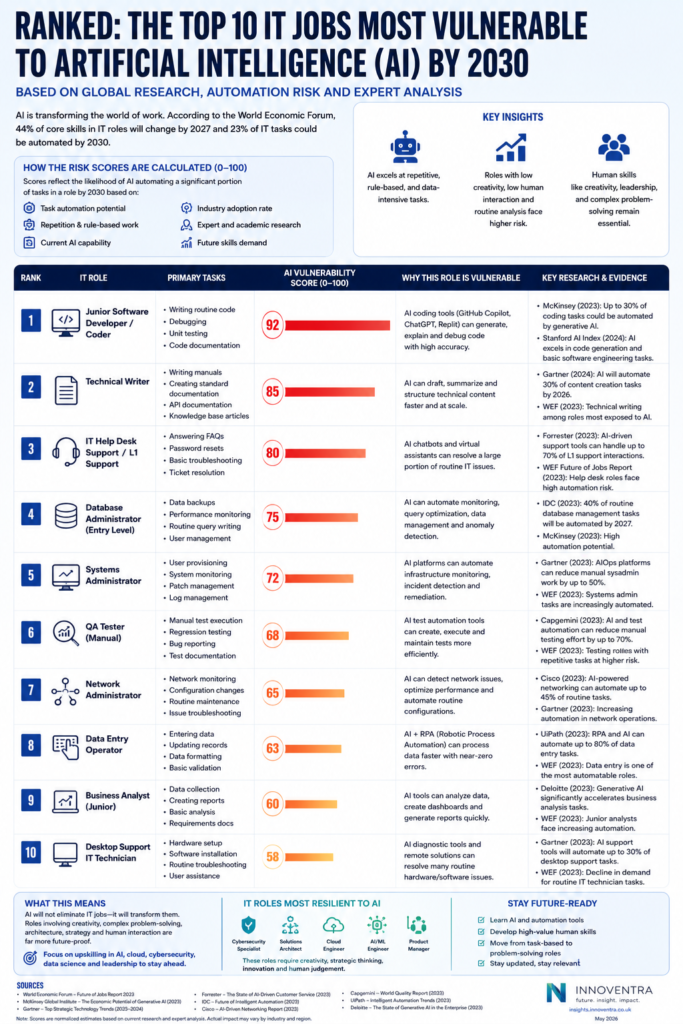
The ranking presented in the infographic reflects the likelihood that a substantial proportion of routine tasks within each role can be automated or significantly augmented by AI, rather than suggesting entire occupations will vanish. Roles characterised by repetitive workflows, structured documentation, predictable troubleshooting and standardised processes naturally present greater opportunities for automation.
Conversely, positions requiring systems architecture, cybersecurity strategy, enterprise transformation, stakeholder engagement, innovation, ethical judgement and leadership remain considerably less susceptible because these responsibilities depend heavily on human expertise and decision-making.
The future of work in IT is therefore better understood as task transformation rather than job elimination
Why Junior and Routine IT Roles Face the Greatest Disruption
Many of the highest-ranked roles share common characteristics. Junior software developers often spend considerable time writing boilerplate code, debugging routine errors and documenting applications—activities increasingly supported by AI coding assistants such as GitHub Copilot and similar tools.
Technical writers can now use generative AI to draft documentation, API references and knowledge base articles, dramatically reducing production time. Likewise, AI-powered chatbots and virtual support assistants are handling an increasing proportion of repetitive IT helpdesk requests, including password resets, troubleshooting common issues and answering frequently asked questions.
Database administration, infrastructure monitoring, manual software testing and basic network management are also becoming increasingly automated through intelligent monitoring systems, predictive analytics and AI-enabled operational platforms. This does not eliminate the need for skilled professionals but fundamentally changes the nature of their work by reducing repetitive operational tasks.
The Future Belongs to AI-Augmented IT Professionals
Perhaps the most important insight emerging from current research is that the highest-performing IT professionals are unlikely to be those who avoid AI—but those who use it effectively.
Software engineers are already employing AI to accelerate development, automate documentation, generate test cases and identify software vulnerabilities. Cybersecurity specialists increasingly rely on AI to detect anomalies, identify malicious activity and prioritise emerging threats. Cloud engineers use AI-powered monitoring tools to optimise infrastructure performance, while data scientists combine machine learning with human analytical expertise to solve increasingly complex business problems.
Artificial intelligence should therefore be viewed as a productivity multiplier rather than simply a workforce replacement technology. Professionals who integrate AI into their daily workflows are likely to become more productive, more innovative and more valuable to employers.
The Skills That Will Define the Future of IT Careers
As AI automates routine technical tasks, demand is expected to shift towards capabilities that remain uniquely human.
Critical thinking, systems design, enterprise architecture, cybersecurity strategy, cloud engineering, AI governance, data science, product management and technology leadership are likely to become increasingly important. Equally valuable are communication, collaboration, stakeholder management and ethical decision-making—skills that enable professionals to translate technical capability into organisational value.
Rather than memorising programming languages or repetitive technical procedures, future IT professionals will need to understand how to solve complex problems, evaluate AI-generated outputs, manage intelligent systems responsibly and continuously adapt to rapidly evolving technologies.
In many respects, learning how to collaborate with AI may become as important as learning to code itself.
Innoventra Insight: The AI Productivity Paradox
One of the most significant but least discussed consequences of AI is what Innoventra describes as the AI Productivity Paradox.
As artificial intelligence dramatically increases individual productivity, organisations may require fewer people to complete routine technical work. At the same time, demand for highly skilled professionals capable of designing, governing, integrating and supervising AI systems is expected to grow.
This creates a widening gap between routine technical capability and strategic technological expertise.
In other words, AI is likely to reduce demand for repetitive technical tasks while increasing demand for professionals who can build, manage and govern intelligent digital ecosystems.
The challenge for today’s workforce is therefore not simply to learn AI tools, but to develop the strategic capabilities that AI cannot easily replicate.
Preparing for an AI-Driven Technology Workforce
For organisations, the priority should be workforce transformation rather than workforce reduction. Businesses that invest in continuous learning, AI literacy and employee reskilling are more likely to realise productivity gains while retaining valuable institutional knowledge.
For IT professionals, lifelong learning has become a competitive necessity. Developing expertise in cloud computing, cybersecurity, artificial intelligence, machine learning, enterprise architecture, data engineering and responsible AI governance will significantly improve long-term career resilience.
Governments and educational institutions also have a critical role to play by modernising curricula, expanding digital skills programmes and ensuring workers have access to continuous professional development throughout their careers.
Conclusion: AI Will Transform IT Careers Not End Them
Artificial intelligence represents one of the most significant technological transformations in the history of information technology. While certain routine tasks are becoming increasingly automated, current evidence suggests that AI is fundamentally changing the nature of IT work rather than eliminating the profession itself.
The most resilient careers will belong to professionals who embrace continuous learning, develop strategic expertise and use AI to enhance rather than replace their capabilities. Organisations that combine human creativity, technical excellence and responsible AI adoption are likely to outperform those relying solely on automation.
The future of information technology will not be defined by humans competing with artificial intelligence.
It will be defined by human intelligence amplified by artificial intelligence.
Key Takeaways
- AI is transforming IT roles by automating tasks rather than replacing entire professions.
- Junior and highly repetitive technical roles face the greatest disruption.
- AI literacy is rapidly becoming a core professional competency.
- Cybersecurity, AI engineering, cloud computing, enterprise architecture and technology leadership remain among the most resilient career paths.
- The future belongs to professionals who combine technical expertise with strategic thinking, creativity and responsible AI adoption