
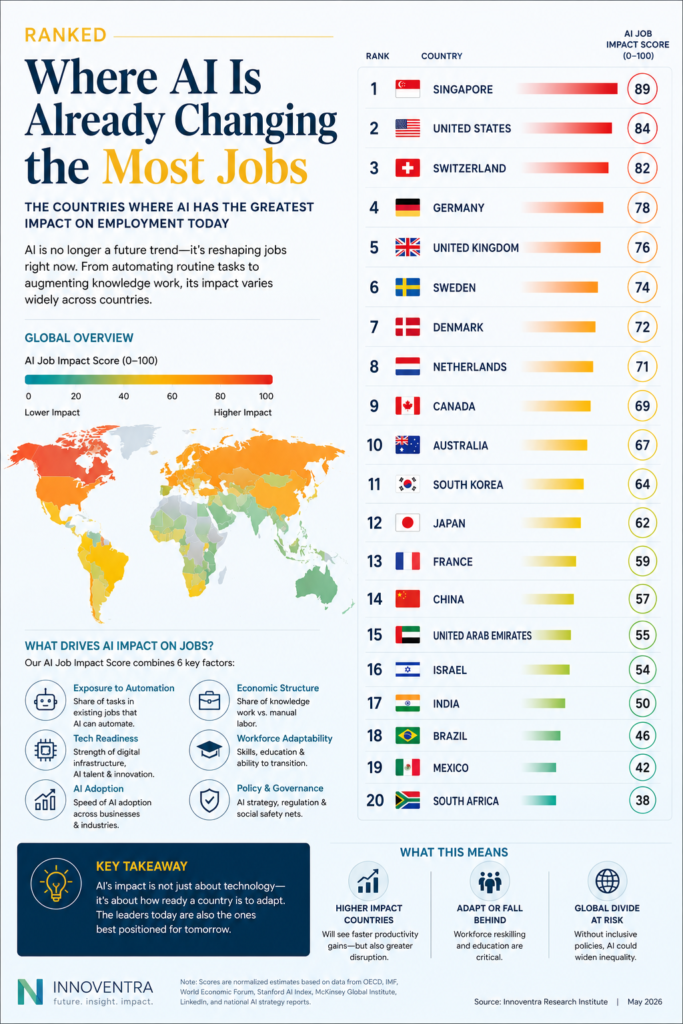
Artificial intelligence is no longer a future possibility. It is already changing how millions of people work. Yet its effects are unfolding unevenly and the countries facing the greatest exposure may also have the most to gain.
Economies such as Singapore, the United States, Switzerland, Germany and the United Kingdom combine advanced digital infrastructure with strong research institutions, skilled workforces and knowledge-intensive industries. Their exposure is especially high in finance, law, consulting, technology and professional services.
But this raises a more difficult question: does a high AI Job Impact Score signal economic danger or readiness for the next productivity revolution?
Does a High AI Job Impact Score Mean More Jobs Will Disappear?
Not necessarily.
An impact score measures how extensively AI could change existing work. It should not be read as a direct forecast of unemployment. The International Labour Organization’s 2025 assessment found that one in four jobs worldwide has some exposure to generative AI, but concluded that job transformation is more likely than widespread replacement. Clerical occupations face the greatest exposure, while increasingly capable AI systems are also affecting professional and technical work. International Labour Organization
This distinction matters. AI can automate individual tasks without eliminating the occupation containing them. An accountant may use AI to reconcile transactions. A lawyer may use it to review documents. A software developer may generate routine code while retaining responsibility for architecture, security and quality.
Workers in highly exposed economies could therefore become more productive but only if employers redesign jobs intelligently and workers receive the skills needed to adapt.
Could Greater AI Exposure Become an Economic Advantage?
Yes, but the benefits are not automatic.
AI can help employees analyse information, draft reports, translate content, write software and identify patterns more quickly. This can reduce the time spent on routine work and allow people to concentrate on decisions requiring judgement, creativity or specialist knowledge.
The OECD describes AI as a potential general-purpose technology capable of supporting productivity and innovation across many industries. However, it also warns that the scale and distribution of those gains remain uncertain. OECD analysis of AI, productivity and growth
The crucial divide may therefore emerge within countries, not simply between them. Businesses that combine AI with training, reliable data and redesigned processes may advance rapidly. Organisations that purchase tools without changing how work is organised may see little benefit.
This is why a high national impact score can represent both opportunity and vulnerability. It shows where AI can create value—but also where poor adaptation could displace workers or widen inequality.
For professionals considering how to respond, Innoventra’s analysis of the AI skills revolution explains why career resilience increasingly depends on combining technical confidence with human and organisational expertise.
Are Developing Economies Protected From AI Disruption?
A lower AI impact score does not necessarily mean greater protection.
In many middle- and lower-income countries, lower exposure reflects slower adoption. Common barriers include limited broadband coverage, expensive computing infrastructure, skills shortages, restricted access to quality data and weaker investment ecosystems.
This may delay immediate disruption. It may also create a more serious long-term risk.
The OECD warns that structural constraints in low- and lower-middle-income countries could prevent them from capturing AI-led productivity gains. Without targeted intervention, AI could strengthen already productive economies while leaving less digitally prepared countries further behind. OECD: AI and the Global Productivity Divide
The result could be a widening international divide:
- AI-leading economies produce more with fewer resources.
- Their businesses reduce costs and compete more effectively.
- Investment and highly skilled workers flow towards established technology centres.
- Slower adopters struggle to close the productivity gap.
The unresolved question is therefore not whether developing economies will encounter AI. It is whether they will build the infrastructure and skills required to shape its adoption or become dependent on systems developed elsewhere.
Which Jobs Is AI Changing the Fastest?
AI affects tasks before it affects entire occupations.
The greatest exposure currently falls on roles containing routine, repeatable and digitally recorded activities. These include administrative processing, document classification, standardised customer support, basic content production and some forms of data analysis.
The ILO’s refined occupational index identifies clerical work as the most exposed category. It also finds growing exposure across highly digitised professional and technical occupations. ILO Global Index of Occupational Exposure
Jobs involving the following capabilities are generally more difficult to automate completely:
- Accountability for high-stakes decisions
- Leadership and negotiation
- Complex problem-solving
- Physical work in unpredictable environments
- Emotional intelligence and relationship-building
- Original creative direction
- Contextual and ethical judgement
Resilience, however, does not mean immunity. Even comparatively protected careers will change as AI takes over parts of research, administration, analysis and communication.
Readers can explore this distinction further in Innoventra’s rankings of jobs most at risk from AI and 50 AI-resilient careers.
Will Humans Compete Against AI or Against Other AI-Enabled Workers?
The most immediate competition may not be between humans and machines. It may be between people who use AI effectively and those who do not.
AI-enabled employees can already complete some research, drafting, coding and analytical tasks more quickly. That does not make human expertise irrelevant. It changes where human value is created.
Workers will increasingly need to verify AI-generated information, recognise weak outputs, protect sensitive data and apply professional judgement. Employers will need clear accountability when automated recommendations affect customers, employees or the public.
The safest strategy is therefore neither blind adoption nor complete avoidance. It is AI-enabled expertise: combining subject knowledge with the ability to use, question and govern intelligent systems.
What Makes a Country Truly AI-Ready?
Technology alone is not enough.
An AI-ready economy requires:
- Reliable digital and computing infrastructure
- Accessible education and lifelong learning
- Workforce transition and reskilling programmes
- Responsible AI regulation and assurance
- Cybersecurity and data protection
- Investment in research and commercial innovation
- Support for smaller businesses as well as major corporations
The OECD notes that demand for AI-related skills is increasing across industries and that workers possessing those skills can command relatively high wages. OECD Digital Economy Outlook
Yet technical capability must be matched by governance. Poorly managed AI can introduce bias, expose confidential information and produce confident but inaccurate recommendations. Responsible adoption will determine whether AI strengthens national resilience or creates new systemic risks.
Which Countries Will Convert AI Disruption Into Prosperity?
This ranking is not simply a list of countries where jobs face the greatest threat. It reveals where work is likely to change first and where the consequences of success or failure may appear earliest.
The countries that benefit most will not necessarily be those with the most advanced AI models. They will be those that can spread the technology beyond a small group of leading companies, prepare workers for changing roles and protect people whose jobs are disrupted.
Artificial intelligence is already reshaping employment. The unanswered question is whether governments and businesses can adapt quickly enough to ensure that productivity gains create better jobs and broader prosperity.
That question not the technology itself may ultimately decide which economies lead the next decade and which are left struggling to catch up.