
Why AI Is Becoming a Competitive Advantage for SMEs
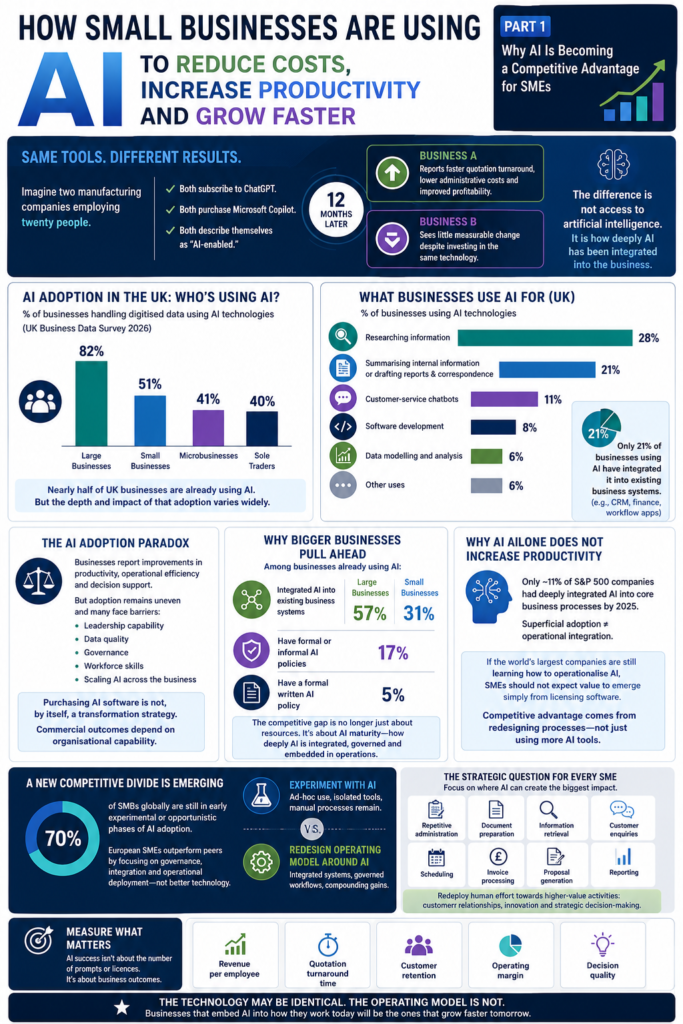
Imagine two manufacturing companies employing twenty people.
Both subscribe to ChatGPT.
Both purchase Microsoft Copilot.
Both describe themselves as “AI-enabled.”
Twelve months later, one business reports faster quotation turnaround, lower administrative costs and improved profitability. The other sees little measurable change despite investing in the same technology.
The difference is not access to artificial intelligence.
It is how deeply AI has been integrated into the business.
Recent evidence suggests that many organisations remain in the early stages of AI adoption. The UK Business Data Survey 2026 found that 41% of businesses handling digitised data now use AI technologies, but adoption varies considerably by size. AI use rises to 82% among large businesses, compared with 51% of small businesses, 41% of microbusinesses and 40% of sole traders.
At first glance, these figures appear encouraging. Nearly half of UK businesses are already using AI.
A closer examination tells a different story.
The same survey found that the most common uses of AI are researching information (28%) and summarising internal information or drafting reports and correspondence (21%). By contrast, more advanced applications including customer-service chatbots, software development and data modelling remain concentrated among larger organisations. Only 21% of businesses using AI reported integrating it into existing business systems, such as CRM platforms, finance software or workflow applications.
This reveals one of the most important findings emerging from AI adoption research.
Most SMEs are using AI alongside their business rather than inside their business.
That distinction may determine which businesses achieve sustainable competitive advantage over the next decade.
The AI Adoption Paradox
The widespread narrative suggests that businesses adopting AI automatically become more productive.
Current evidence is considerably more nuanced.
The Department for Science, Innovation and Technology commissioned one of the UK’s largest studies into business AI adoption to understand not simply whether organisations use AI, but whether it delivers measurable commercial value. The research found that organisations increasingly report improvements in productivity, operational efficiency and decision support. However, it also concluded that adoption remains uneven and that many organisations continue to face barriers to scaling AI across the business, including leadership capability, data quality, governance and workforce skills.
This suggests that purchasing AI software is not, by itself, a transformation strategy.
Instead, commercial outcomes increasingly depend on organisational capability how effectively businesses redesign processes, develop skills and embed AI into operational decision-making.
In other words, technology is becoming easier to buy than competitive advantage.
Why Bigger Businesses Continue to Pull Ahead
The UK Business Data Survey provides another important insight.
Larger organisations are not simply more likely to use AI; they are also far more likely to integrate AI into core business systems and establish formal governance.
Among businesses already using AI:
- 57% of large businesses have integrated AI into existing business systems.
- Only 31% of small businesses report similar integration.
- Just 17% of AI-using businesses have formal or informal AI policies, and only 5% have a formal written policy.
These findings suggest that the competitive gap between large enterprises and SMEs is no longer determined solely by financial resources.
Increasingly, it is determined by AI maturity.
Businesses that connect AI to customer relationship management, finance, workflow automation and knowledge management are creating systems that continuously improve organisational productivity. Those relying on isolated AI prompts remain dependent on manual processes.
The technology may be identical.
The operating model is not.
Why AI Alone Does Not Increase Productivity
One of the biggest misconceptions surrounding artificial intelligence is that productivity improvements occur automatically once employees gain access to AI tools.
Research increasingly challenges that assumption.
A recent analysis of AI adoption across S&P 500 companies found that only around 11% had deeply integrated AI into core business processes by 2025, despite widespread investment and public discussion around AI. The study distinguishes between superficial adoption and operational integration, arguing that genuine business transformation depends on embedding AI within workflows rather than treating it as an isolated productivity tool.
The implication for SMEs is significant.
If many of the world’s largest organisations are still learning how to operationalise AI, smaller businesses should not expect value to emerge simply from licensing software.
Competitive advantage is likely to come from redesigning processes rather than increasing the number of AI applications employees use.
A New Competitive Divide Is Emerging
Recent industry research suggests that many organisations remain at an experimental stage of AI maturity.
A joint SAS and IDC study reported that around 70% of SMBs globally are still in early experimental or opportunistic phases of AI adoption, with many lacking a formal AI strategy or roadmap. European SMEs were found to outperform global peers not because they owned better AI technology, but because they placed greater emphasis on governance, integration and operational deployment.
This finding aligns closely with UK government evidence.
Both point towards the same conclusion:
The next competitive divide is unlikely to be between businesses that have AI and those that do not.
It will increasingly be between businesses that experiment with AI and those that redesign their operating model around AI.
The Strategic Question for Every SME
For many business owners, the question has traditionally been:
Should we adopt artificial intelligence?
Current evidence suggests that is becoming the wrong question.
A more useful question is:
Which parts of our business create the least value for our people but consume the most time?
The answer is often surprisingly consistent:
- repetitive administration;
- document preparation;
- information retrieval;
- customer enquiries;
- scheduling;
- invoice processing;
- proposal generation; and
- reporting.
These are not merely opportunities to save time.
They represent opportunities to redeploy human effort towards higher-value activities such as customer relationships, innovation and strategic decision-making.
Businesses that recognise this distinction are unlikely to measure AI success by the number of licences purchased.
Instead, they will measure improvements in revenue per employee, quotation turnaround time, customer retention, operating margin and decision quality.
Those are the metrics that ultimately determine competitive advantage not the number of AI prompts written.
The AI Productivity Paradox: Why Some SMEs Are Pulling Ahead While Others See Almost No Return
Artificial intelligence has reached an unusual point in its adoption cycle.
Few business leaders now question whether AI will influence the future of work.
The more important question is why organisations investing in similar technologies are achieving dramatically different commercial outcomes.
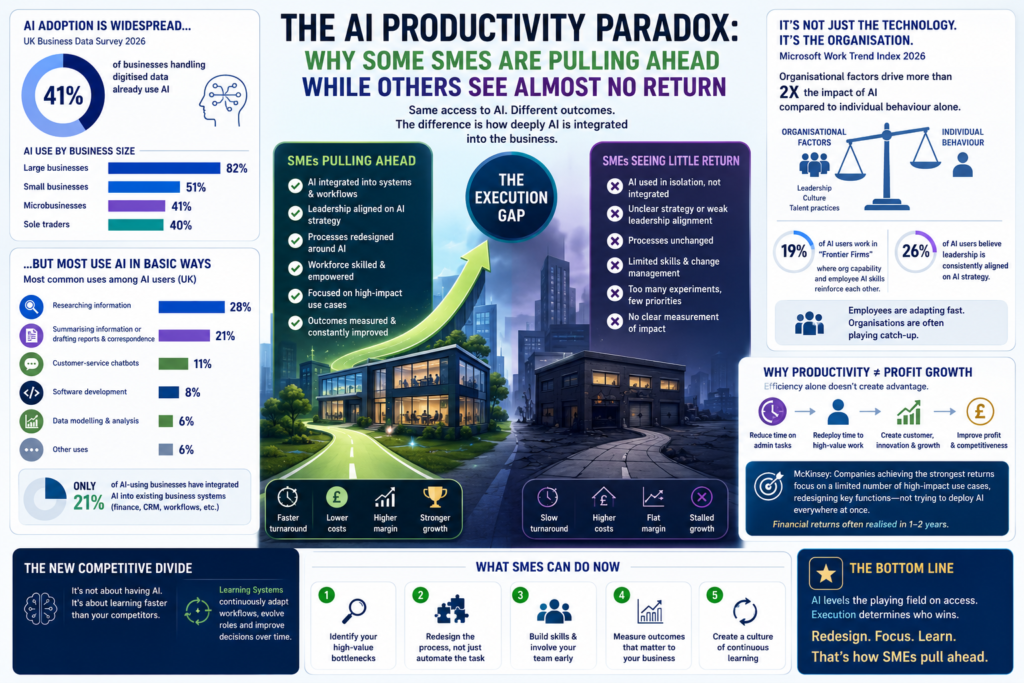
Recent UK government evidence illustrates this contradiction clearly. The 2026 UK Business Data Survey found that 41% of businesses handling digitised data already use AI, rising to 82% of large businesses. Yet among AI users, only 21% have integrated AI into their existing business systems, such as finance platforms, CRM software or workflow applications. Most continue to use AI primarily for researching information (28%) or drafting reports and correspondence (21%).
Those figures reveal an important distinction that receives relatively little attention.
Most organisations have adopted AI. Far fewer have operationalised it.
The difference is significant because productivity improvements rarely emerge from technology alone. They occur when technology changes how work is organised.
Microsoft’s 2026 Work Trend Index reinforces this conclusion. Drawing on trillions of anonymised Microsoft 365 productivity signals and a survey of 20,000 AI users across ten countries, Microsoft found that organisational factors including leadership support, culture and talent practices—account for more than twice the reported impact of AI compared with individual behaviour alone. Only 19% of AI users work within what Microsoft describes as “Frontier Firms”, where organisational capability and employee AI skills reinforce one another.
This challenges one of the most persistent assumptions surrounding artificial intelligence.
The competitive advantage no longer belongs simply to businesses with access to better AI models.
It increasingly belongs to organisations capable of redesigning their operating model around those technologies.
The Evidence Suggests SMEs Face an Execution Gap Rather Than a Technology Gap
Over the past two years, the cost of accessing frontier AI models has fallen rapidly.
Powerful language models, AI coding assistants, image generation tools and workflow automation platforms are now available to businesses of almost every size.
If technology has become widely accessible, why do productivity outcomes vary so dramatically?
Current research increasingly points towards execution rather than software.
Microsoft’s analysis found that nearly half of Microsoft 365 Copilot interactions (49%) support high-value cognitive activities such as analysing information, solving problems and evaluating options rather than simply generating text. Yet only 26% of AI users believe leadership within their organisation is consistently aligned on AI strategy. The research concludes that employees are often adapting faster than the organisations around them.
For SME leaders, this has an important implication.
The constraint is becoming less about whether employees know how to use AI and more about whether business processes have evolved to capture its value.
Why Productivity Gains Do Not Automatically Become Profit Growth
One misconception dominates many AI discussions.
Businesses frequently assume that reducing administrative effort will naturally increase profitability.
Economic evidence suggests the relationship is considerably more complex.
Reducing the time required to prepare quotations, answer emails or write reports undoubtedly improves efficiency.
However, efficiency alone does not generate competitive advantage unless the time released is reinvested into activities that create commercial value.
McKinsey’s recent work with organisations implementing AI at scale found that businesses achieving the strongest returns generally concentrated their efforts on a limited number of strategically important use cases rather than attempting enterprise-wide deployment from the outset. Many reported financial returns within one to two years, with some achieving substantial improvements in core profitability after redesigning targeted business functions.
The pattern is consistent.
Successful organisations are not necessarily deploying more AI.
They are deploying AI more selectively and aligning it with measurable business outcomes.
The New Competitive Divide Is Emerging
Traditional competitive advantages such as capital, workforce size and market share remain important.
However, evidence increasingly suggests another differentiator is emerging.
It is not whether organisations possess AI.
It is whether they have developed the organisational capability to learn faster than competitors.
Microsoft describes these organisations as Learning Systems businesses that continuously adapt workflows as AI capabilities evolve. Rather than treating AI as another software application, they redesign work, redefine employee roles and use organisational learning to improve decision-making over time.
For SMEs, this may prove particularly significant.
Unlike previous technology waves that demanded substantial capital investment, generative AI lowers the cost of accessing advanced analytical capability.
That allows smaller businesses to compete in ways previously reserved for much larger enterprises.
The strategic challenge therefore shifts from acquiring technology to redesigning the business around it.